
Shower Mold: Identify, Remove and Stop It Coming Back
Shower mold is the discoloured growth that appears on grout, caulking, tile, and ceilings after repeated exposure to steam and standing water. Most shower mold is not immediately dangerous, but it almost always signals a moisture problem that will spread to the wall cavity or ceiling if you ignore it. Black mold in the shower, pink mold (which is actually a bacterium called Serratia marcescens), and the green and white species in between each need a slightly different response. This guide walks through what each one is, how to remove it safely, and how to keep it from coming back, based on what our certified inspectors have found in more than fifteen years of Canadian bathroom assessments.
Why Shower Mold Keeps Coming Back
Shower mold keeps returning because most homeowners scrub the visible patch and leave the conditions that grew it. Mold spores are always in the air. What they need to grow is water, a food source (soap scum, skin cells, grout, caulking, drywall), and stagnant air above 50% relative humidity. A typical Canadian shower delivers all three in eight to ten minutes, twice a day.
Four patterns explain almost every recurring shower mold our inspectors document:
- Exhaust fan too weak or vented wrong. Health Canada’s residential indoor air quality guidance on moulds repeatedly ties indoor mould to ventilation gaps. A 50 CFM bath fan vented into the attic instead of outside leaves humid air sitting on cold ceiling tile, which is exactly where ceiling mold begins.
- Standing water on grout and caulking. Water that pools at the bottom edge of the wall and along the silicone bead at the tub or shower base has eight to fourteen hours overnight to feed mold and biofilm before the next shower.
- Soap scum and skin cells. Pink shower mold (actually Serratia marcescens) doesn’t even need wood or drywall to grow on; it feeds on the protein and fat residue from soap, shampoo, and body wash. Cleaning the grout and ignoring the soap film is why it keeps coming back.
- Hidden water behind tile. A leaking shower valve, a cracked pan, or a failing waterproof membrane lets water reach the back of the drywall. By the time it shows on the visible face of the tile, the cavity behind is already saturated.
Surface cleaning fails on shower mold for the same reason it fails on bathroom mold: a spore-free surface meets the same wet conditions and regrows within two to six weeks. For broader bathroom context, see our guide on bathroom mold causes and prevention.

Mold vs Mildew in the Shower
The words mold and mildew get used interchangeably, but they behave differently and call for different responses. Mildew is a surface fungus: flat, grey or pale yellow, and it wipes away with household cleaner. Mold is the broader category, grows in three dimensions, penetrates porous materials, and returns after surface cleaning if the moisture stays. If what you see is raised, fuzzy, or darker than grey, it is probably mold.
Mildew
- Flat, powdery texture
- Grey, white, or pale yellow
- Stays on the surface of grout, tile, glass
- Wipes clean and stays gone if the area dries
- No musty odour
Mold
- Raised, fuzzy, or slimy texture
- Black, dark green, pink, or orange
- Penetrates porous caulking, grout, drywall
- Returns after surface cleaning if moisture remains
- Musty, earthy smell
How to Identify Shower Mold by Color
Shower mold is not always black, and not every dark patch is mold. Correct identification decides whether you can clean it yourself, whether bleach will help or make it worse, and whether the porous material under it has to be replaced. Four colors cover almost everything we find in Canadian showers.
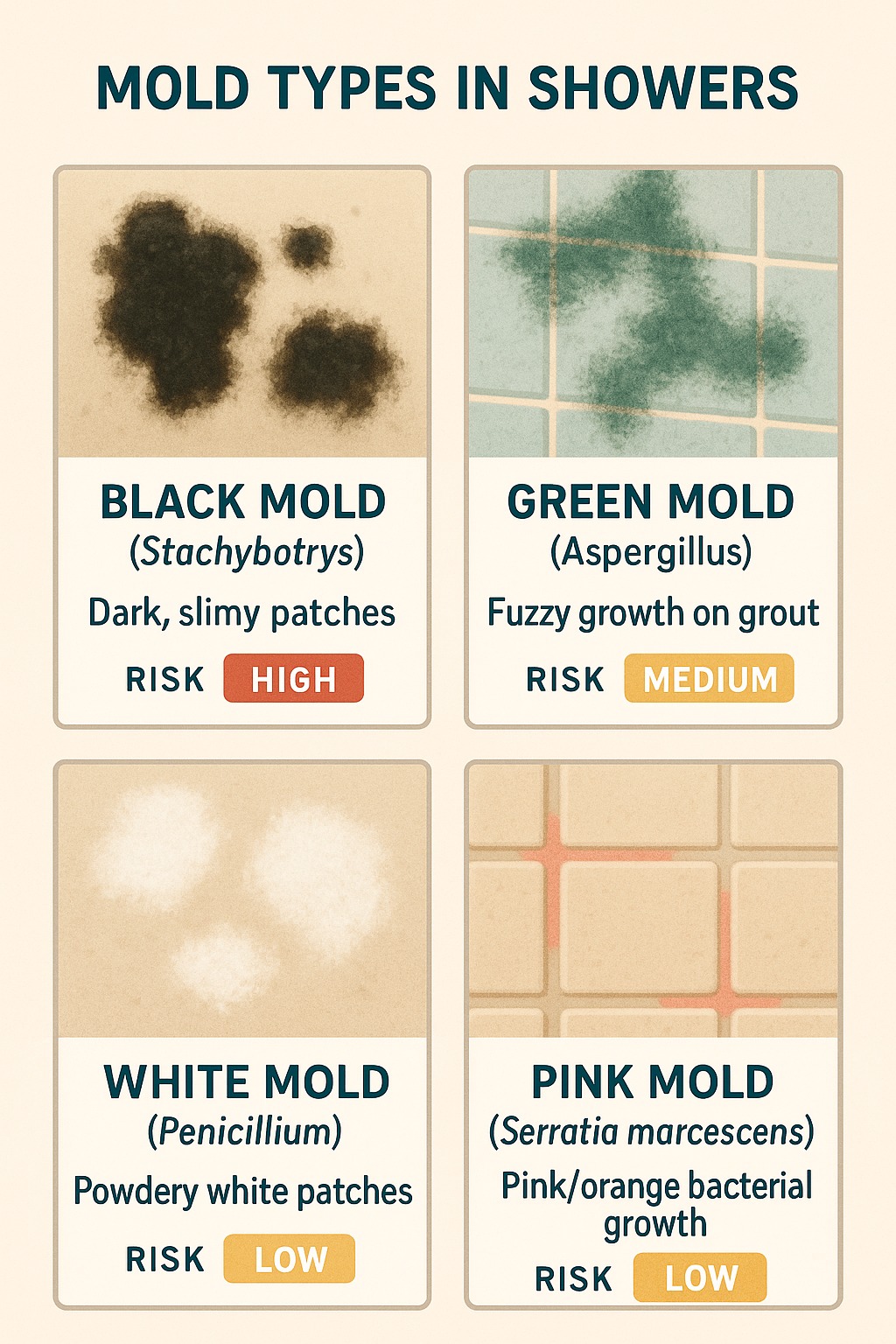
Black — Stachybotrys & Cladosporium
Slimy or wet-looking, dark green-black, musty smell. Stachybotrys chartarum needs prolonged saturation of paper-faced drywall or wood backing — it almost never grows on glazed tile. What looks like black mold on shower tile is more often Cladosporium, which is drier and much more common. See our guide on the health effects of black mold for the deeper science.
Green — Aspergillus & Cladosporium
Powdery or velvety, pale sage to deep forest green. Favours grout lines, silicone caulking, and the cold corners of glass shower doors. Most small patches respond to vinegar or a commercial mold cleaner if you address the moisture afterward.
White — Penicillium or Efflorescence
Fuzzy growth on caulking or grout is Penicillium. A chalky, dry, crystalline crust is mineral efflorescence, not mold — water has carried salts out of the grout. Mold grows back after wiping; efflorescence does not.
Pink — Serratia marcescens (bacteria)
Salmon-pink rings around drains, in soap dishes, along the bottom edge of shower doors, and on grout near the floor. Not a true mold — Serratia marcescens is a bacterium that feeds on soap residue and skin cells. Bleach kills it on contact but it returns within two to four weeks unless you eliminate the standing water and biofilm. Full protocol in the next section.
Pink "Mold" in Showers Is Actually Bacteria
The pink-orange streaks at the bottom of your shower wall, in the soap dish, and around the drain are almost certainly not mold. They are colonies of Serratia marcescens, a pigmented bacterium that lives on the protein and fatty-acid residue from soap, shampoo, and conditioner. It also shows up in toilet bowls, pet water dishes, and rarely-used sinks for the same reason: standing water plus soap film.
This matters for two reasons. First, telling people they have black mold when it is actually a pink bacterium can drive unnecessary remediation costs. Second, the cleaning protocol is different. The standard mold approach — scrub, apply fungicide, dry — kills the visible Serratia on contact but leaves the food source (the soap film) and the moisture (the wet grout line) untouched. The colony rebuilds in days.
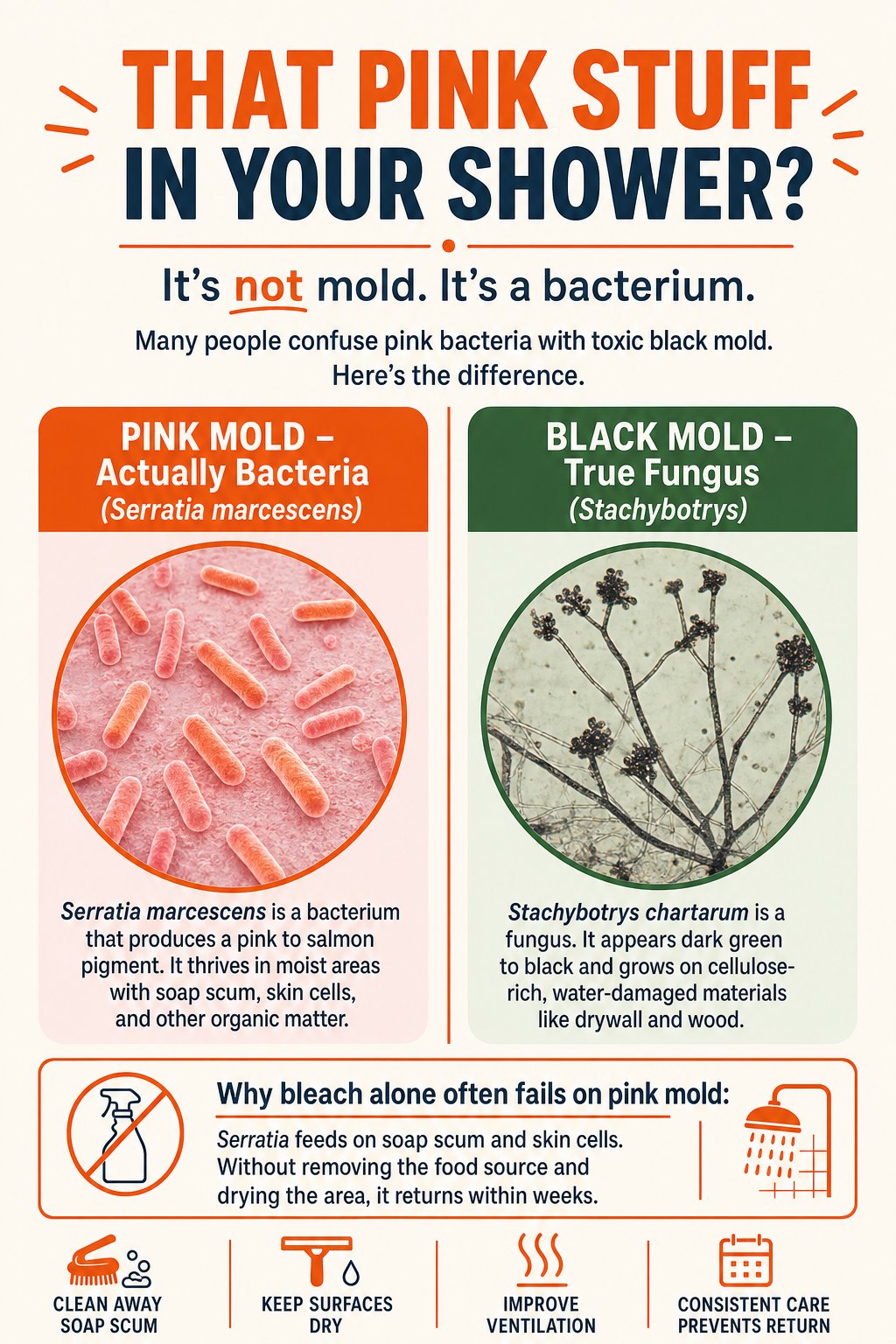
Serratia marcescens doesn’t need drywall, wood, or grout to grow on. It only needs three things: water that doesn’t drain, organic residue (soap, body oils, conditioner), and a temperature above about 5 °C. A perfectly clean tile wall that stays wet and has soap film returns to pink within two to four weeks.
Getting Rid of Pink Mold and Keeping It Out
The protocol below works on porous and non-porous surfaces. Total time is about twenty minutes plus overnight drying.
Strip the biofilm
Apply a 50/50 white vinegar and water solution, let it sit for ten minutes, then scrub with a stiff brush. Vinegar dissolves the slimy biofilm Serratia hides under — bleach alone often doesn’t penetrate it.
Remove the soap residue
Follow with a degreasing dish soap or a commercial soap-scum remover. This is the step most people skip. Without it, the bacteria’s food source is still on the wall.
Disinfect and dry
Spray hydrogen peroxide (3%) or a diluted bleach solution (1 cup bleach to 1 gallon water), wait five minutes, rinse. Then squeegee the walls and run the exhaust fan for twenty minutes so the surfaces dry within an hour.
The ongoing prevention step is the one that actually keeps the pink off: switch to a soap or shower wash that rinses cleaner, squeegee the walls after each shower, and leave the door or curtain open between uses so the surfaces dry.
Mold in Shower Caulking, Silicone, and Grout
Caulking and grout are the highest-risk surfaces in any shower because both are porous. Once mold has rooted past the surface, scrubbing the visible patch off can make the colour fade but the colony continues to feed from inside the seam.
If you can scrape a small amount of caulking out with a utility knife and see mold staining inside the bead, the caulking has to be replaced — cleaning the surface won’t stop the regrowth. Healthy grout cleans up; healthy caulking cleans up. Stained-through caulking gets cut out.
Mold in Silicone Caulking
Silicone caulking sits at the tub-to-tile joint, around the shower base, and between the shower door frame and the wall. Mould-resistant silicones include a fungicide that wears out in three to five years, depending on humidity. Once the fungicide is exhausted, the silicone behaves like any other organic surface and supports mold. Black or dark grey streaks running along the length of the bead, not just on top of it, mean the fungicide is spent.
Mold in Shower Grout
Unsealed cementitious grout is one of the most absorbent surfaces in the entire bathroom. Water and soap residue soak in within seconds. Once mold colonises grout, the visible black or green colour penetrates deep enough that household cleaners only bleach the top layer — the colony underneath survives and re-stains the surface in weeks. Re-sealing grout every two years with a penetrating silicone sealer is the simplest long-term defence.
How to Replace Moldy Shower Caulking
This is a thirty- to forty-minute job that homeowners can do themselves on a single shower stall. Anything broader than one wall or that exposes wet drywall behind is a job to call in.
Cut and pull
Use a utility knife or a caulk-removal tool to slice along both edges of the bead. Pull the old silicone out in continuous strips with needle-nose pliers.
Disinfect the gap
Spray hydrogen peroxide or a 1:10 bleach solution into the gap, brush it into the corners, and wait ten minutes. Wipe out residual debris with a dry rag.
Dry completely
Run a hair dryer or a small fan into the gap for twenty to thirty minutes. New caulking will not bond to a wet surface — this is the step that determines whether the new bead lasts six months or six years.
Apply mould-resistant silicone
Use 100% silicone labelled mould-resistant or mildew-resistant. Apply a continuous bead, smooth it with a wet finger or a silicone-smoothing tool, and keep the shower dry for 24 hours to cure.
Mold on the Shower Ceiling, Curtain, and Drain
Three shower zones get overlooked in most cleaning routines and account for a large share of the recurring complaints our inspectors hear about.
Shower Ceiling Mold
Mold on the shower ceiling is almost always a ventilation problem, not a leak problem. Warm, humid air rises during a shower and condenses on the cold underside of the ceiling drywall — especially if there is uninsulated attic space directly above. Black or grey speckling that starts in the corner farthest from the exhaust fan is the signature. The fix is two-part: clean the visible mold with a 1:10 bleach solution applied with a long-handled brush, then upgrade the exhaust fan to at least 80 CFM (110+ for showers with steam) and run it for twenty minutes after each shower. A fan timer switch costs about thirty dollars and removes the human factor.
Shower Curtain Mold
Fabric shower curtains can be machine washed on hot with a cup of white vinegar and a regular detergent load. Vinyl liners with pink or black staining at the bottom hem are usually past saving — replace them, and pull the new liner taut so water sheets off instead of pooling. Spread the curtain across the rod after each shower so both sides dry, rather than bunching it.
Mold and Biofilm in the Shower Drain
The slimy black or pink ring inside the drain opening is biofilm — bacteria, fungi, soap residue, and hair binding into a layer that breeds odour and grows back fast. A monthly drain protocol stops it: pour half a cup of baking soda followed by one cup of white vinegar down the drain, let it foam for ten minutes, then chase with a kettle of boiling water. For showers that drain slowly, pulling the hair trap and cleaning it weekly does more than any chemical treatment.
Health Risks of Shower Mold Exposure
Most shower mold is not an emergency for healthy adults, but it isn’t harmless either. Per Health Canada’s residential indoor air quality guideline on moulds, the recommendation is to clean any visible mould regardless of species — there is no safe exposure threshold. The clinical risk scales with three factors: how much mold is present, how long you’ve been exposed, and whether the person breathing it has asthma, allergies, or an immune-compromised condition.
Level 1 — Minor (Most Common)
Small patches of green, white, or pink in grout and caulking. Healthy adults: occasional throat irritation or congestion after a shower with the door closed. Action: clean within a week, improve ventilation. The CDC’s overview of mold and dampness notes that even minor exposures can trigger respiratory symptoms in people with allergies.
Level 2 — Moderate
Visible mold across multiple grout lines, on the ceiling, or in the caulking — but the wall and ceiling materials are intact. Healthy adults: cough, sinus congestion, eye and throat irritation that worsens during long showers. Asthmatics: increased reliever-inhaler use, wheezing. Action: clean within 48 hours and address the moisture source.
Level 3 — Extensive
Mold has reached the drywall or ceiling material itself (soft spots, staining behind the tile, visible mold on the ceiling drywall), or anyone in the household has asthma, a confirmed mold allergy, or a compromised immune system. Action: stop using the shower until assessed. Health Canada and CDC both single out infants, the elderly, and immunocompromised people as needing prompt remediation regardless of visible scale.
For the full picture of how mold affects the body across exposure levels, see our guides on symptoms of mold exposure and health effects of black mold.
Check What Is Behind the Tile
Mold that keeps coming back through grout or caulking usually means water has reached the substrate. Cleaning the surface will not stop it if the wall behind is wet.
or send the details
How to Remove Shower Mold Safely — Step by Step
This is the protocol our inspectors recommend for the typical small-to-medium shower mold problem — under ten square feet of growth on grout, caulking, or non-porous tile. Anything broader, anything that has reached drywall or ceiling material, or any case where someone in the household has asthma or a confirmed mold allergy should be handed off to a professional.
Cleaner Selection: Bleach vs Vinegar vs Hydrogen Peroxide vs Borax
Choice of cleaner matters because some surfaces are porous and bleach is the wrong tool for porous surfaces. The EPA’s brief guide to mold, moisture, and your home is explicit that bleach is not recommended for routine clean-up of porous materials because it disinfects the surface but does not penetrate the pores where the mold is rooted. The table below summarises what each cleaner is for.
| Cleaner | Works on | Avoid on | Notes |
|---|---|---|---|
| White vinegar (undiluted or 50/50) | Grout, glazed tile, glass, fibreglass, shower doors | Natural stone (marble, travertine) | Mild acid; safe for daily use; penetrates biofilm |
| Hydrogen peroxide (3%) | Grout, caulking, tile, drains | Coloured grout (can lighten over time) | Kills mold and bacteria; no toxic fumes |
| Borax solution (1 cup to 1 gallon water) | Painted ceiling, grout, hard surfaces | Surfaces that contact food | Inhibits regrowth; needs no rinse |
| Bleach (1:10 dilution) | Non-porous tile, glass, fibreglass — final disinfection step | Caulking, drywall, grout (porous) | Disinfects the surface only; does not penetrate porous materials per the EPA |
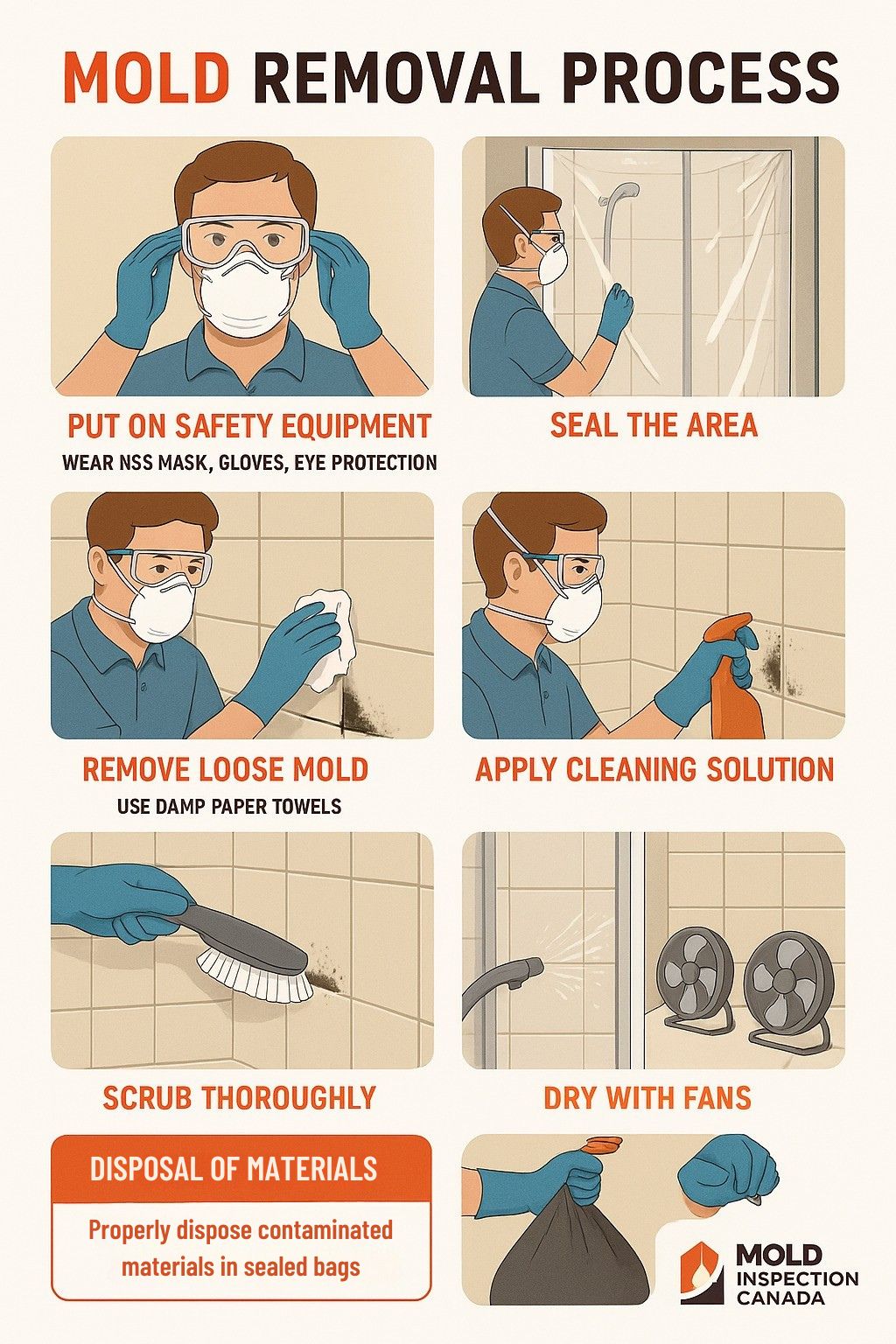
Six-Step Removal Process
Put on personal protective equipment
An N95 respirator, nitrile gloves, and wraparound safety goggles. Health Canada is explicit that PPE matters even for small mould clean-ups because scrubbing aerosolises spores.
Ventilate, do not just open the window
Run the bath fan and place a box fan in the doorway blowing inward. The goal is to direct spores out an open window, not let them circulate to other rooms.
Apply the cleaning solution
Spray the chosen cleaner (vinegar or hydrogen peroxide for porous, bleach dilution for non-porous), let it sit ten minutes. Do not mix bleach with vinegar or ammonia — the combination releases toxic gas.
Scrub with a stiff brush
Work the bristles into the grout lines and along the caulking edge. A toothbrush handles tight corners and shower-door tracks. Wipe out the loosened residue with disposable paper towels and bag them.
Rinse and re-disinfect
Rinse thoroughly with warm water. Follow with a light spray of hydrogen peroxide and let it air-dry — peroxide breaks down to water and oxygen, leaves no residue, and discourages regrowth.
Dry the surfaces fully
Squeegee the walls, run the bath fan for an hour, and place a small fan in the open shower for the next four to six hours. Mold cannot return on a surface that dries in under an hour after a shower.
You see soft spots on the drywall behind the tile, water-staining on the ceiling above the shower, mold returning within four weeks of a thorough clean, or anyone in the household has asthma, a documented mold allergy, or an immune-compromised condition. The Free Virtual Inspection is the fastest way to confirm whether a job is safe to do yourself.
How to Prevent Shower Mold
Mold prevention in the shower is moisture management. Three habits cover almost everything.
Ventilation: An 80+ CFM Fan Run for 20 Minutes
The single highest-return change a Canadian homeowner can make to a mold-prone bathroom is upgrading the exhaust fan. The general rule is at least 80 CFM for a standard 80 sq ft bathroom, 110+ for showers with steam. The fan should vent to outside (through the roof or an exterior wall, never into the attic), and it should run for twenty minutes after the shower ends — long enough to drop the room’s relative humidity back under 50%. A simple timer switch removes the need to remember.
Humidity: Under 50% Year-Round
Indoor relative humidity above 50% lets mold grow on any surface with organic residue. CMHC’s residential moisture guidance recommends keeping indoor RH between 30% and 50% year-round. A $20 hygrometer on the bathroom counter tells you whether the fan is doing its job. In summer, a portable dehumidifier upstairs takes the load off the bath fan.
Daily, Weekly, and Monthly Habits
Daily
Squeegee the walls and door after each shower. Run the exhaust fan for twenty minutes. Hang the curtain across the rod or leave the door open so both sides dry.
Weekly
Spray a 50/50 vinegar-water solution on grout and caulking lines and rinse. Wash the hair trap. Wipe down the shower-door track.
Monthly
Baking-soda-and-vinegar treatment in the drain. Inspect caulking and grout for cracks or staining. Re-seal grout once per two years.
When to Call a Professional
DIY shower-mold cleaning works for the typical case. Some situations don’t, and trying to handle them at home wastes time and money — or worse, spreads spores deeper into the home.
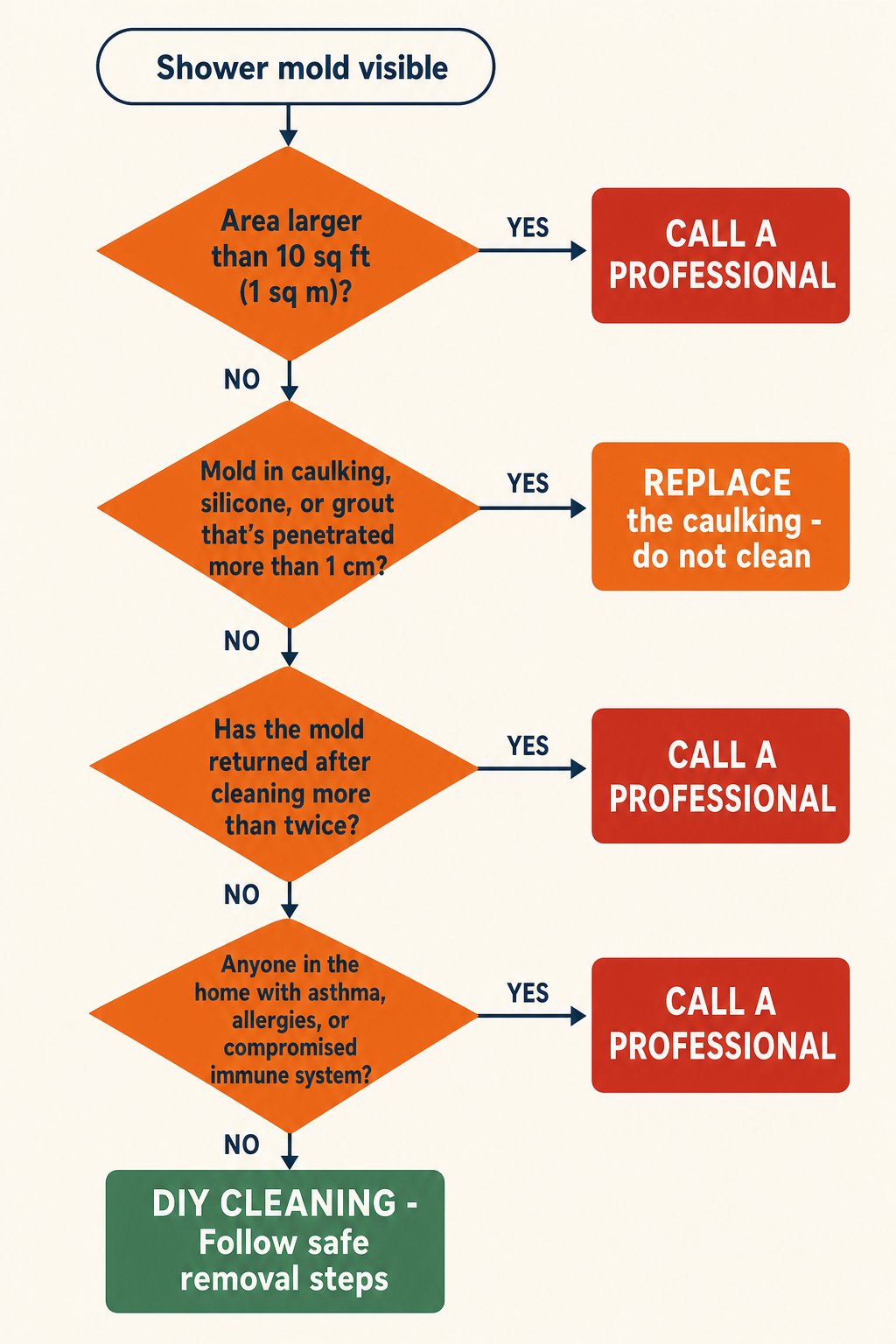
The four checks that decide DIY versus pro:
- Area larger than ten square feet (about one square metre). Health Canada classifies anything over this as a medium-sized contamination that calls for professional assessment.
- Caulking or grout penetrated more than 1 cm. Cleaning the surface doesn’t stop the regrowth — the porous material has to come out and be replaced.
- The mold returns within four weeks of a thorough clean. That isn’t a cleaning failure; it’s a moisture problem behind the wall.
- Anyone in the household has asthma, a confirmed mold allergy, or a compromised immune system. The risk of stirring up spores during DIY removal isn’t worth it.
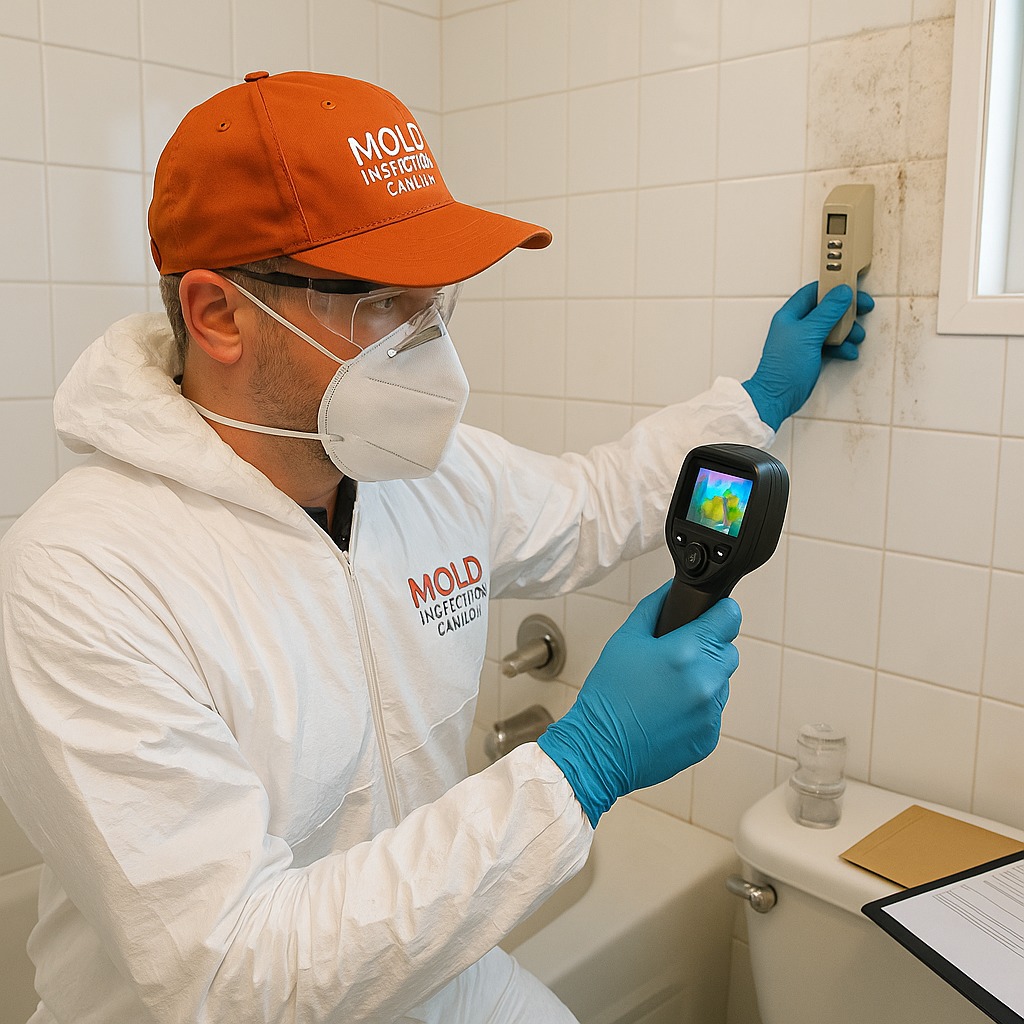
Our certified inspectors do thermal imaging, moisture-meter checks behind the tile, and lab-grade air sampling when needed. The Free Virtual Inspection takes about ten minutes by video and lets us tell you whether a paid on-site visit is even necessary — most callers find out their problem is a DIY clean plus a fan upgrade. For full-service support, see our mold inspection process and mold removal services.
Frequently Asked Questions
Is shower mold dangerous?
Most shower mold is not an emergency for healthy adults, but per Health Canada’s residential indoor air quality guideline on moulds, all visible mould should be cleaned regardless of species — there is no safe exposure threshold indoors. People with asthma, mold allergies, or compromised immune systems should treat any visible shower mold as a prompt-remediation issue. Pink shower mold (Serratia marcescens) is technically bacteria and is generally low-risk for healthy adults, but it still indicates ongoing standing water that will support true mold growth.
Can bleach kill black mold in a shower?
Bleach kills surface mold on non-porous surfaces like glazed tile, glass, and fibreglass. The EPA’s brief guide to mold, moisture, and your home explicitly does not recommend bleach for routine clean-up of porous materials — it disinfects the surface but cannot penetrate the pores where mold roots. For caulking, grout, and drywall, hydrogen peroxide, vinegar, or borax penetrate better. If the porous material is heavily mold-stained, replacement is the right call.
Why does pink mold keep coming back in my shower?
Pink mold isn’t mold — it’s Serratia marcescens, a bacterium that feeds on soap residue and skin cells. Standard mold cleaners kill the visible colony but leave the food source (soap film) and moisture (wet grout, standing water in the soap dish) untouched, so the colony rebuilds in days to weeks. To keep it gone, strip the soap film with a degreasing cleaner, dry the surfaces fully after each shower with a squeegee, and switch to a soap or body wash that rinses cleaner.
Should I replace moldy shower caulking or clean it?
Clean it if the staining is only on the surface — scrape a small section with a utility knife and check inside the bead. If the mold has stained through the silicone or grown into the gap behind it, the caulking has to come out and be replaced. The replacement is a thirty-minute job per shower wall; trying to clean caulking that is colonised through-and-through just delays the regrowth by a few weeks.
Does vinegar actually work on shower mold?
Yes for most household shower mold cases. White vinegar (5% acetic acid, applied undiluted or 50/50 with water) penetrates grout and biofilm better than bleach and kills the most common shower-mold species. It is not as fast-acting on heavy infestations and it will not stop regrowth on its own — the moisture source still has to be addressed. Avoid vinegar on natural stone (marble, travertine) where the acidity etches the surface.
How much does professional shower mold removal cost in Canada?
For a typical shower-only mold problem in Ontario or Quebec, professional inspection and small-area remediation runs roughly $250 to $700 depending on access, sampling, and whether caulking or tile replacement is needed. Cases that involve tile demolition, drywall replacement behind the shower, or visible ceiling-cavity mold push higher. See our mold remediation cost guide for the full pricing breakdown and what drives the variation.
When should I worry about black mold in my shower?
Worry signals: the mold patch is larger than about ten square feet (one square metre); it has reached drywall or ceiling material; it returns within four weeks of a thorough cleaning; or anyone in the household has asthma, a documented mold allergy, or an immune-compromised condition. Most black-coloured shower mold is Cladosporium rather than the more aggressive Stachybotrys, but visual identification alone isn’t reliable — if any of the warning signs apply, book an inspection rather than guess.