
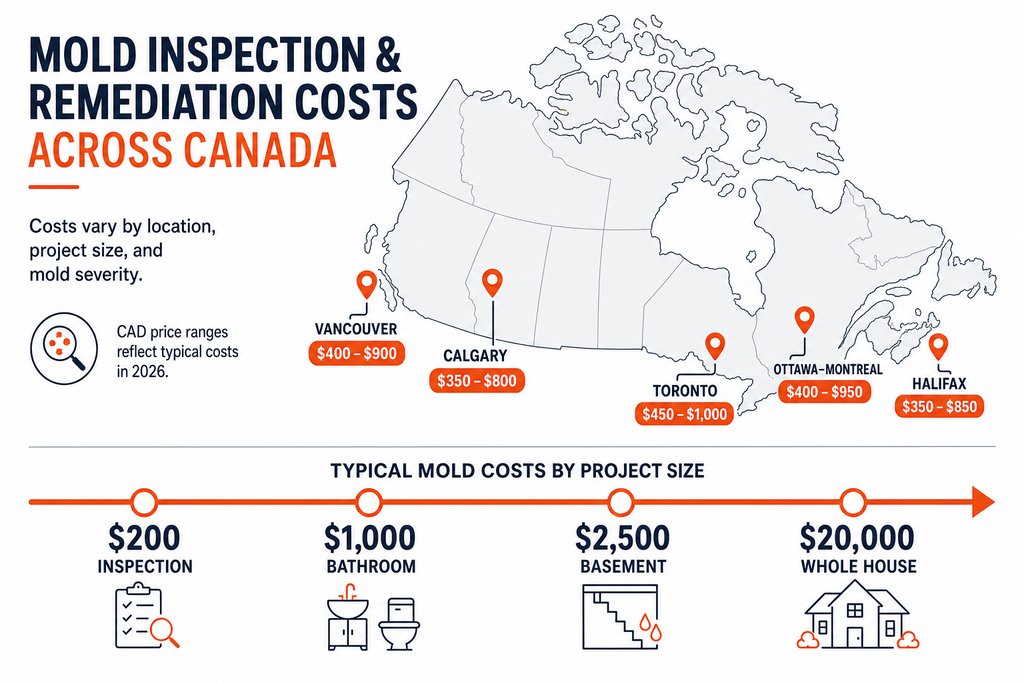
Mold inspection in Canada costs $200 to $700 for a typical home. Mold remediation — the actual removal work — ranges from $500 for a small bathroom job to $30,000 for whole-house contamination. This guide breaks down 2026 Canadian prices for every part of the problem: the diagnostic step, the removal step, and the factors that move the final invoice up or down.
Canadian English uses both mold and mould, and pricing language follows the same split — provincial health departments use mould, most contractors use mold. Prices below apply to both.
Mold Inspection Cost in Canada ($200–$700)
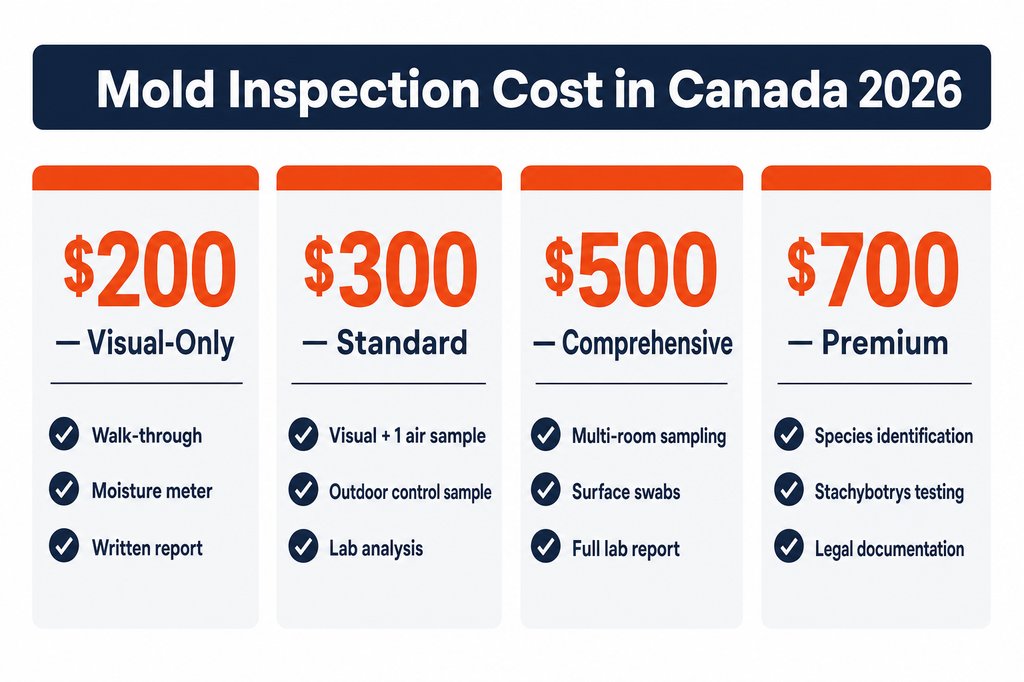
A professional mold inspection in Canada costs between $200 and $700 depending on how many rooms are tested, whether air samples are collected, and how fast you need lab results. The national average sits near $300.
Three tiers cover most residential jobs:
| Inspection level | Price | What it covers |
|---|---|---|
| Visual-only | $150–$250 | Walk-through with moisture meter and thermal camera, written report |
| Standard | $250–$400 | Visual + one indoor air sample + one outdoor control, lab analysis |
| Comprehensive | $500–$700 | Visual + multi-room air sampling + surface swabs + species-level lab report |
A mould inspection cost in Quebec or the Maritimes often runs $50–$100 higher than the Prairies — labour rates and travel time drive the gap. The same job is sometimes called a mold evaluation or a mold and mildew inspection in older listings; the scope is identical.
What a Professional Mold Inspection Includes
A standard inspection covers four things:
- Visual assessment — every room is checked for visible growth, water stains, and warped finishes. Crawl spaces and attic hatches included.
- Moisture mapping — a calibrated moisture meter reads drywall, framing, and subfloor. Anything above 16% gets flagged.
- Air sampling — typically one indoor sample per affected level plus one outdoor control. Spore counts are compared between the two.
- Written report — lab results, photographs, moisture readings, and a remediation protocol if mould is present.
For a black mold inspection cost, the base price is identical. The extra step is species-level identification at the lab, which adds $100–$200 if you want confirmation that Stachybotrys chartarum is present versus a benign black-coloured species like Cladosporium.
DIY Test Kit vs Professional Inspection: Cost Comparison
DIY Test Kit ($30–$80)
- Available at Canadian Tire, Home Depot, Amazon Canada
- Detects airborne mould spores using a Petri dish or air pump
- Does not identify species, source, or extent
- Results take 3–7 days
- Not accepted for insurance claims, real estate transactions, or legal proceedings
- Best use: rough triage when you’re already 90% sure
Professional Inspection ($200–$700)
- Certified inspector with calibrated equipment
- Pinpoints source, species, and contamination boundaries
- Lab-verified results within 24–72 hours
- Accepted by insurance, lenders, and courts
- Written remediation protocol
- Best use: any decision involving money, health, or property value
The DIY kit answers “is there mould?” The professional inspection answers “where is it, how bad, what species, and what do I do about it?” — which is what every downstream decision actually needs.
Air Sampling vs Surface Sampling: Price Breakdown
| Sample type | Added cost per sample | When to use |
|---|---|---|
| Air sample (spore trap) | $80–$150 | Musty smell with no visible growth, post-remediation clearance test |
| Surface swab | $50–$100 | Visible suspicious growth — confirms species |
| Tape lift | $50–$100 | Same as swab but for porous surfaces |
| Bulk material sample | $75–$150 | Drywall, insulation, or carpet sent intact to lab |
Most inspectors quote a flat “standard inspection” rate that includes 1–2 samples; additional samples are billed at the per-sample rate above.
When a Free Mold Inspection Is Worth It (and When It Isn’t)
A free virtual inspection (homeowner uploads photos, a remote inspector reviews) is a different product — it costs the company nothing because there’s no truck roll. It can rule out obvious non-issues but cannot detect hidden mould inside walls, in HVAC ducts, or under flooring.
Pay for an inspection when:
- Buying or selling a home (closing-day disputes are expensive)
- Filing an insurance claim
- Symptoms keep appearing after a visual cleanup
- Musty smell persists with nothing visible
- The remediation quote is over $3,000 — an arms-length second opinion costs $300 and may save thousands
Free is fine when:
- The mould is visibly limited to a bathroom corner or window frame
- You’re getting a sales-call diagnostic before deciding on DIY vs hire-out
- You explicitly tell the company you want triage, not a contract
Mould Inspection Cost: Canadian Pricing Variations by Region
Inspection prices vary across Canada because labour rates and lab turnaround times do too:
- Ottawa, Kanata, Gatineau: $250–$400 typical, lab results 48 hours
- Montreal, Laval: $275–$450 (bilingual report adds nothing; lab same-day in some labs)
- Toronto, GTA: $300–$500 (highest base rates in Canada)
- Kingston, Brockville, Cornwall: $200–$350 (smaller markets, faster scheduling)
- Quebec City, Trois-Rivières: $300–$425
- Atlantic provinces: $325–$550 (lab samples often shipped to central Canada, adds 2–3 days)
- Prairie provinces: $200–$400 (drier climate, lower demand)
If the property is more than 30 km from the inspector’s base, expect a travel surcharge of $50–$150.
Average Mold Removal Cost in Canada at a Glance
The table below summarizes the seven most common Canadian remediation scenarios. Detailed cost breakdowns follow in the sections below.
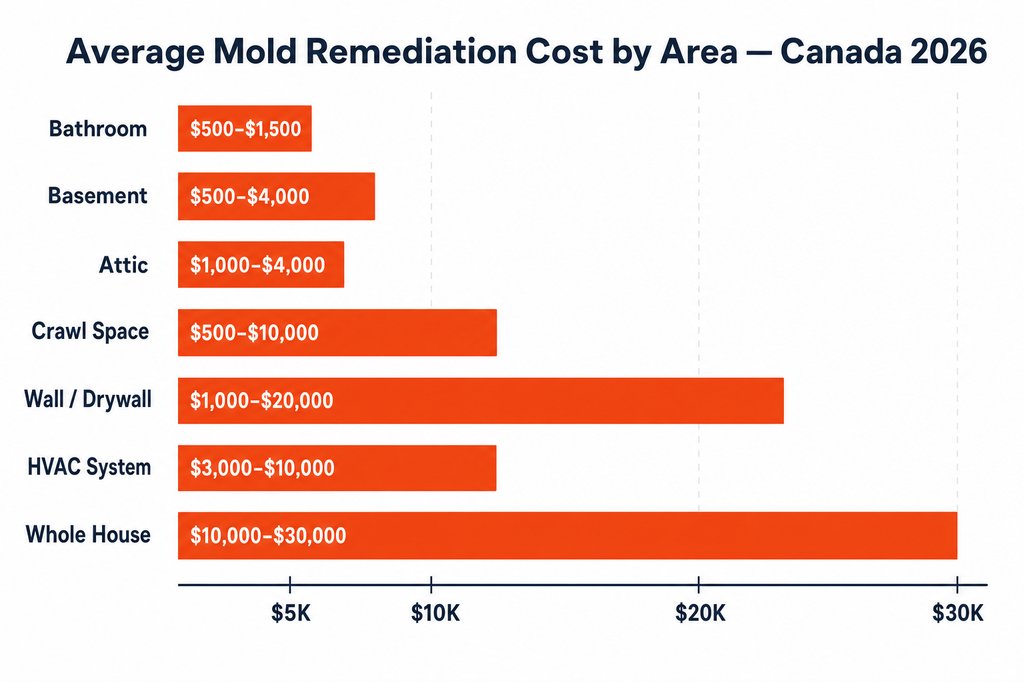
| Affected area | Low end | Typical | High end |
|---|---|---|---|
| Bathroom (visible tile/grout) | $500 | $1,000 | $1,500 |
| Basement (small, dry) | $500 | $1,500 | $4,000 |
| Attic (post-condensation) | $1,000 | $2,000 | $4,000 |
| Crawl space | $500 | $5,000 | $10,000 |
| Wall / drywall (per room) | $1,000 | $7,500 | $20,000 |
| HVAC system | $3,000 | $6,500 | $10,000 |
| Whole house | $10,000 | $20,000 | $30,000 |
A 2024 industry survey put the average Canadian residential mould remediation invoice at $1,223–$3,751 for single-area jobs and $10,000+ for multi-area contamination.
1. Attic Mold Removal & Cleanup Cost ($1,000–$4,000)
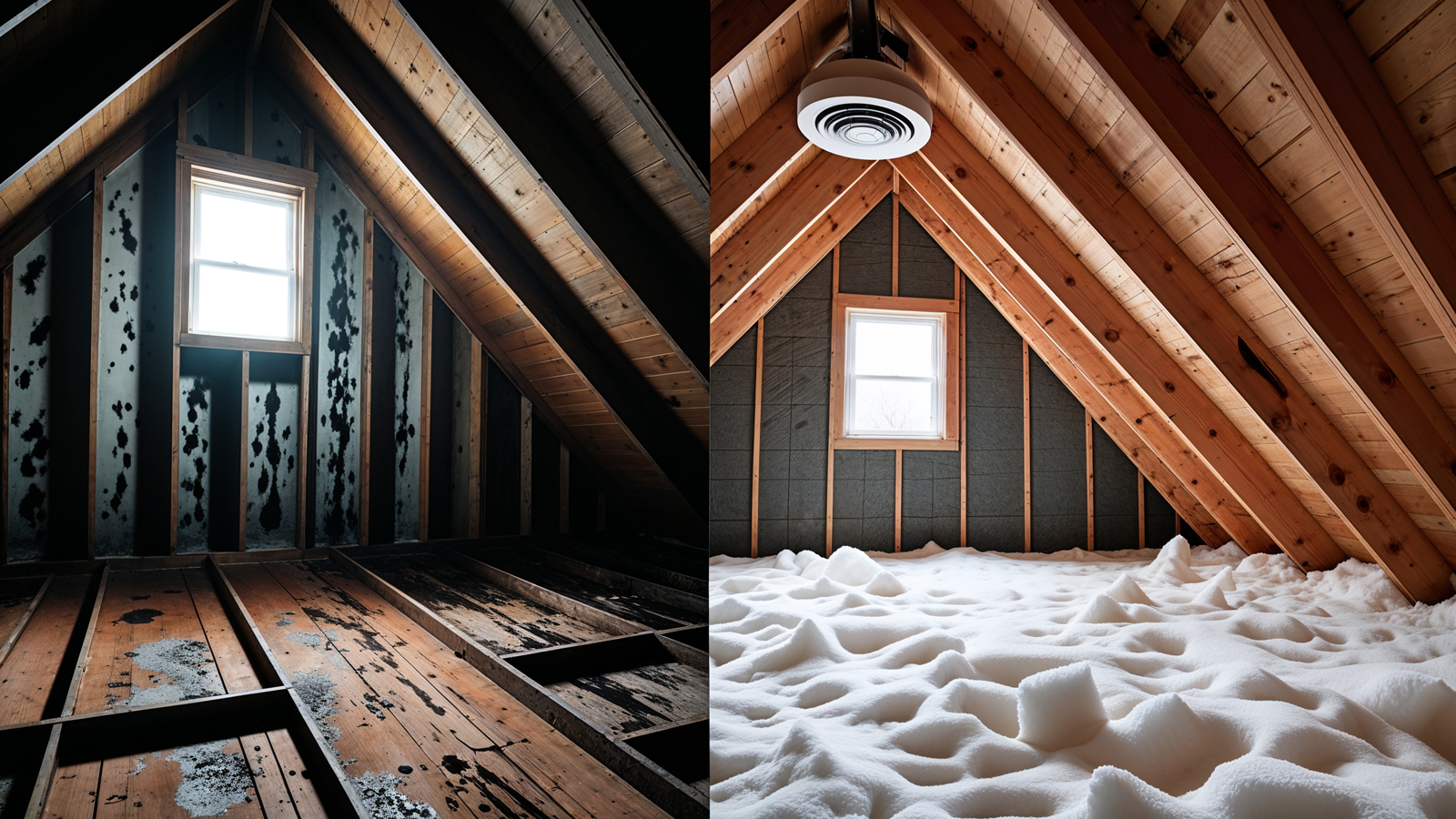
Attic mold removal cost in Canada averages $2,000 for a typical residential attic, with a range of $1,000 to $4,000. The price depends on attic size, mould severity, whether insulation needs replacing, and how accessible the affected sheathing is.
Why It Happens in Canada
Canadian attics are prime mould habitat. In winter, warm indoor air leaks through ceiling penetrations (potlights, bathroom fans, attic hatches), hits cold roof sheathing, and condenses. By spring, the underside of the plywood is fuzzy with mould. The 2026 Ottawa River freshet flooded enough homes that attic-condensation problems multiplied in the surrounding suburbs — Kanata, Orleans, and Stittsville all saw spikes in attic remediation calls through May.
Cost Breakdown
- Small attic (under 800 sq ft, light surface mould): $1,000–$2,500
- Medium attic (800–1,500 sq ft, sheathing affected): $2,500–$3,500
- Large attic with insulation removal: $3,000–$5,000
Insulation removal alone adds $500–$1,500 because contaminated batt or blown cellulose must be bagged and removed before the sheathing can be treated.
What Drives the Final Number
Three factors push attic mould jobs to the high end: roof sheathing that needs encapsulation rather than just cleaning, full insulation replacement (often required when there’s spore embedment), and any roof or soffit ventilation repairs that prevent recurrence. A job that includes a new bathroom fan vented through the roof, soffit baffle installation, and new R-60 insulation can land near $5,000 — but it solves the root cause permanently.
See attic mold causes and prevention for the underlying problem before booking remediation.
2. Basement Mold Removal Cost ($500–$4,000)
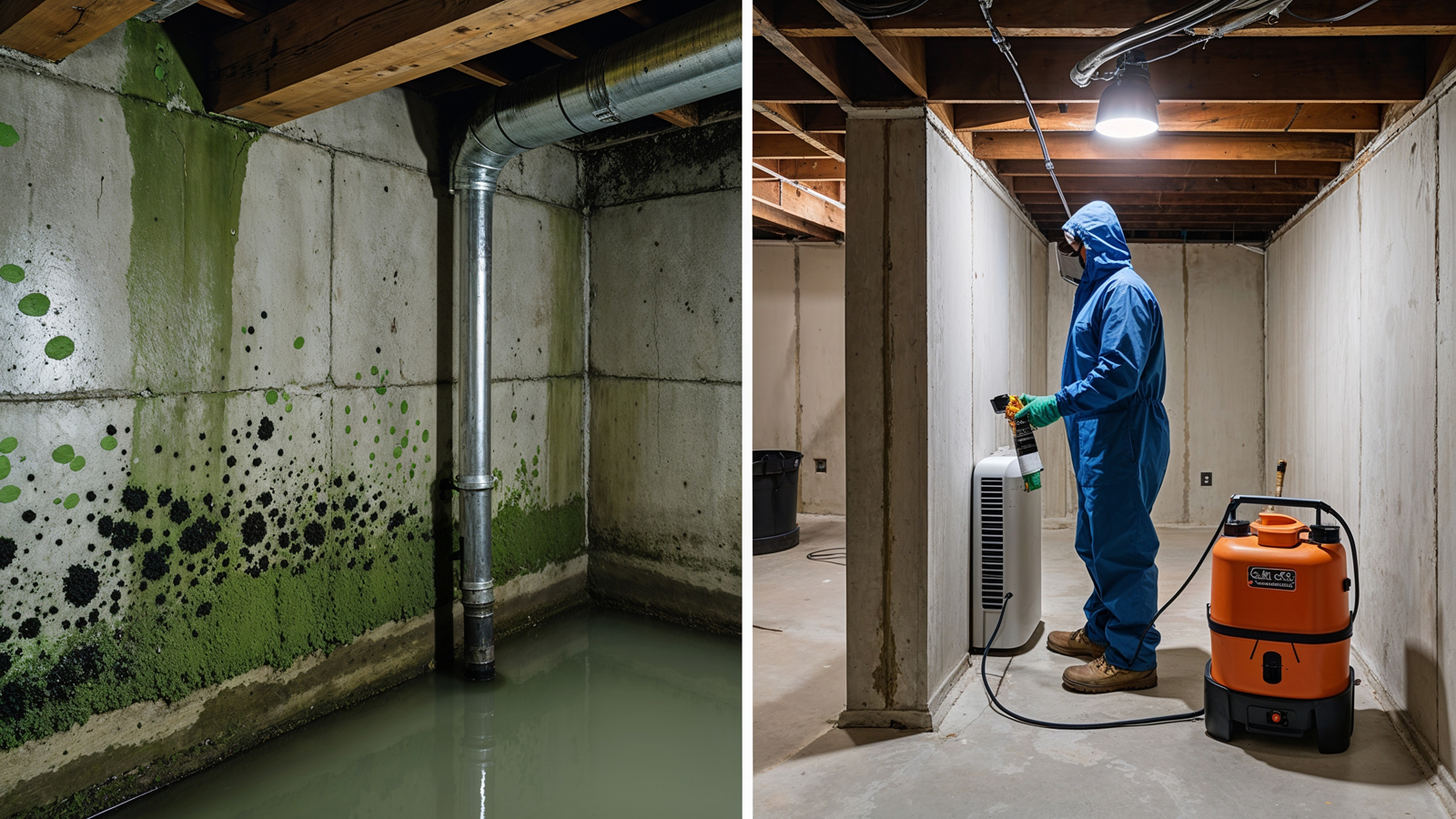
Basement mould removal cost in Canada falls between $500 and $4,000, with most homeowners paying close to $2,500. Basements are the single most common Canadian remediation scenario because of hydrostatic pressure, foundation seepage, and condensation on cold concrete walls.
Why It Happens in Canada
Canadian basements run cold year-round. Even with no leaks, summer humidity condenses on basement walls — relative humidity above 60% sustains mould growth. Add a spring thaw event, a failed sump pump, or an unsealed foundation crack and the problem escalates fast. Quebec duplexes and Ottawa Valley homes built before 1985 are the most common high-cost basement remediation cases.
Cost Breakdown
- Small isolated patch (under 50 sq ft, no structural damage): $500–$1,000
- Moderate basement (200–500 sq ft, drywall replacement): $1,000–$2,500
- Full basement remediation with framing repair: $2,500–$4,000+
The line between “remediation” and “renovation” gets blurry past $3,000 — at that point you’re often replacing drywall, insulation, baseboards, and trim because the affected area is too large to spot-treat.
What Drives the Final Number
Square footage matters less than what’s behind the wall. Mould on the painted side of a finished basement wall is cheap to fix; mould on the foundation side that’s seeped through requires the wall to come down, the framing to be dried, and the cause (interior or exterior foundation issue) to be addressed. A finished basement with hidden mould behind a vapour barrier is the single most expensive scenario short of whole-house contamination.
For prevention and full-scope context, see the dedicated basement mould guide.
3. Bathroom Mold Remediation Cost ($500–$1,500)
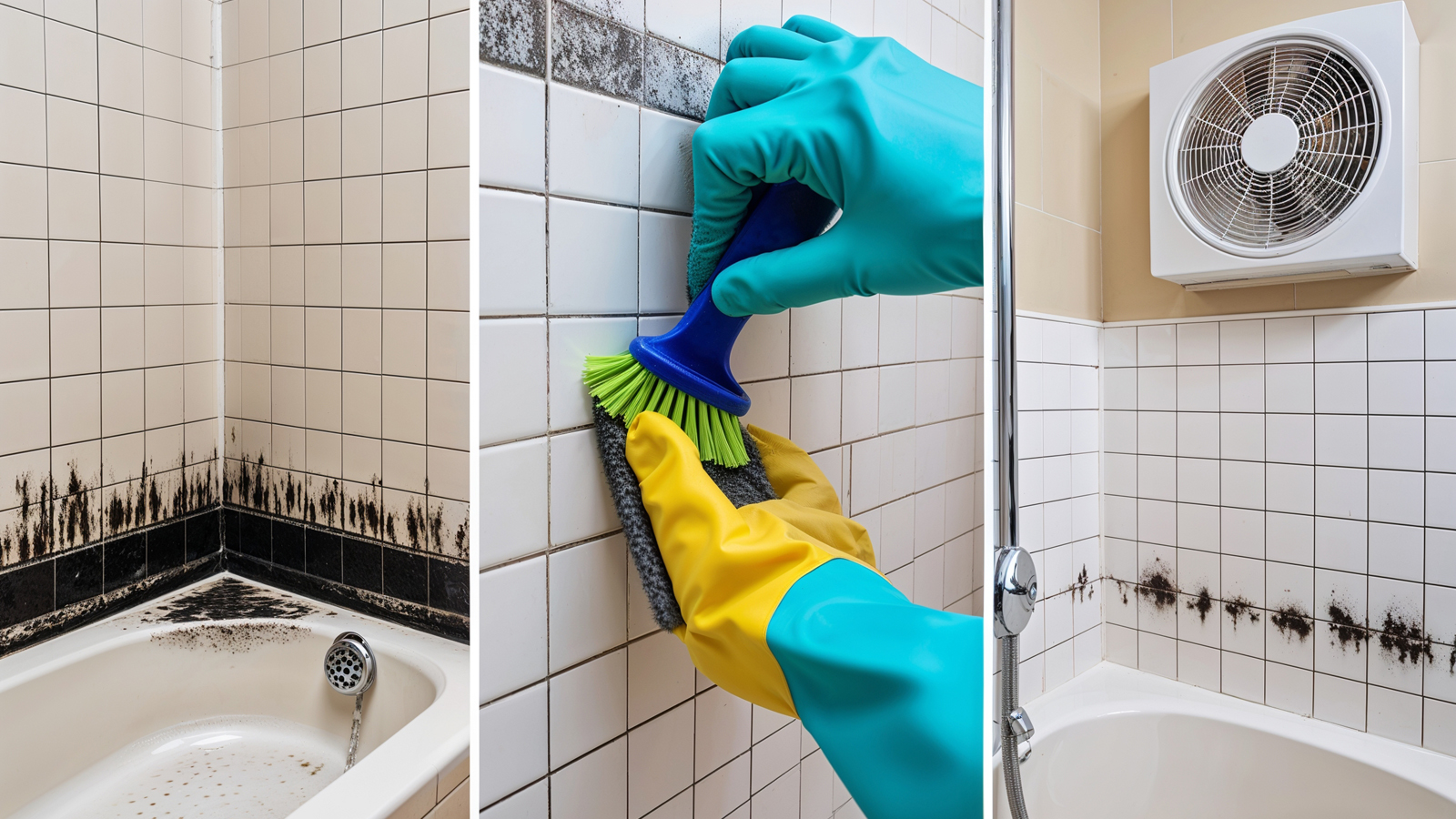
Bathroom mould remediation cost in Canada is $500 to $1,500, with a national average near $1,000. Bathrooms are the cheapest remediation scenario because the problem is almost always visible, contained, and accessible.
Why It Happens in Canada
Canadian bathrooms cycle through 90%+ humidity multiple times a day. Without a working exhaust fan vented to the exterior — not just to the attic — moisture sits on tile grout, drywall behind the tile, and the ceiling. By month six, the grout is darkening. By year two, the drywall behind it is rotting.
Cost Breakdown
- Surface tile and grout (no drywall damage): $500–$800
- Tile + drywall replacement, ceiling included: $800–$1,200
- Full bathroom rebuild after hidden mould: $1,200–$1,500+
If hidden mould is found behind a tub surround or under flooring, costs can exceed $2,000 — but at that point the project is closer to a bathroom renovation than a remediation.
What Drives the Final Number
The single biggest cost driver is what the inspection finds behind the visible mould. Surface mould on grout is a one-day cleaning job. Mould that’s penetrated drywall, soaked the framing, or compromised the subfloor turns into a multi-day project with new tile, new drywall, and sometimes a new exhaust fan vented properly through the roof.
See the full bathroom mould guide for diagnosis and prevention.
4. Crawl Space Mold Remediation Cost ($500–$10,000)
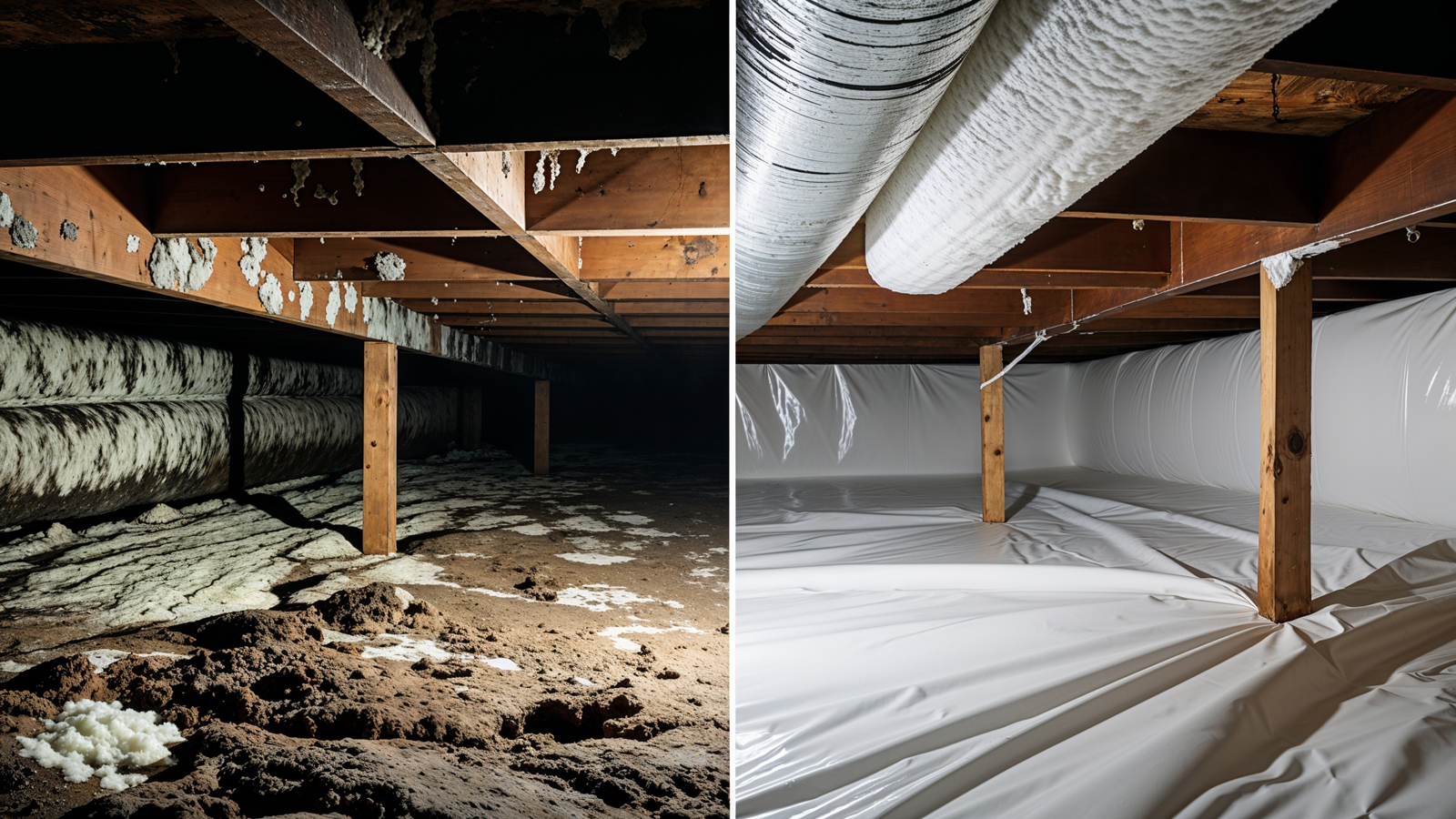
Crawl space mould remediation cost runs $500 to $10,000, with most jobs landing near $5,000. The wide range reflects the binary nature of crawl spaces: either a quick fan-and-encapsulate job (low end) or a full vapour-barrier-and-insulation rebuild (high end).
Cost Breakdown
- Light surface treatment + dehumidifier install: $500–$2,000
- Full encapsulation with new vapour barrier: $2,000–$5,000
- Encapsulation + drainage + framing repair: $5,000–$10,000
What Drives the Final Number
Crawl space jobs scale with whether the underlying moisture problem is solved at the same time. Spraying away surface mould without installing a vapour barrier or drainage means the mould returns within 18 months — and homeowners end up paying twice. Most remediation contractors will not warranty crawl space work unless encapsulation is part of the scope, which is why the typical invoice lands in the $4,000–$6,000 range.
5. Wall and Drywall Mold Remediation Cost ($1,000–$20,000)
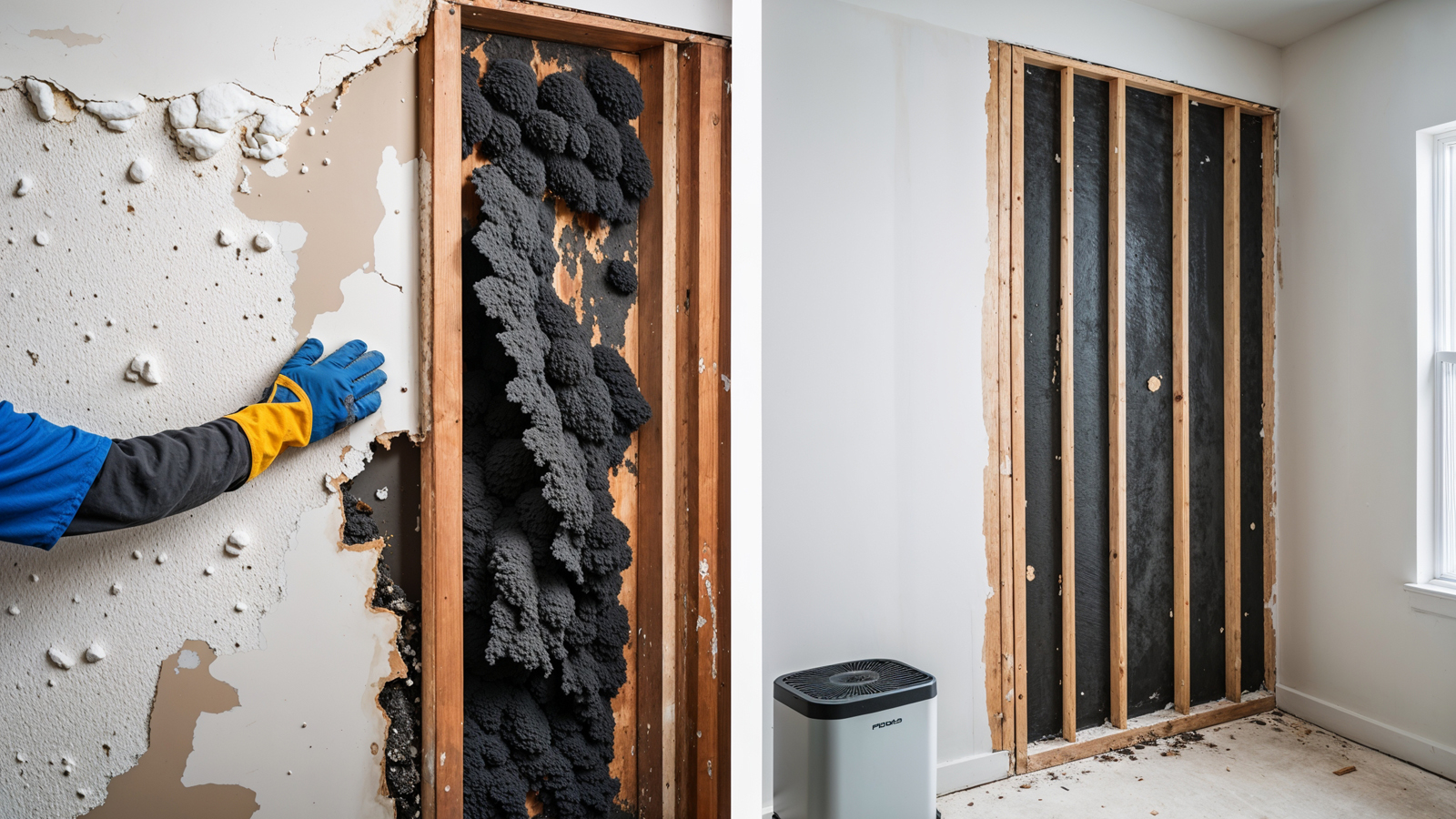
Wall and drywall mould remediation cost is the most variable category — $1,000 for a single isolated wall, up to $20,000 for multi-room contamination affecting framing. The price scales linearly with affected square footage and exponentially when framing dries out below 16% moisture only after weeks of equipment.
Cost Breakdown
- Single wall, surface-level (under 10 sq ft): $1,000–$3,000
- Multiple walls, drywall replacement: $3,000–$10,000
- Framing affected, multiple rooms: $10,000–$20,000
What Drives the Final Number
Whether the mould is on the painted side (cheap) or the cavity side (expensive). Cavity-side mould — typically discovered after a slow plumbing leak or a roof leak — requires the drywall to come down, the insulation to be removed and bagged, the framing to be dried with industrial dehumidifiers for 5–14 days, and then everything rebuilt. That’s a $5,000–$15,000 job by itself for one room.
6. HVAC System Mold Remediation Cost ($3,000–$10,000)
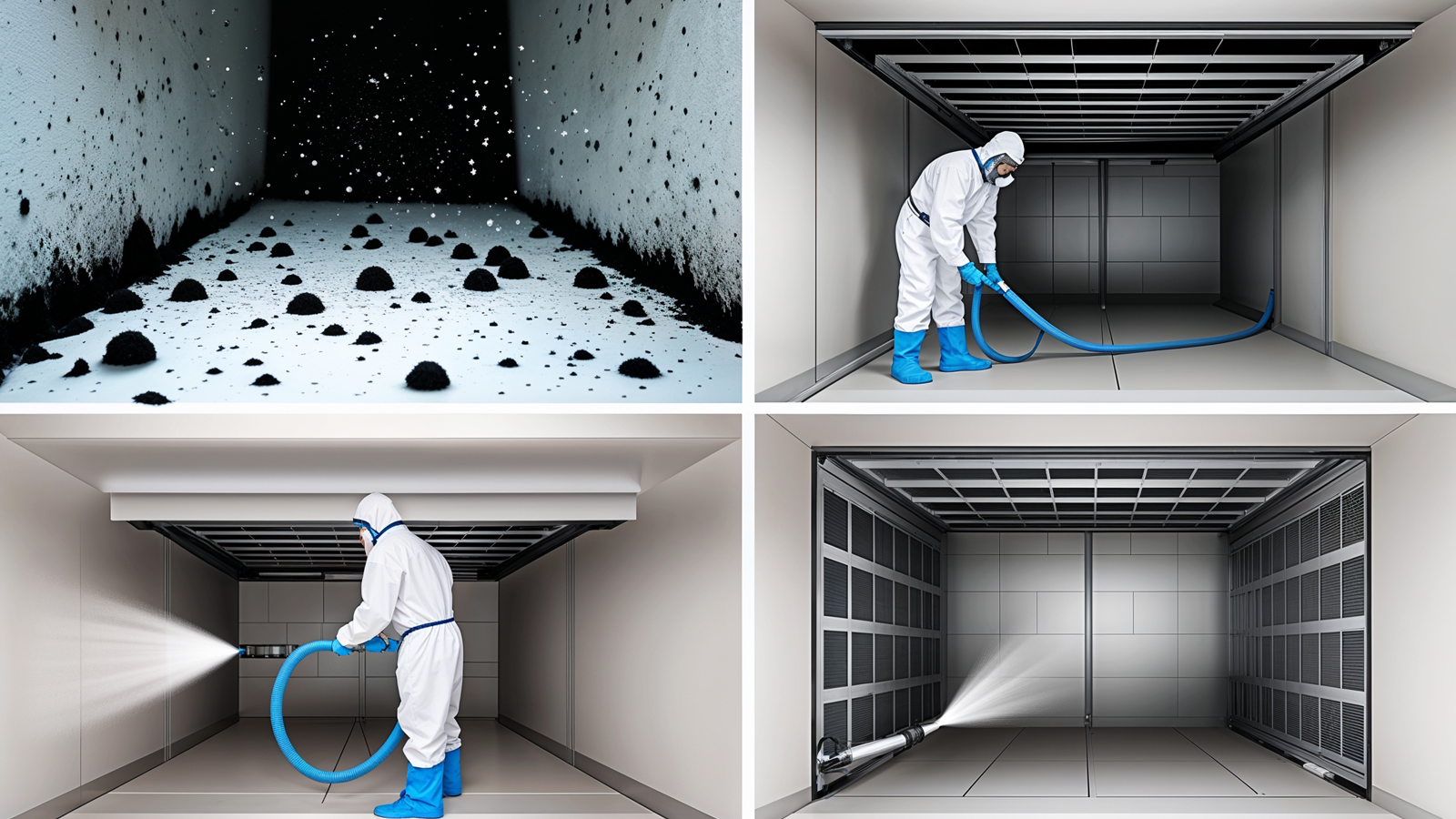
HVAC mould remediation cost averages $6,500 with a range of $3,000 to $10,000. HVAC jobs are uniquely expensive because the mould is distributed across the entire ductwork, the air handler, the evaporator coil, and any humidifier components — none of which can be reached without specialized equipment.
Cost Breakdown
- Coil cleaning and basic duct sanitization: $3,000–$5,000
- Full duct cleaning, coil replacement, UV light install: $5,000–$8,000
- Air handler replacement + ductwork sections: $8,000–$10,000+
What Drives the Final Number
Whether the evaporator coil and air handler can be cleaned or have to be replaced outright. A 12-year-old air handler with mould-impacted internals often costs more to clean than to replace. UV-C sterilization lights added at the coil are typically a $500–$1,000 upsell that prevents recurrence — almost always worth it.
Get an Exact Price for Your Property
Every range on this page is an estimate. The only way to know what your situation actually costs is to have someone look at it. A short virtual inspection is free and gets you a real number.
or send the details
7. Whole House Mold Remediation Cost ($10,000–$30,000)

Whole-house mould remediation cost in Canada lands between $10,000 and $30,000, with the typical invoice at $20,000. Whole-house jobs follow a major event: a roof failure that went unnoticed for months, a flooded basement that wasn’t dried within 48 hours, or a long-term plumbing leak that contaminated framing across multiple floors.
Cost Breakdown
- Multiple affected rooms, no structural impact: $10,000–$15,000
- Whole-house with framing remediation: $15,000–$25,000
- Catastrophic contamination (post-flood, abandoned property): $20,000–$30,000+
What Drives the Final Number
Time. A house that’s dried, contained, and remediated within 72 hours of a water event costs a fraction of one that sat wet for two weeks. Insurance coverage is also a major variable: a sudden burst pipe is typically covered, while long-term seepage typically is not, which can shift $15,000 of the invoice from the insurer to the homeowner.
What Drives the Final Mold Remediation Cost
Five factors move every Canadian remediation invoice up or down, regardless of the affected area.
Home Size and Affected Area
Square footage is the headline number, but affected area is what actually drives cost. A 3,500 sq ft house with mould only in the bathroom is a $1,000 job. A 1,200 sq ft bungalow with whole-basement contamination is $4,000+. Get the inspection report to specify affected square footage, not just home size.
Mold Type
| Species | Remediation impact |
|---|---|
| Cladosporium (common indoor mould) | Standard remediation pricing |
| Aspergillus / Penicillium (often together in reports) | Standard pricing; air clearance test recommended |
| Stachybotrys chartarum (toxic black mould) | +20–30% cost; requires HEPA filtration + containment + clearance testing |
| White mould (commonly Penicillium) | Standard pricing |
| Pink mould (Aureobasidium, often bathroom) | Standard pricing |
Black mould doesn’t cost more to find — but it does cost more to remove, because the remediation protocol mandates negative-pressure containment, HEPA air scrubbers, full PPE, and post-clearance air testing.
Accessibility
Easy-access areas (open basement, walk-in attic, exposed bathroom wall) cost half what hidden areas cost (wall cavities, sealed crawl spaces, behind built-in cabinetry). When you contact any of the top mold removal companies in Ottawa for a quote, ask the inspector to specify accessibility tier. It’s the single biggest driver of the labour line.
Geographic Location
| Region | Typical price band vs national average |
|---|---|
| Ontario (GTA, Ottawa, Hamilton) | National average |
| Quebec (Montreal, Quebec City) | -5% to +5% |
| Atlantic provinces | +10–15% (smaller contractor pool) |
| Prairie provinces | -10–15% (drier climate, less competition) |
| BC (Vancouver, Victoria) | +15–20% (coastal humidity, high labour rates) |
According to Health Canada, indoor relative humidity should be kept between 30% and 50% in winter and below 60% in summer to prevent mould growth. CMHC publishes free guidance on moisture control in Canadian homes, which is the cheapest preventive step available.
Quebec pricing runs on its own logic, partly because of provincial licensing and partly because older Montreal housing stock complicates access. We break the local market down in our guide to the best mold removal companies in Montreal.
How to Save on Mold Inspection & Remediation in Canada
What insurance typically covers:
- Sudden water damage (burst pipe, appliance failure, accidental flood)
- The remediation work that results from that event
What insurance typically doesn’t cover:
- Slow leaks discovered after months
- Condensation-driven mould
- Mould caused by deferred maintenance
- Pre-existing problems
A condensation-driven attic mould job is almost never covered. A burst dishwasher hose that flooded a basement and grew mould is almost always covered. Knowing which category you’re in before you start the claim conversation saves time and protects future premium rates.
Frequently Asked Questions
How much does a mold inspection cost in Canada?
A standard residential mould inspection in Canada costs $200 to $700. The national average is around $300 for a visual inspection plus one indoor air sample with lab analysis. Visual-only inspections start at $150; comprehensive multi-room inspections with surface swabs and full lab work top out near $700. Most insurers and real-estate transactions require at least a standard inspection with air sampling.
Is a $200 mold inspection enough or do I need air sampling?
A visual-only inspection at $200 is enough when mould is obviously visible and confined to one area. Add air sampling ($80–$150 extra) when there’s a musty smell with no visible growth, when buying or selling a home, when occupants report respiratory symptoms but no mould is seen, or when post-remediation clearance is needed. Air sampling is what catches hidden mould inside walls and HVAC systems.
What’s the difference between a mold assessment and a mold inspection?
A mould assessment is a broader walk-through with a moisture meter and a written summary — often free or under $200, sometimes offered by remediation companies as a sales lead. A mould inspection is a formal procedure with documented sampling, lab analysis, photographs, moisture readings, and a written remediation protocol. Assessments diagnose; inspections produce evidence for insurance, lenders, and courts.
How much does mold testing cost compared to mold removal?
Mould testing in Canada costs $200 to $700 for inspection plus lab work. Mould removal ranges from $500 for a bathroom corner to $30,000 for whole-house contamination. The testing-to-removal cost ratio for a typical Canadian basement job is roughly 1:8 — $300 for the test, $2,500 for the removal. Testing is what makes the removal quote accurate.
Is a free mold inspection ever worth it?
A free mould inspection is worth it for rough triage when you already suspect a localized issue and want a second opinion before deciding on DIY versus hiring out. It is not worth it for insurance claims, real-estate transactions, mortgage closings, or any decision involving significant money — those require an arms-length paid inspector. Free inspections from remediation companies have an inherent conflict of interest.
How much does black mold inspection cost?
A black mould inspection in Canada costs the same as a standard inspection — $200 to $700. The species-specific lab analysis to confirm Stachybotrys chartarum versus benign black-coloured species like Cladosporium adds $100 to $200 if requested. Most reputable inspectors include species identification automatically when colour and pattern suggest Stachybotrys.
Should I get a DIY mold test kit instead of a professional inspection?
DIY mould test kits ($30–$80 from Canadian Tire or Home Depot) are useful for rough triage. They confirm whether mould spores are present in the air, but they cannot identify species, pinpoint the source, measure contamination boundaries, or be used for insurance, legal, or real-estate purposes. Treat them as a sanity check before deciding whether to call a pro — not as a substitute.
How much does mold remediation cost on top of inspection?
Mould remediation in Canada costs $500 to $30,000 depending on affected area. Typical scenarios: bathroom $1,000, basement $2,500, attic $2,000, crawl space $5,000, HVAC $6,500, whole-house $20,000. The inspection itself is usually 5–10% of the total project cost — meaning a $300 inspection followed by a $3,000 remediation is a typical Canadian invoice pattern.
Get a Quote
Need a documented inspection or a remediation quote backed by lab evidence? A certified inspector serves homes across Ontario and Quebec, with same-day virtual triage and 24–72 hour lab turnaround.