
Health Effects of Black Mold: What You Actually Need to Know
Black mould is one of the most googled household-health topics in Canada, and one of the most misunderstood. The fear is aimed at one species, Stachybotrys chartarum, but most dark-coloured mould Canadians find in their homes is not Stachybotrys at all. The health risks are real, the panic usually isn’t, and telling the two apart changes what you should do next.
This guide covers what black mould actually is, what it looks like in real homes, who faces the highest risk, the symptoms that should put you on alert, and how to decide between DIY cleanup and a professional inspection.
What Is Black Mold? (And What It Actually Looks Like)
Black mould is the common name for Stachybotrys chartarum, a slow-growing fungus that prefers wet, cellulose-rich materials. In a Canadian home, that almost always means drywall paper, ceiling tile, cardboard, or wood that has stayed wet for more than a week. Stachybotrys does not grow on glass, tile, or metal, and it does not grow without sustained moisture.
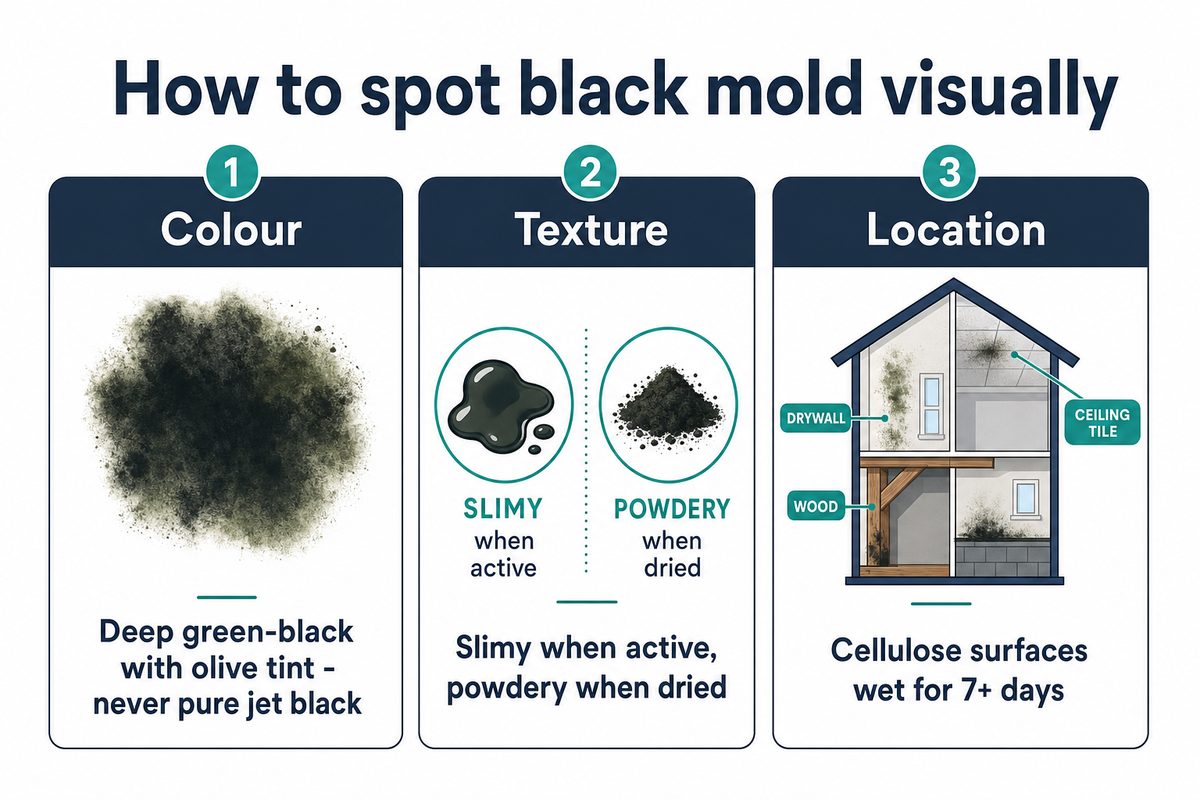
Three visual cues separate Stachybotrys from look-alikes:
Colour
Deep, dark green-black, often with a slightly olive tint, almost never pure jet black. Bluish-black, brownish, or grey usually means a different species.
Texture
Slimy when actively growing; powdery once dried. Most look-alikes (Cladosporium especially) start out velvety.
Location
Needs water for at least 7–10 days. Appears almost exclusively at the site of a leak, flood, or chronic condensation — behind a leaking pipe, on drywall under a roof leak, on basement walls after spring flooding.
The species matters for one reason: removal protocol. Stachybotrys-suspected sites should not be disturbed by an untrained person. The spores released when a dried colony is scrubbed are the dangerous part, not the colony sitting still on the wall.
Is Black Mold Actually Dangerous? The Science vs The Hype
Black mould can cause real harm, but the version of the story you usually read online — toxic black mould kills, black mould causes brain damage, sick-building syndrome from a single patch — is not what the science says. Here is where the consensus sits in 2026, drawn from Health Canada, the CDC, NIEHS, and the Mold and Human Health: A Reality Check review (Borchers et al., PubMed 28299723):
What Stachybotrys does do
- Produces mycotoxins on the surfaces where it grows.
- Causes the same allergy and irritant symptoms as other moulds, often more strongly.
- Is genuinely harmful in long-term, large-scale water-damaged buildings — linked to new-onset asthma, hypersensitivity pneumonitis, and chronic respiratory inflammation.
- Poses a well-documented risk to infants, the elderly, pregnant women, and immunocompromised people.
What it has not been proven to do
- Cause “mould toxicity syndrome” as a discrete diagnosable condition.
- Cause permanent neurological damage in otherwise healthy adults.
- Produce mycotoxin air concentrations high enough to poison residents through breathing alone.
- Health Canada’s position: mycotoxin exposure of clinical significance from indoor air has not been demonstrated. The harm pathway in homes is allergic and inflammatory, not toxicological.
This is not an argument for ignoring black mould. It is an argument for treating it as what it is: a serious moisture problem that needs prompt remediation and that can make sensitive people sick. That is enough reason to act.
Black Mold Health Effects: Symptoms by Severity
People react to black-mould exposure very differently depending on spore dose, exposure duration, and immune reactivity. Symptoms cluster into three severity bands, plus an emergency category.
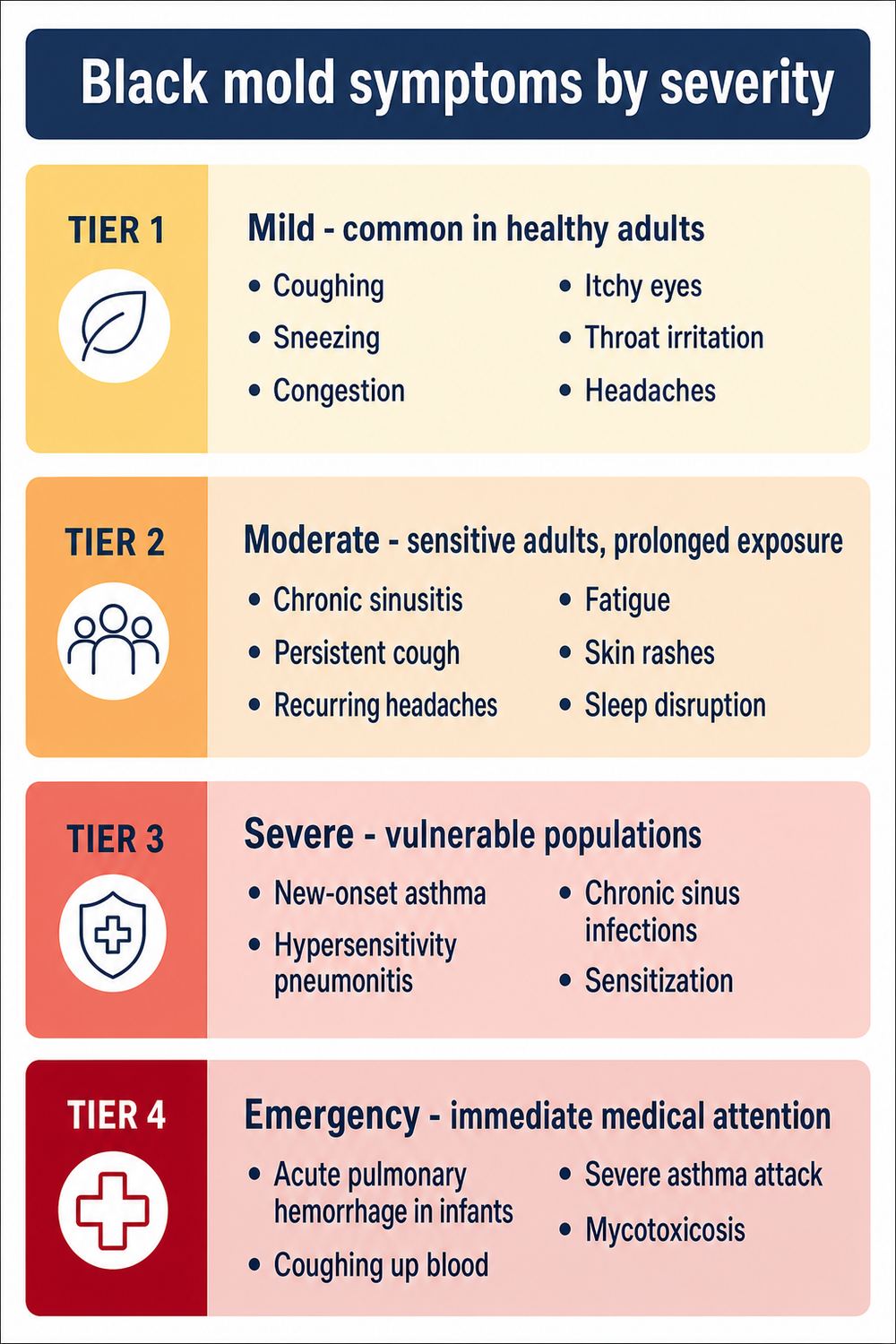
Mild — common in healthy adults
Coughing, sneezing, nasal congestion, itchy or watery eyes, throat irritation, occasional headaches, mild skin irritation. These usually appear within hours of being in the affected space and ease within a day or two of leaving it.
Moderate — in sensitive adults and prolonged exposure
Persistent sinus inflammation that doesn’t clear with normal allergy treatment, chronic dry cough or wheezing, recurring headaches, sleep disruption, fatigue that doesn’t track to a clear cause, skin rashes that flare in the home. Worsening of existing asthma or allergies.
Severe — in vulnerable populations or large-scale water-damaged buildings
New-onset asthma in previously healthy people, hypersensitivity pneumonitis (lung inflammation that mimics pneumonia), chronic sinus infections, recurring respiratory infections. Symptoms that persist even after leaving the home, suggesting sensitization.
For the general mould-exposure symptom deep dive across all species — including 10 warning signs of mould toxicity — see our companion guide on symptoms of mold exposure. This page stays focused on what’s specific to black mould.
Who Faces the Highest Risk?
Most healthy adults can be exposed to short bursts of indoor black mould without lasting consequences. The risk profile changes sharply for these six groups, who should treat any visible Stachybotrys-suspected mould as a “leave the area, call a professional” situation rather than a clean-it-yourself problem.
Infants and young children
Higher breathing rates relative to body mass and developing lungs. Health Canada and the CDC have documented acute idiopathic pulmonary hemorrhage in infants in heavily mould-contaminated homes; pediatric exposure guidance is uniformly cautious.
Pregnant women
Increased respiratory and immune sensitivity. Prolonged mould exposure during pregnancy has been associated with increased childhood-asthma risk in the resulting child.
Older adults (65+)
Reduced lung capacity and a higher baseline rate of underlying respiratory conditions. Symptoms in this group escalate faster and resolve more slowly.
People with asthma, COPD, or cystic fibrosis
Airways that already overreact to inhaled triggers. Mould spores are one of the most common asthma triggers in Canadian indoor air; Stachybotrys exposure can cause acute attacks from short exposure.
Immunocompromised people
Chemotherapy, transplant recipients, HIV, long-term corticosteroids. Can develop genuine fungal infections (aspergillosis-type illness) from indoor mould exposure that healthy people clear without incident.
People with existing mould allergies
The most predictable and most severe reactions, sometimes within minutes of exposure to a confirmed Stachybotrys site.
How Black Mold Gets Into Your Home
Stachybotrys does not arrive. It develops. Spores are present in low concentrations in almost every Canadian home year-round, blown in from outside and tracked in on shoes. They only colonize when four conditions hold at once.
A cellulose food source
Drywall paper, ceiling tile, cardboard, untreated wood, wallpaper backing. Stachybotrys cannot grow on tile, glass, metal, or plastic on its own.
Sustained moisture
Surface dampness for at least 7 days. A one-off spill that dries within a day rarely starts a colony. A chronic leak, slow drip, persistent condensation, or a flooded basement not dried within 48 hours all qualify.
Moderate temperatures
Stachybotrys grows fastest between 15 and 25°C — ordinary Canadian indoor temperatures. It is one of the few moulds that keeps growing in cool basements where other species slow down.
Stable conditions for 7 to 10 days
Unlike Aspergillus or Penicillium, which can colonize within 48 hours, Stachybotrys is slow. It shows up where moisture has been ignored for a week or more.
In Canadian homes the predictable sites are basement walls after spring flooding, cavities behind leaking dishwasher or refrigerator water lines, aging window frames that condense heavily in winter, soaked subfloors after a slab leak, attic plywood below a roof leak, and drywall behind a slow plumbing leak in a wall cavity. Location-specific guidance: basement mould, mould in drywall, attic mould.
How To Tell If The Black Mold In Your House Is Stachybotrys
This is the single highest-value question on this page, and most online guides skip it. Four dark-coloured moulds are commonly mistaken for Stachybotrys in Canadian homes. Knowing which one you are looking at changes the urgency and the response.
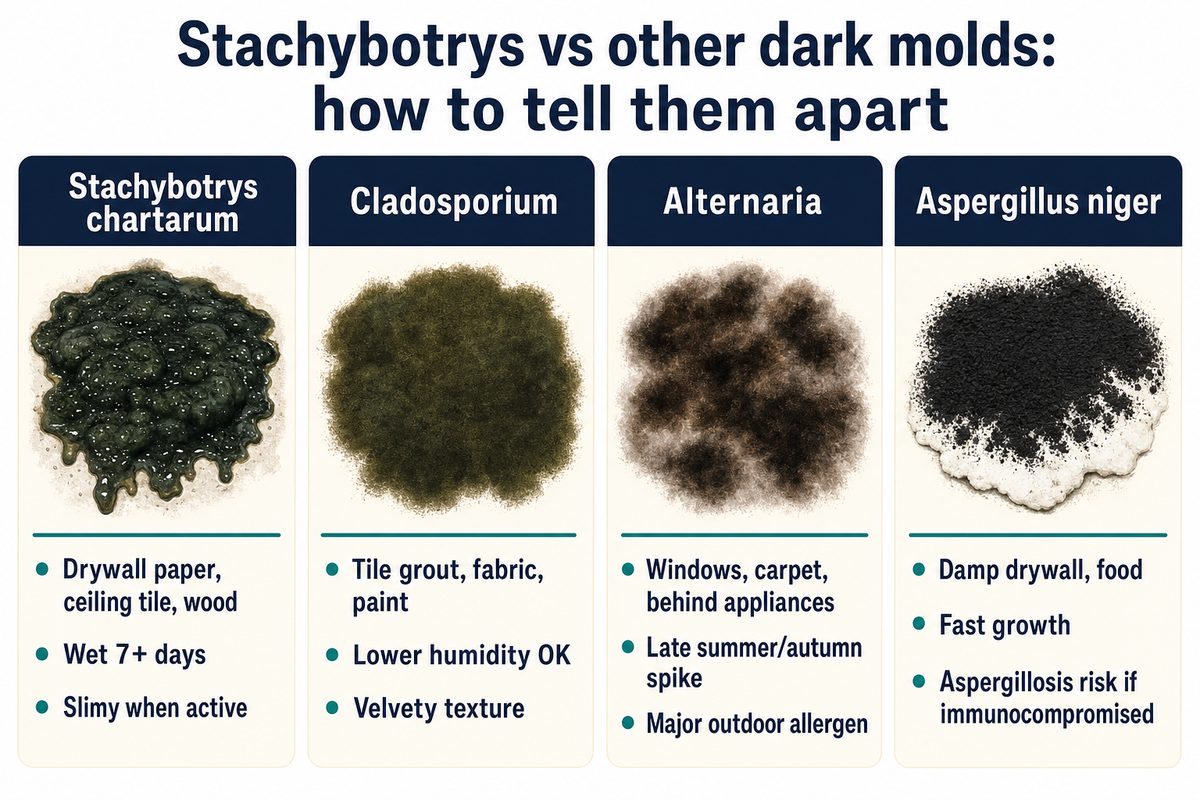
| Species | Colour & texture | Where it grows | Key tell |
|---|---|---|---|
| Stachybotrys chartarum | Dark green-black with olive tint. Slimy when active, powdery when dried. | Drywall paper, ceiling tile, wood — cellulose surfaces wet 7+ days. | Almost always tied to a sustained water source. Slow to appear. |
| Cladosporium | Velvety, dark green to brownish-black, sometimes nearly black. | Tile grout, fabric, painted surfaces. Tolerates lower humidity. | The most common indoor mould in Canada. Different mycotoxin profile. |
| Alternaria | Dark brown-black with a slightly cottony texture. | Around windows, in damp carpet, behind appliances. | Major outdoor allergen that drifts indoors in late summer and autumn. |
| Aspergillus niger | Black on the surface, almost always white or yellow underneath when scraped. | Damp drywall, food, leather. Fast growth. | Can cause aspergillosis in immunocompromised people. |
In practice: if the patch is slimy, in a known water-damaged area, growing on drywall paper wet for a week or more, and a deep green-black — assume Stachybotrys and do not disturb it. If it’s velvety, on tile grout, around a window, or white underneath when scraped — it is one of the other three: still a real problem, just not the species the panic articles are talking about.
What To Do If You Find Black Mold
Whether you can handle it yourself depends on four factors: how big the patch is, what surface it’s on, who lives in the home, and where it sits.
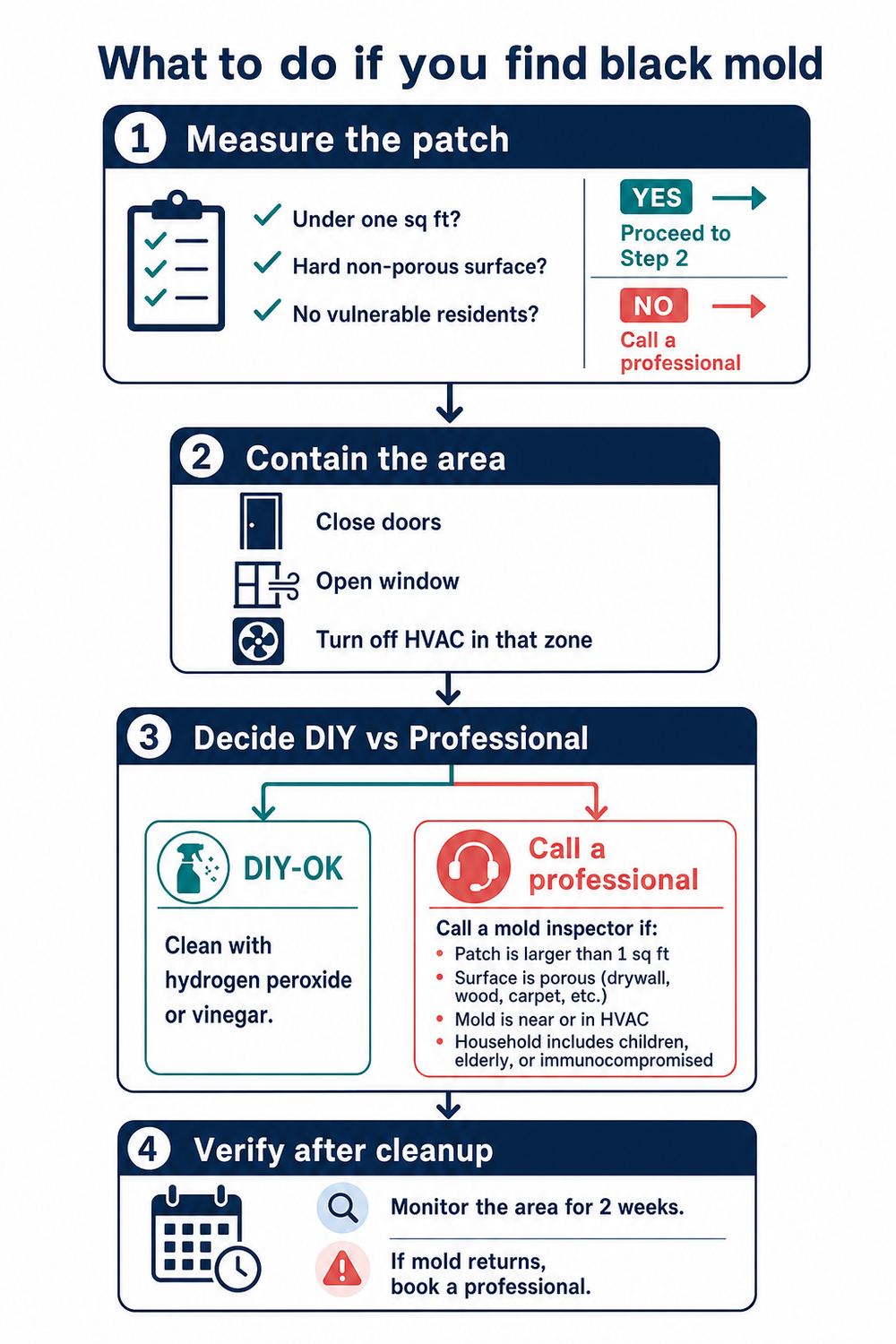
Measure the patch
Anything under one square foot, on a hard non-porous surface (tile, sealed wood, metal, glass), with no medically vulnerable people in the home, is a candidate for DIY cleaning.
Contain the area before you touch anything
Close doors to the affected room. Open a window if you can. Turn off the HVAC in that zone so disturbed spores don’t get pulled into ducts and distributed through the rest of the house.
Decide DIY vs professional
If the patch is over one square foot, on a porous surface (drywall, untreated wood, ceiling tile, carpet), in HVAC or behind a wall cavity, or anyone in the home is medically vulnerable — do not clean it yourself. Book a professional mould inspection. Disturbing a Stachybotrys colony without containment is what releases the spore load.
Verify after cleanup
Monitor the cleaned area for two weeks. Mould that returns within a month means you removed the visible colony but did not fix the moisture source — and the regrowth is the bigger problem. If it returns, book a professional inspection.
When Black Mold Becomes a Medical Emergency
Most black-mould health effects develop slowly, but a small set of situations require same-day medical attention rather than a wait-and-see approach.
For everything outside this list — chronic sinus issues, persistent cough, headaches, fatigue that improves when you leave the home — book your family doctor first, mention the mould exposure, and book a professional mould inspection in parallel. The doctor treats the body; the inspector finds the source. You need both.
Frequently Asked Questions
What does black mold look like?
Stachybotrys chartarum is dark green-black with a slight olive tint, slimy when active and powdery when dried. It almost always grows on cellulose materials (drywall paper, ceiling tile, wood) that have been wet for at least 7 days. If the dark mould you are looking at is on tile grout, around a window, or has a velvety texture, it is more likely Cladosporium, Alternaria, or Aspergillus niger.
Is all dark-coloured mold black mold?
No. Cladosporium, Alternaria, and Aspergillus niger all appear black or near-black and are far more common in Canadian homes than Stachybotrys. Any visible mould patch larger than a small spot needs to be removed and the moisture source fixed, regardless of species — but the species changes the urgency and safety protocol for removal.
Can black mold actually kill you?
For healthy adults, no. The “black mould kills” framing is not supported by what Health Canada, the CDC, and NIEHS report on indoor inhalation. Genuine risk concentrates in infants (acute hemorrhagic pneumonitis in heavily water-damaged homes), immunocompromised people (fungal infections), and people with severe asthma or lung disease. For everyone else, it is a real but rarely life-threatening problem needing prompt remediation.
How quickly do black mold symptoms start?
Allergic and irritant symptoms (coughing, sneezing, eye irritation) usually appear within hours of being in the affected space. Symptoms tied to long-term exposure (new-onset asthma, sinus inflammation, fatigue) develop over weeks to months. People with diagnosed mould allergies can react within minutes. Slow-onset effects are easier to miss but more common.
Can I clean black mold myself, or do I need a professional?
DIY only if the patch is under one square foot, on a hard non-porous surface (tile, sealed wood, metal, glass), and no medically vulnerable people live in the home. Anything larger, on a porous surface, in HVAC or behind a wall, or in a home with infants, elderly, pregnant, asthmatic, or immunocompromised residents — book a professional inspection. DIY without containment is what releases the spore load.
Does black mold always need to be removed?
Yes. Visible mould of any species indicates active growth and an underlying moisture problem, both of which get worse over time. Painting over it does not stop it — the colony continues to grow under the paint and the spores continue to release into the air. The harder question is whether you can remove it yourself or need help, not whether to remove it.
How long can you live in a house with black mold before it harms your health?
There is no safe threshold. Exposure dose, duration, immune status, and existing respiratory health all matter more than calendar time. Healthy adults often tolerate small patches for months without obvious symptoms; vulnerable people can develop symptoms within days. The right frame is not “how long can I wait” but “what is the moisture source and when can it be fixed.”
Is bleach the right way to kill black mold?
On hard non-porous surfaces (tile, sealed grout, glass, metal) — yes. On porous surfaces (drywall, untreated wood, ceiling tile, carpet) — no. The chlorine evaporates before it penetrates, leaving root structure intact. On porous materials, hydrogen peroxide, undiluted white vinegar, or a mould-specific cleaner are better. For active Stachybotrys on drywall, the contaminated section usually needs to be cut out and replaced.
Worried You Have Black Mold? Book a Mold Inspection
Found dark mould and unsure which species, the patch is bigger than a small spot, or someone in the home is vulnerable? Get it properly assessed before disturbing it. A professional inspection identifies the species, locates the moisture source, and tells you exactly what needs to come out.