
Mold in Your Air Conditioner: Signs, Cleaning & Prevention
A musty smell the moment the AC kicks on is the classic warning. Mold grows on the cold coil, the drip pan and the ducts every Canadian cooling season — here is how to spot it, clean it safely, and stop it from coming back.
Why Mold Grows in an Air Conditioner
An air conditioner is, by design, the dampest appliance in your home in summer. Warm room air passes over a cold evaporator coil, water condenses out of it, and that water drips into a pan and drains away. Cold metal, constant moisture, dust pulled in from every room, and the dark inside of a cabinet or duct — that is the exact recipe mold needs.
After 20 years of inspecting Canadian homes, our team finds AC and HVAC mold most often at the end of a humid Ontario or Quebec summer, when units have run for weeks and never fully dried out. The species rarely matters. What matters is that the moisture has nowhere to go, so the colony keeps feeding every time the system runs.
If your AC smells musty when it starts, you likely have mold on the coil, in the drip pan or in the ducts. Turn the system off, because US EPA warns that running a mold-contaminated HVAC system can spread spores through the whole house. Clean small, hard surfaces yourself with soap and water — never bleach, per Health Canada — and call a professional for ducts, insulation, mini-splits or anything larger than a small patch.
For the biology behind it, see what mold actually is, and for the conditions it needs, where mold grows in a home.
How Mold Spreads From the Coil to Your Rooms
Understanding the path the air takes explains why a small problem at the coil becomes a whole-house problem. Cool air does not just appear in your rooms — it is pulled across the coil, through the cabinet, and pushed out through ducts or a blower. Mold rides that same path.
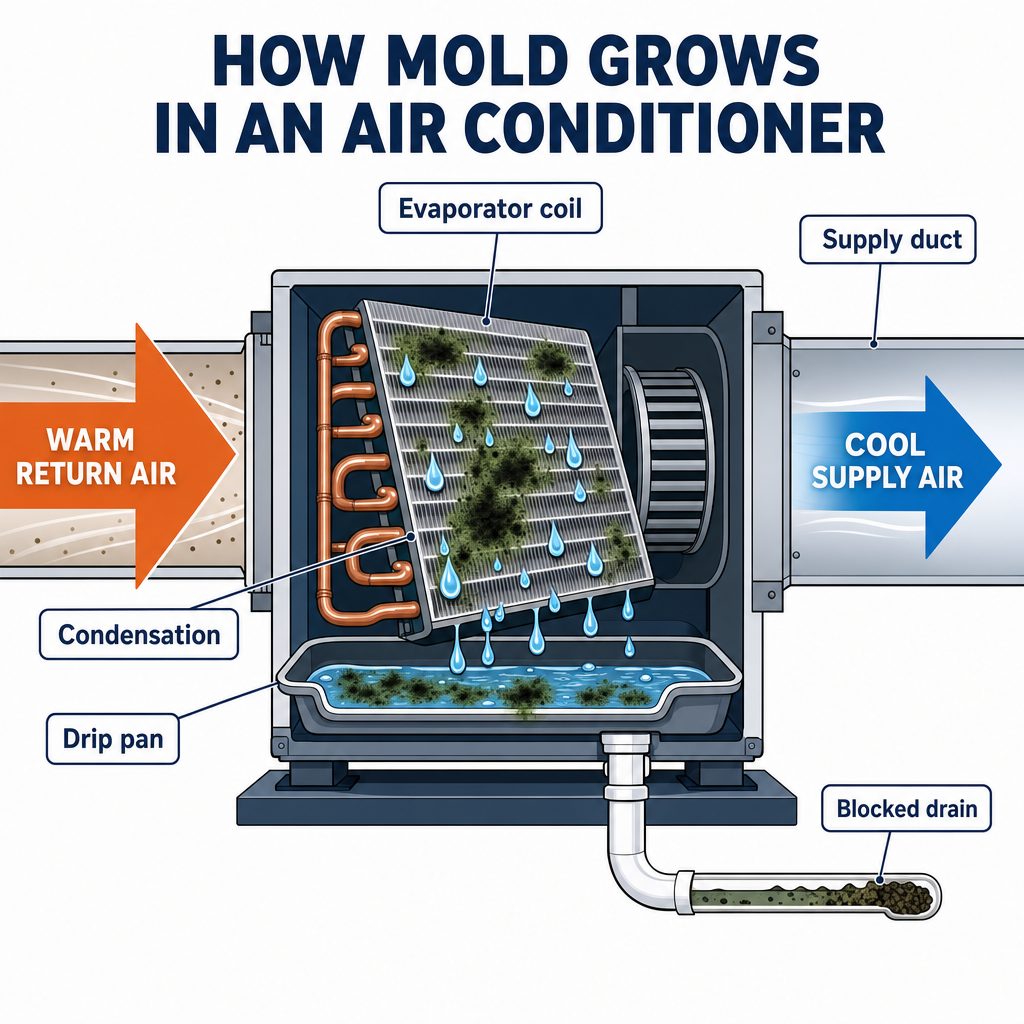
Return air carries household dust and moisture to the cold evaporator coil. Condensation forms on the coil and runs into the condensate (drip) pan below it. If the pan or its drain line is partly blocked — algae and slime are the usual cause — water sits and the coil stays wet between cycles. Mold establishes on the coil fins, in the standing water of the pan, and on any damp dust lining the supply ducts. Every time the fan runs, spores from those surfaces are blown into the rooms downstream.
Signs of Mold in Your AC or HVAC
You rarely see AC mold directly — it hides inside the cabinet, the pan and the ducts. Instead you notice the system behaving differently. These are the six signals that most often turn out to be mold when we inspect.
Musty smell when it runs
The most reliable sign. A damp, earthy or sock-like odour that appears within seconds of the AC starting and fades when it stops means mold somewhere in the airstream — usually the coil or drip pan releasing spores and microbial gases into the supply air.
Visible black or green growth
Dark speckling around the vents, on the front grille of a window unit, on the blower wheel of a mini-split, or inside the first stretch of duct you can see is mold until proven otherwise. Black, grey, olive-green and pink are all common AC colonizers.
Symptoms only when the AC is on
Sneezing, congestion, itchy eyes, throat irritation or headaches that start when the cooling runs and ease when it is off point to something in the system feeding the air. Health Canada treats indoor mold as a respiratory hazard regardless of species.
Weak or reduced airflow
Mold and the biofilm it grows in can clog a coil and restrict a filter. If a unit that used to cool a room now struggles, and the filter looks dirty or smells, a fouled coil is a common cause — and a fouled coil is usually a damp one.
Water around the unit
Pooled water under a window unit, a wet patch beside an indoor air handler, or a constantly damp drip pan means the condensate is not draining. Standing water is where pan-and-coil mold begins, and on recalled window units it is the exact defect involved.
Dust-like buildup at vents
A fuzzy or slimy film around supply registers — different from ordinary grey dust — is often mold that has travelled out of the ducts and settled at the opening. It wipes away but returns quickly while the source upstream is still active.
One sign alone is not proof — a dirty filter smells too. Two or more together, especially a musty smell plus symptoms that track with the AC running, is the point at which we recommend shutting the system off and inspecting before you keep breathing the output. Our guide to checking the rest of your home for mold walks through the rest of the house.
The Four Places Mold Hides in a Cooling System
“AC mold” is not one problem. The fix depends entirely on which kind of system you have, because each one traps moisture in a different spot. These are the four we see across Canadian homes.
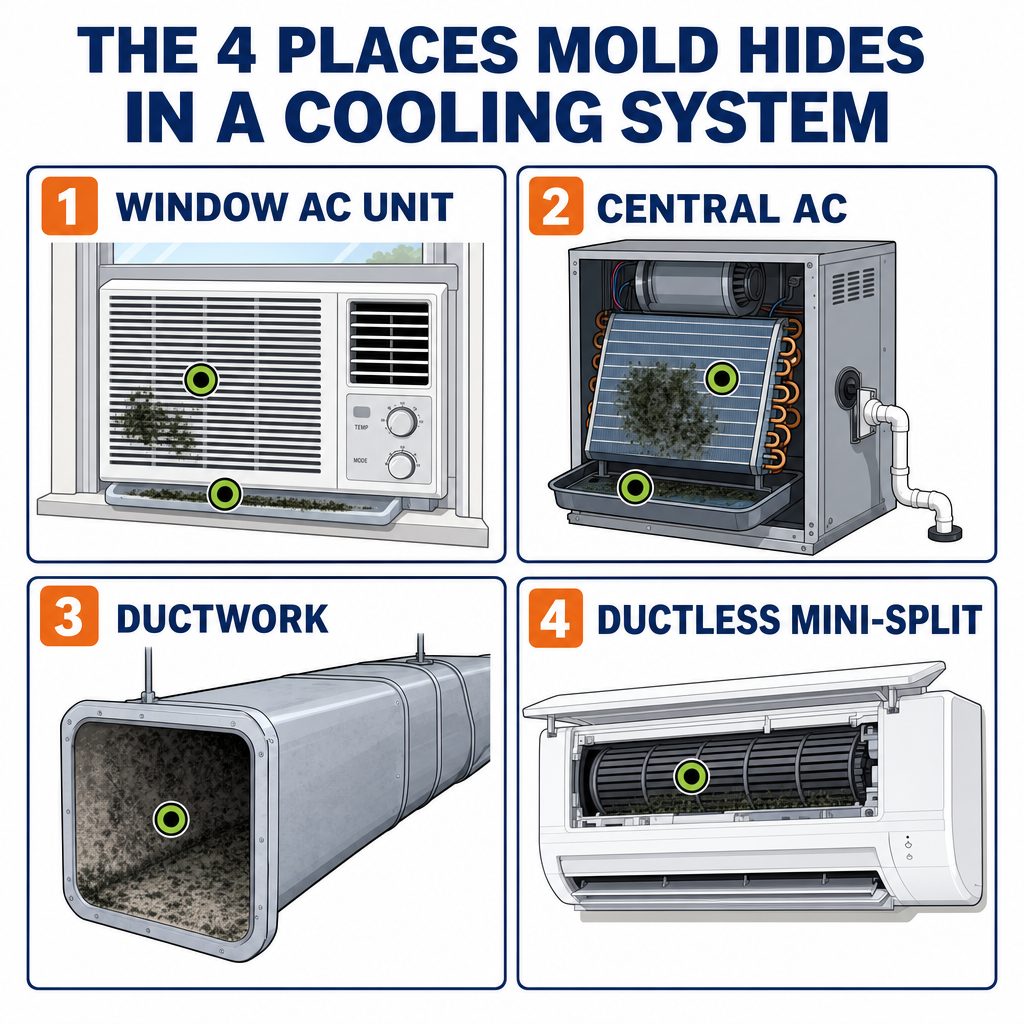
Window air conditioners
The most mold-prone unit in most homes. Water collects in a tray at the base, the foam gaskets stay damp, and the unit often sits in a closet all winter without drying. The front grille and the foam behind it are the first places to check. A specific model defect is also behind a current Canadian recall — covered in the next section.
Central air conditioning
The evaporator coil and condensate pan sit inside or on top of the furnace, out of sight. A blocked drain line keeps the pan full, the coil stays wet, and mold grows on both. Because the same blower then pushes air through the whole duct system, central-AC mold is the type most likely to affect every room.
Ductwork
Ducts collect dust, and if any section runs cold enough to sweat — or a leak lets humid air in — that dust gets damp and grows mold. Flexible ducts and insulated ducts are the worst, because US EPA notes that mold-contaminated duct insulation cannot be cleaned and must be removed and replaced.
Ductless mini-splits
Increasingly common in Quebec and across Canada, the wall-mounted indoor head hides a blower wheel just downstream of the cold coil. It stays wet, collects dust, and grows mold that sprays a fine mist into the room on startup — the classic musty mini-split smell. The blower wheel needs a proper pull-and-clean, which is a professional job.
Window AC Units and the Health Canada Recall
If you own a U-shaped or “U+” window air conditioner, this section matters. Health Canada and the manufacturer have recalled a large batch of these units specifically because they can grow mold.
Here are the recall details to check your unit against:
| Recall detail | What to look for |
|---|---|
| Brands affected | Midea, Danby, Frigidaire, Insignia and Perfect Aire (all made by Midea) |
| Style and sizes | U-shaped and U+ window units in 8,000, 10,000 and 12,000 BTU |
| Sold between | March 2020 and May 2025 |
| Units in Canada | About 45,900 (about 1.7 million in the United States) |
| The hazard | Pooled water can fail to drain quickly enough, which can lead to mold growth |
| The remedy | Contact Midea for a free repair, or a full or prorated refund based on your purchase or manufacture date |
Even if your window unit is not part of the recall, the same weakness applies to most window air conditioners: they hold water, and water that does not drain grows mold. Tip the unit slightly toward the outside so it drains, clear the base tray each season, and never store a damp unit in a closet over winter.
Can AC Mold Make You Sick?
Yes, for some people, and an AC is one of the worst places to have mold because the system actively blows spores into the air you breathe most. US CDC notes that mold can irritate the eyes, nose, throat, skin and lungs even in people who are not allergic, and that damp indoor environments are linked to worsened and new-onset asthma.
Most at risk
People with asthma, allergies or a mold sensitivity, infants and young children, older adults, and anyone whose immune system is weakened can react to far lower spore levels than a healthy adult. For them, AC mold is a reason to stop using the system until it is cleaned.
Typical symptoms
Sneezing, a runny or blocked nose, itchy or watering eyes, a scratchy throat, coughing, wheezing and headaches. The tell-tale pattern is that symptoms appear or worsen when the cooling runs and ease when it is off or you leave the building.
No safe level
Health Canada does not set a safe exposure limit for indoor mold and advises cleaning up any growth regardless of the species. That is why testing which mold you have matters far less than removing it and fixing the moisture that fed it.
For the full health picture, see the health effects of black mold and the broader page on symptoms of mold exposure.
How to Clean Mold From an Air Conditioner Safely
You can safely clean small areas of hard-surface mold on a window unit or a visible coil yourself. You cannot safely clean ductwork, duct insulation, a mini-split blower wheel, or anything large — those are professional jobs. Here is the safe DIY sequence for the parts you can reach.
Power off and open it up
Unplug a window unit or shut off the breaker for central air. Remove the front grille and slide out the filter. On a window unit you can usually lift the cabinet off to reach the coil and base tray.
Clean or replace the filter
A washable filter can be rinsed with soap and water and dried fully before it goes back. A disposable filter that is dirty or smells should be bagged and replaced. A clean filter is the cheapest mold-prevention step there is.
Wash the coil, grille and tray
Wipe the coil fins, the front grille, the foam gaskets and the base tray with warm soapy water or a coil-safe cleaner. Work gently — coil fins bend easily. Rinse, then dry every surface completely. Damp is what brought the mold; dry is what keeps it gone.
Clear the condensate drain
On central air, pour distilled vinegar through the condensate drain access to clear the slime that blocks it. On a window unit, make sure the drain holes at the base are open so water runs out rather than pooling.
Dry fully, then reassemble
Let every part air-dry completely before you put the unit back together — an hour or more. Reinstall the filter and grille. Run the unit on fan-only for 30 minutes afterward to dry the interior airstream.
Confirm the smell is gone
Run the cooling and check for the musty odour. If it is gone, the mold was where you cleaned. If it returns, the source is deeper — in the ducts, the insulation or the blower — and it is time for a professional.
When to Call a Professional
Some AC mold is a 30-minute DIY clean. Some of it needs equipment, training and access you do not have at home — and trying to DIY those cases usually spreads the problem. Here is the line we draw.
DIY is appropriate when
- Mold is on hard, reachable surfaces — a window unit’s grille, coil or tray
- The patch is small and the unit can be fully dried
- No one in the household has asthma, allergies or a weakened immune system
- The smell goes away and stays away after cleaning
- There is no sign of mold in the ducts themselves
Call a pro when
- Mold is in the ductwork or on duct insulation (which must be replaced)
- It is a ductless mini-split — the blower wheel needs a proper pull-and-clean
- The musty smell returns after cleaning the reachable parts
- Anyone in the home has a respiratory condition
- The growth is widespread or the moisture source is unknown
US EPA is explicit that HVAC mold remediation should be done only by people experienced with HVAC systems, and that a contaminated system should be turned off until it is cleaned. If you are not sure which side of the line you are on, our DIY home inspection checklist helps you decide before you start — or book a free virtual inspection and we will tell you.
Should You Have Your Air Ducts Cleaned?
Duct cleaning is heavily marketed, and most of the time a healthy home does not need it. But mold changes the calculation. US EPA recommends having ducts cleaned when there is substantial visible mold growth inside the hard-surface ducts — and warns of two things people often miss.
So the order matters: confirm the mold is real and substantial, identify why the ducts got damp, fix that, then clean or replace. A reputable contractor will inspect before quoting, not the other way around. If a duct-cleaning ad promises to “kill mold” with a fogging chemical and no inspection, treat it with caution.
How to Prevent Mold in Your AC and HVAC
Almost all AC mold is preventable, and the habits are cheap. The goal is simple: never let the system stay wet when it is not running.
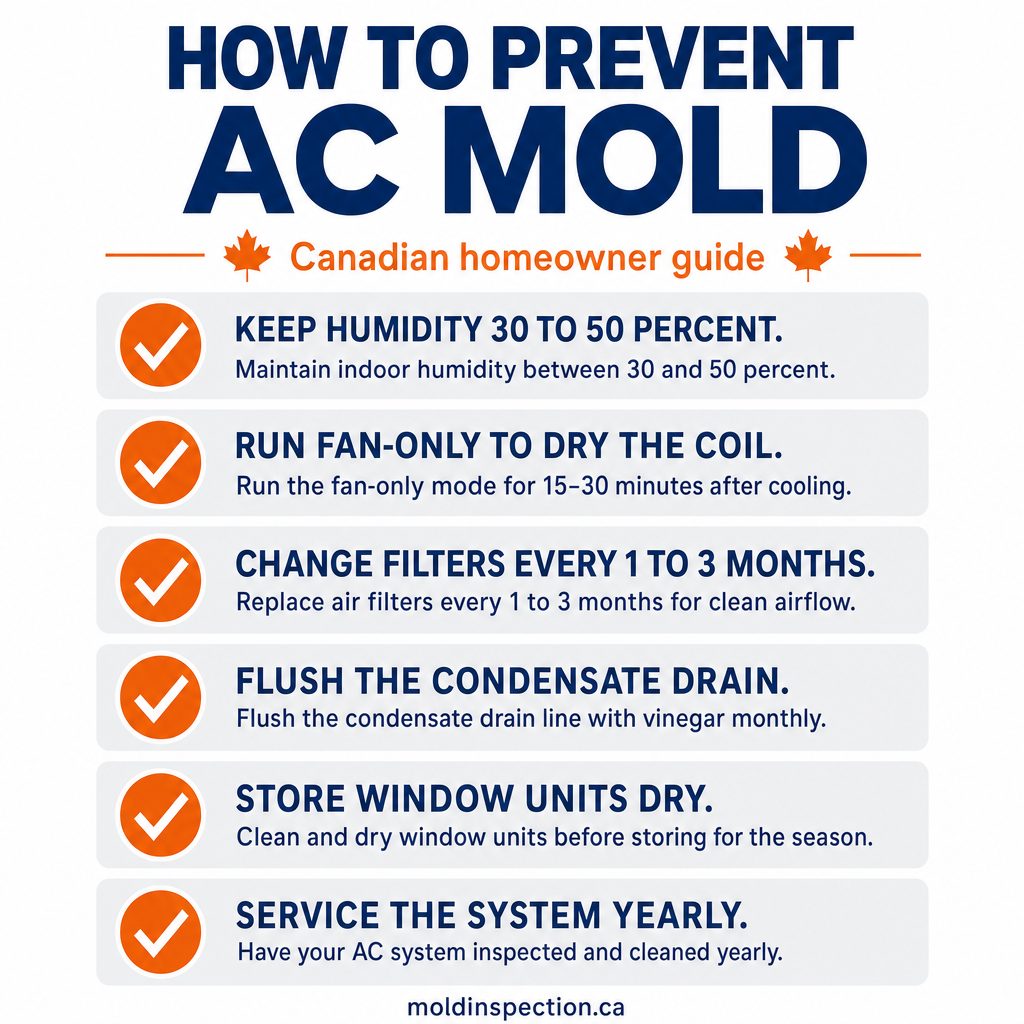
Keep humidity 30 to 50%
Health Canada recommends indoor relative humidity between 30 and 50%. A $20 hygrometer tells you where you stand. In a damp Canadian summer, a dehumidifier alongside the AC keeps the whole system drier and the coil less prone to mold.
Run fan-only to dry the coil
Before shutting the cooling off for the day, run the fan on its own for 15 to 30 minutes. It dries the coil and the drip pan so they are not sitting wet for hours. Many thermostats and units can do this automatically.
Change filters every one to three months
A clean filter keeps dust off the coil — and dust is the food mold needs. Check monthly during cooling season and replace whenever it looks grey or smells. It is the single most effective five-dollar habit.
Flush the condensate drain
Pour distilled vinegar through the central-AC condensate drain access twice a season to stop the slime that blocks it. A draining pan is a dry pan, and a dry pan does not grow mold.
Store window units dry
At the end of summer, clean the unit, dry it fully, and store it somewhere ventilated — not sealed in a damp closet or basement corner. A unit put away wet is a unit that grows mold all winter.
Service the system yearly
An annual HVAC tune-up includes a coil and drain check that catches moisture problems before they become mold. For homes with mini-splits, ask specifically about a blower-wheel inspection — it is the part most likely to hide growth.
A dehumidifier is part of the prevention picture, and dehumidifiers grow their own mold if neglected — we cover that separately. For tracing a musty smell that is not coming from the AC, see diagnosing a musty smell in the house, and for damp-prone areas below grade, basement moisture and humidity control.
Mold in Air Conditioner FAQ
Can I run my air conditioner if it has mold in it?
No. US EPA advises turning off a mold-contaminated HVAC system and not using it until it has been cleaned, because running it can spread mold spores throughout the building. A window unit with mold should be unplugged; central air should be switched off until the coil, pan and any affected ducts are dealt with.
Can mold in an AC make you sick?
It can, especially for people with asthma, allergies or a weakened immune system, and for children and older adults. US CDC notes mold can irritate the eyes, nose, throat and lungs even in non-allergic people. Because an AC blows the spores directly into the air you breathe, a moldy unit affects you more than the same amount of mold sitting still elsewhere.
What does mold in an air conditioner smell like?
Damp, earthy, musty — often described as a wet-sock or basement smell — and it appears within seconds of the cooling starting. The smell coming on with the AC and fading when it stops is the clearest sign the source is inside the system rather than elsewhere in the room.
How do I know if my AC has mold?
Watch for a musty smell when it runs, visible black or green specks around the vents or on a window unit’s grille, allergy-type symptoms that track with the cooling, weak airflow, water pooling around the unit, or a slimy film at the supply registers. Two or more of these together is the point to shut the system off and inspect.
How do I clean mold out of a window air conditioner?
Unplug it, wear an N95 mask and gloves, and take off the grille and filter. Wash the filter, coil fins, grille and base tray with warm soapy water or a coil-safe cleaner — not bleach. Make sure the drain holes are clear, dry every part completely, reassemble, and run the unit on fan-only for half an hour. If the musty smell comes back, the source is deeper and you need a professional.
Should I use bleach or vinegar to clean AC mold?
Neither is the first choice. Health Canada advises against using bleach to clean up mold; soap and water on hard surfaces is the recommended approach. Distilled vinegar is useful specifically for clearing the condensate drain line, but for cleaning coils and trays, a coil-safe cleaner or plain soapy water is what you want.
Will mold in my AC spread through the whole house?
With central air, yes — the blower that mold grows near is the same blower that pushes air to every room, so coil and duct mold can distribute spores house-wide. That is exactly why US EPA says to turn a contaminated system off until it is remediated. A window unit affects mainly the room it is in.
Is my window AC part of the Health Canada recall?
Possibly, if it is a Midea-made U or U+ window unit sold under the Midea, Danby, Frigidaire, Insignia or Perfect Aire brand in 8,000, 10,000 or 12,000 BTU, bought between March 2020 and May 2025. About 45,900 of these were sold in Canada and recalled because pooled water can fail to drain and grow mold. Stop using a recalled unit and contact Midea for a free repair or refund.