
Found Mold in Your Apartment? Get Expert Help Fast

If you have just found mould in your apartment, three things are true: your health is at risk, your landlord is almost certainly legally responsible, and the way you handle the next 48 hours decides whether this gets fixed in two weeks or two years.
What to Do in the First 24 Hours
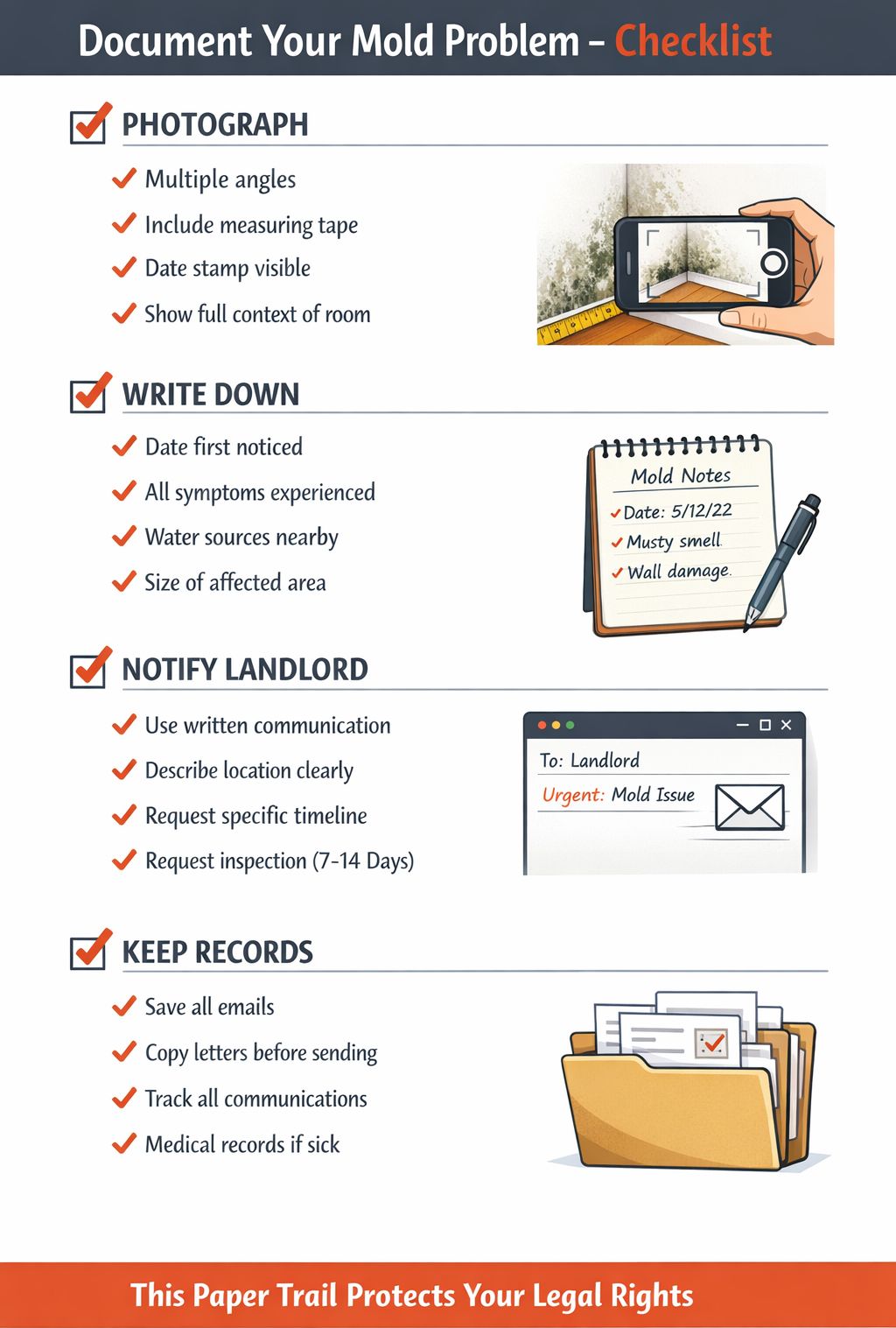
Before you read about your legal rights, get the basics done. The next page makes it visual: discover, document, notify, protect, follow up.
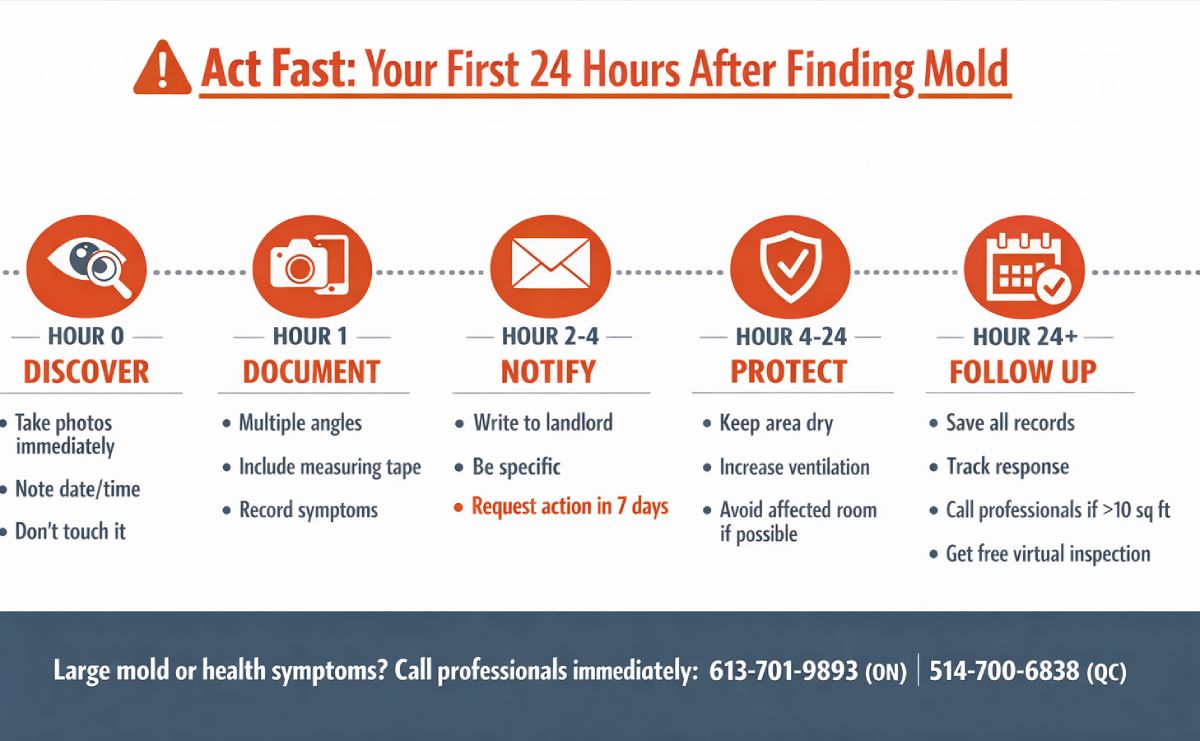
One nuance to add: when you write to your landlord, email or text — never just a phone call. A timestamp is what starts the clock. And do not strip the metadata when you transfer photos; the date and time embedded in the file is part of your evidence. If anyone in the unit has asthma, allergies, or weakened immunity, also ask in writing for alternate accommodation during remediation.
Why Apartments Get Mould More Than Houses
Apartment mould is not just house mould in a smaller space. The building itself is part of the problem.
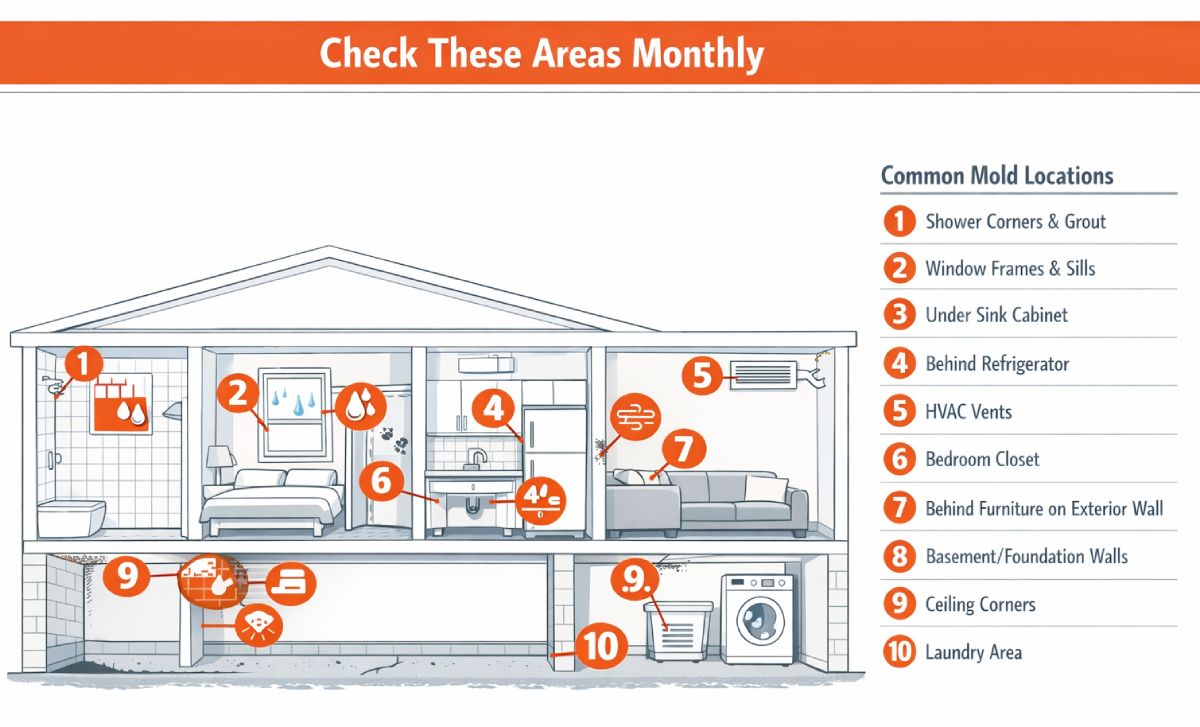
Shared HVAC and stacks
Moisture from a neighbour’s shower or under-vented dryer can travel through a shared stack and condense in your unit. CMHC’s Moisture and Air guide notes the source may not even be in the same unit.
Mid-century concrete
Apartments built between 1950 and 1980 are over-represented in mould complaints. Concrete and masonry walls run colder than wood-frame, so condensation forms on the inside face during winter.
Limited ventilation control
You usually cannot adjust the bathroom fan or the make-up air supply. Health Canada recommends keeping indoor humidity between 30 and 50 percent — controls that often sit with the building, not the tenant.
Stacked plumbing
A slow leak in the unit above can saturate your ceiling drywall for weeks before anyone sees a stain. By the time you smell it, the mould is established in the cavity.
Sealed buildings
Energy-retrofit apartments are tighter than what they replaced. If ventilation was not upgraded alongside the windows, moisture has nowhere to go — the first sign is condensation on the inside of the window in January.
Normal use adds up
CMHC measures normal indoor moisture generation at 10 to 50 litres per day per household. Over a 200-day heating season, that is 2,000 to 10,000 litres of moisture the building has to handle.
Sources cited by name: CMHC, Moisture and Air: A Guide for Understanding and Fixing Interior Moisture Problems in Housing; Health Canada, residential indoor air quality guidance on moulds.
Your Rights as a Tenant in Ontario
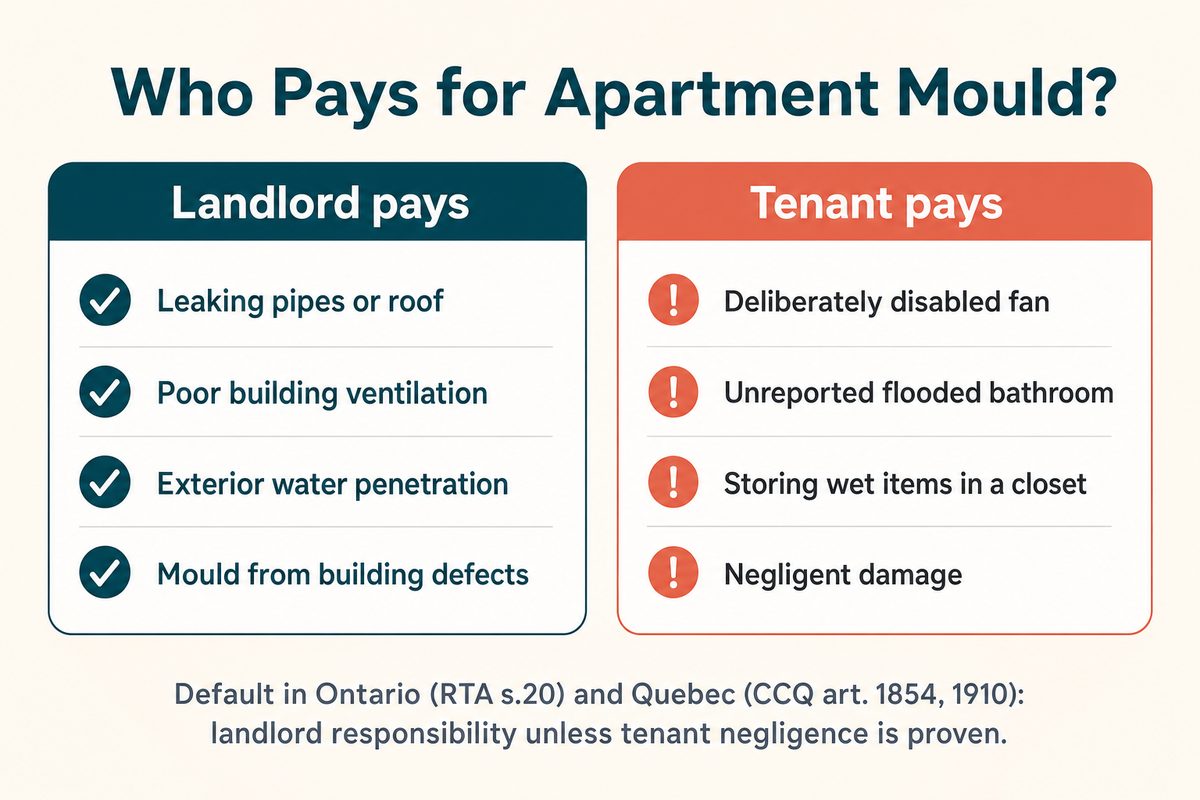
If you rent in Ontario, the law on your side is the Residential Tenancies Act, 2006. Two sections matter for mould.
“Fit for habitation” is decided case-by-case by the Landlord and Tenant Board. In practice, visible mould caused by a building defect — leaking roof, plumbing failure, poor ventilation, exterior water — is treated as a breach of section 20.
The remedy most tenants want is a repair order plus rent abatement for the period the unit was below standard. The Board has wide discretion under paragraph 9 to “make any other order that it considers appropriate.”
Public health is a parallel route, not a substitute
Your municipal property-standards office and local public-health unit can also inspect and issue an order under provincial health-protection law. This route is free and sometimes faster, but it does not award you compensation. Most tenants use both: public health for an inspection report and order, LTB for the rent abatement.
How to File a T6 Application with the Landlord and Tenant Board (Ontario)
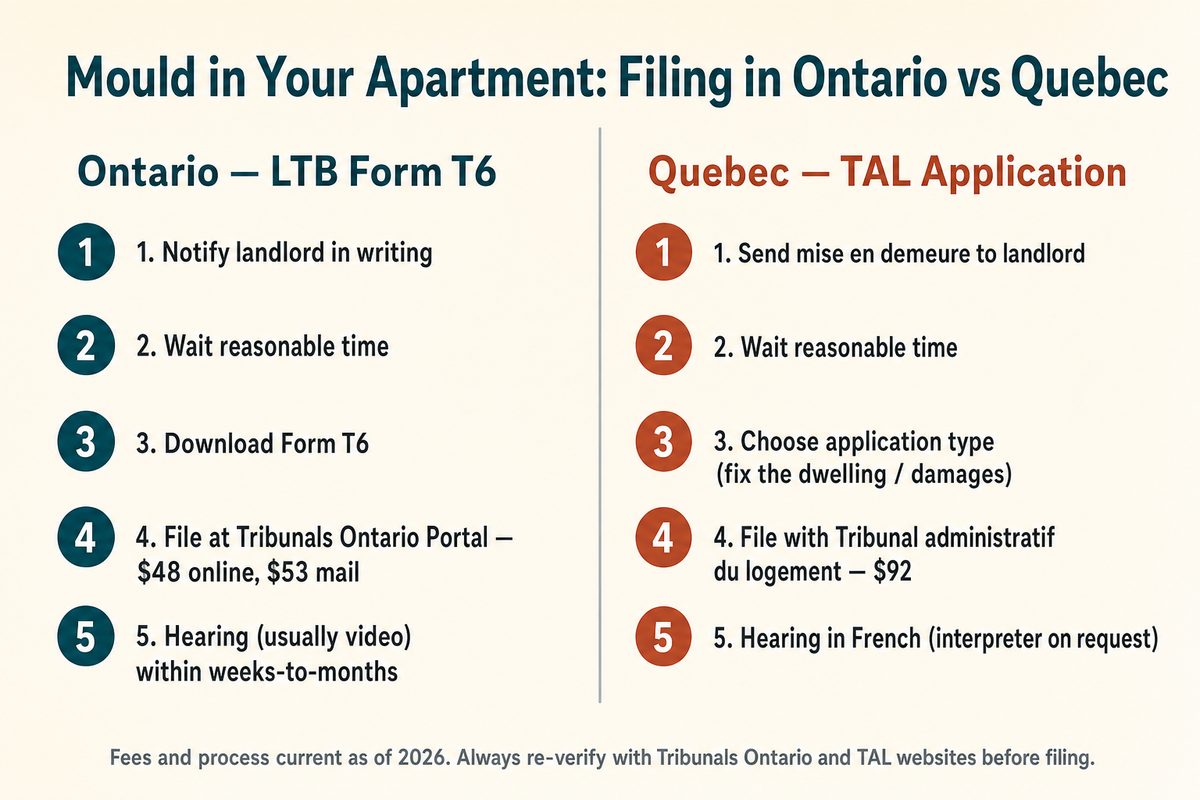
If your landlord has had reasonable notice — typically two weeks for non-urgent mould, less for active water damage — and has not acted, your formal remedy is Form T6.
Download Form T6
Form T6: Tenant Application about Maintenance, from the Tribunals Ontario website. Describe the maintenance problem, what you have asked the landlord to do, and the remedy you want.
Pay the filing fee
$48 through the Tribunals Ontario Portal online, $53 by mail, in person, or at a ServiceOntario centre. Fee waivers are available for tenants who qualify on income.
Attach your evidence
Dated photos, written notices, landlord responses, symptom log, any public-health report, contractor quotes. Quality of evidence is the single biggest factor in T6 outcomes.
Wait for the hearing notice
The Board sets the date and serves your landlord. Hearings are usually by video; in-person is available with longer waits.
Attend the hearing
Most T6 hearings run under two hours. You walk through your evidence, the landlord responds, the adjudicator rules on the day or reserves judgment.
You do not need a lawyer. Free help is available through community legal clinics, and Steps to Justice publishes plain-language T6 guides.
Your Rights as a Tenant in Quebec
If you rent in Quebec, your protections sit in the Civil Code of Québec, and your forum is the Tribunal administratif du logement (TAL) — the same tribunal formerly known as the Régie du logement.
The second sentence of article 1910 is important. Even if your lease says you accepted the dwelling “in good habitable condition,” that clause is void if the dwelling is not actually habitable. A landlord cannot contract out of the obligation.
Article 1913 is the article that gives a Quebec tenant the right to refuse to move in, abandon the dwelling, or have the lease resiliated when mould reaches the level of a “serious danger to health.” A health inspector’s report from the municipal public-health authority is the most common “competent authority” declaration.
How to File an Application with the TAL (Quebec)
The TAL is Quebec’s single specialized housing tribunal. It has exclusive jurisdiction over residential-lease disputes — you do not file at small claims for a mould problem in your apartment.
Choose the right application type
For mould, you usually file an “Application to fix the dwelling” or a damages claim. Both fall in the $92 category under the schedule in force from April 1, 2026.
Pay the fee
$92 CAD for a standard dwelling-condition or damages application. Tenants on last-resort financial assistance are exempt.
Serve the landlord and assemble evidence
Dated photos, your written notice (mise en demeure), any health-inspector report, medical notes if available, your written log.
Wait for the hearing
TAL hearings are conducted in French by default; an interpreter is available on request. Most hearings are now by videoconference.
Attend the hearing
You present, the landlord responds, the adjudicator rules from the bench or reserves judgment.
If the mould meets the article 1913 “serious danger to health or safety” standard, an urgent application can be filed and a hearing scheduled within days rather than months.
When Mould Makes Your Unit Uninhabitable
“Uninhabitable” is the legal threshold that unlocks the strongest remedies: rent suspension, lease termination, and in Quebec the right to walk away under article 1913. There is no single national rule for what counts. Both Ontario and Quebec adjudicators use a similar test in practice — how bad is the mould, what is the health risk, and is there a competent-authority report.
Liveable, but breaching the standard
Visible mould patches under one square metre, no active water source, no household members with respiratory conditions. Health Canada classifies this as “small” (one to three patches each under one square metre). Tenant remedy is repair plus rent abatement for the period the unit was below standard.
Serious — partial loss of use
Mould affects an entire room, or a bedroom is no longer safe to sleep in, or visible patches between one and three square metres total. Health Canada classifies this as “medium.” Tenant remedy: ordered repair, alternate accommodation if remediation requires vacating, rent abatement that reflects the lost room.
Uninhabitable — full loss of use
Mould larger than three square metres total, structural mould inside walls, mould plus active water damage, or any case where a public-health inspector has issued an order. Health Canada classifies this as “extensive.” In Ontario, this is grounds for lease termination under section 30(1) paragraph 1. In Quebec, article 1913 applies and the tenant can resiliate the lease.
Source cited by name: Health Canada residential indoor air quality guidance on moulds, classification of small / medium / extensive mould.
Template Letter: Notifying Your Landlord About Mould
This is the written notice that starts the clock. Copy the block below, paste it into an email to your landlord, fill in the bracketed fields, and keep a copy of what you sent. Send by email if at all possible, so you have a verifiable timestamp. If your lease lists a designated address for notices, also send a copy by registered mail.
How to Get Your Apartment Professionally Inspected
A professional inspection report is the strongest single piece of evidence you can bring to the LTB or TAL. It also tells you the truth about what is behind the drywall before you start arguing with the landlord.
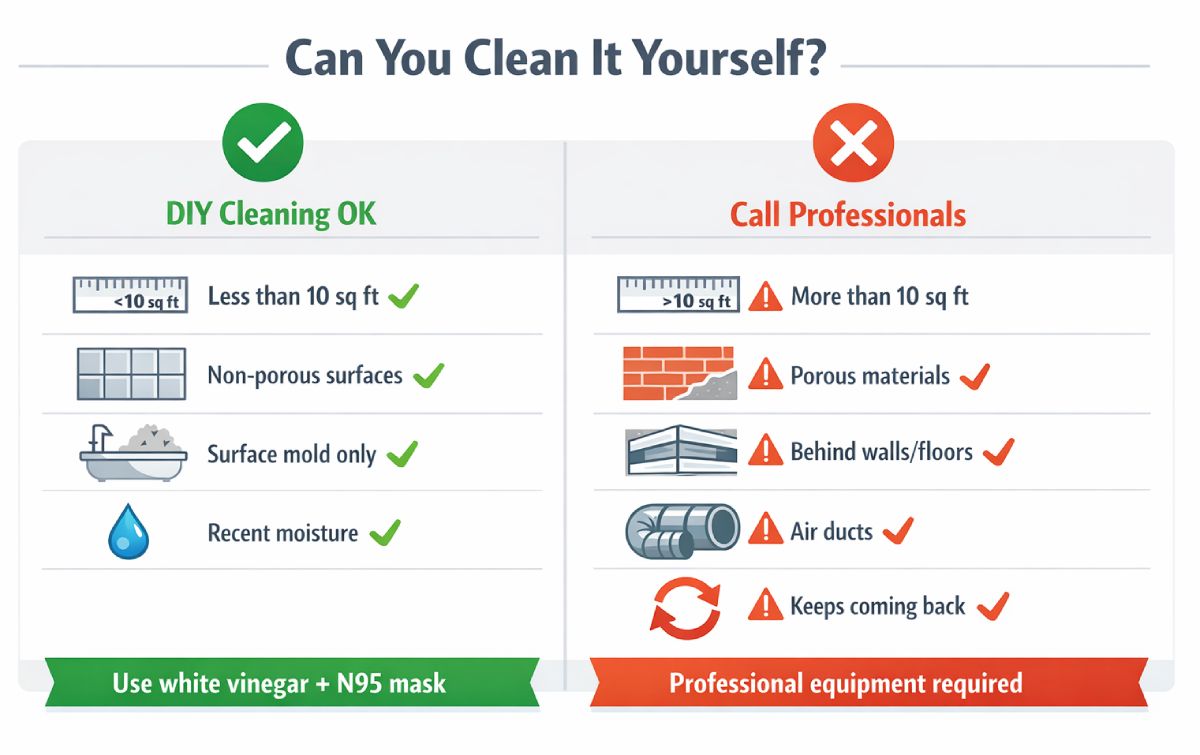
DIY inspection
- Free.
- Good for documenting visible mould and obvious moisture sources.
- Cannot quantify what is inside walls, cavities, or HVAC ducts.
- Surface “mould test kits” sold in hardware stores are not accepted as evidence by the LTB or TAL because they do not identify exposure or species reliably.
- Phone photos with date metadata are the most useful DIY artefact.
Professional inspection
- $200 to $700 in most Canadian markets for a residential apartment.
- Includes a visual inspection, moisture-meter readings of suspect surfaces, and usually thermal imaging of exterior walls.
- Air and surface samples sent to an accredited lab if growth is suspected behind finishes.
- Written report with photos, lab results, and recommended scope of remediation.
- Accepted as expert evidence at the LTB and the TAL.
Mold Inspection Canada offers a free virtual mould inspection — a video call with one of our inspectors before any paid visit. We also do paid on-site inspections across Ontario and Quebec, including Ottawa, Montreal, Gatineau, and Kingston.
Health Symptoms That Mean You Should Act Now
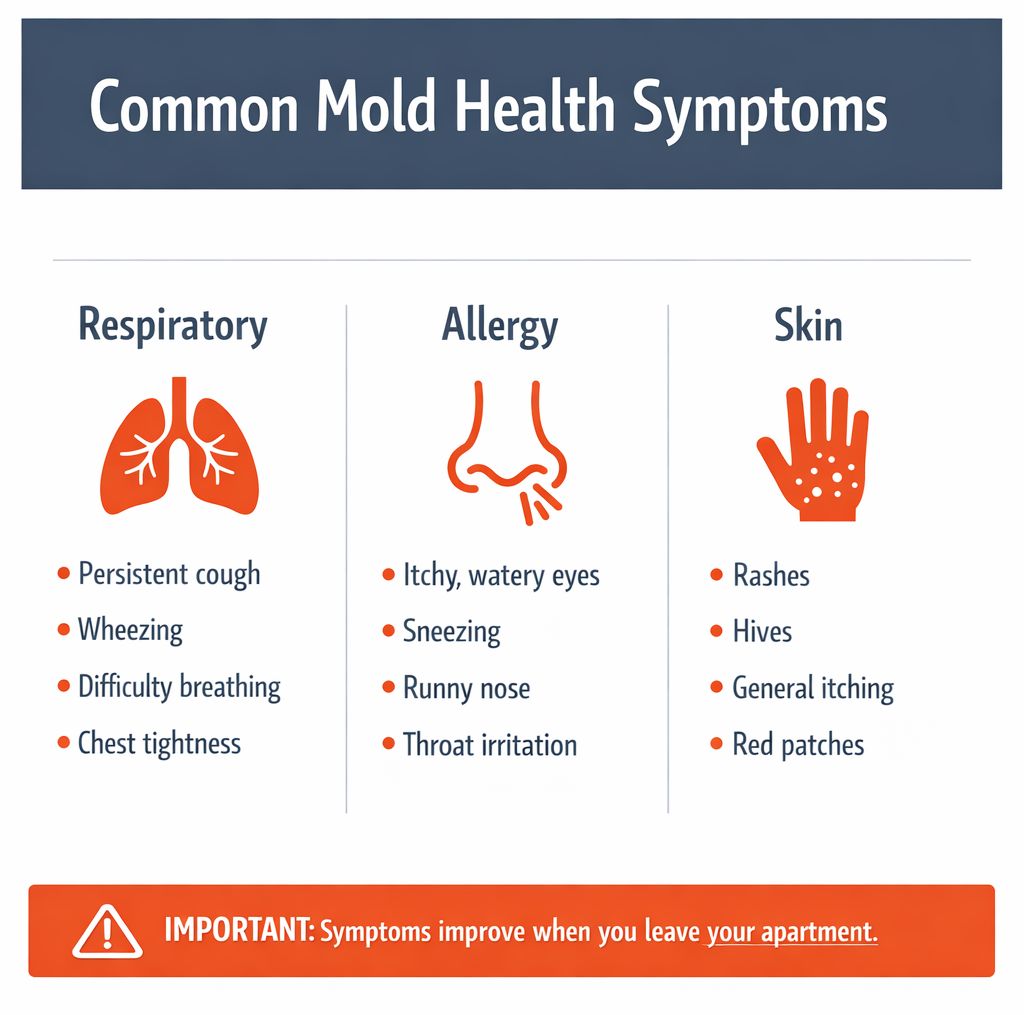
Health Canada’s position is that any visible mould should be cleaned regardless of species, because there is no safe exposure level and individual sensitivity varies. The symptoms that move a mould problem from “deal with it next month” to “file today” are a persistent cough or wheeze that improves when you leave the apartment, new or worsening asthma, recurring sinus infections, eye and throat irritation, rashes that clear up elsewhere, and fatigue or headaches that track with how much time you spend in the unit.
For the symptom-by-symptom picture, see symptoms of mould exposure, health effects of black mould, and mould allergies and symptoms.
What Tenants Often Get Wrong About Apartment Mould
Frequently Asked Questions
Is my landlord legally responsible for mould in my apartment?
Almost always yes. In Ontario, section 20 of the Residential Tenancies Act, 2006 requires the landlord to maintain the unit in a good state of repair and fit for habitation. In Quebec, articles 1854 and 1910 of the Civil Code of Québec impose an obligation to deliver and maintain a habitable dwelling. The only common exception is mould caused by the tenant’s own negligence — for example, deliberately disabling a ventilation system.
How long does my landlord have to fix mould in Ontario?
There is no statutory deadline. The Landlord and Tenant Board applies a “reasonable time” test that depends on severity. Active water damage is treated as 24 to 48 hours. Visible mould without active water is usually one to two weeks for inspection and a remediation plan, with the work itself depending on scope. If your landlord has gone past these benchmarks without a written response, that delay strengthens your T6 application.
Can I withhold rent if my landlord won’t remove the mould?
You should not. Withholding rent without a tribunal order can lead to an eviction application for arrears. The correct remedy is to file Form T6 with the Landlord and Tenant Board (Ontario) or an application with the Tribunal administratif du logement (Quebec) and ask for a rent abatement as part of the order. The tribunal can retroactively reduce your rent for the period the unit was below standard.
What is an LTB T6 form and how much does it cost?
Form T6 is the Ontario tenant application about maintenance — the form you file when your landlord has not maintained the unit in a good state of repair. The filing fee is $48 if you file through the Tribunals Ontario Portal online, or $53 if you file by mail, in person, or at a ServiceOntario centre. Fee waivers are available for tenants who qualify on income.
How do I file a mould complaint with the TAL in Quebec?
You file an application with the Tribunal administratif du logement, either online, by mail, or at a TAL office. For a standard dwelling-condition application or damages claim, the fee is $92 CAD under the schedule in force from April 1, 2026. Tenants on last-resort financial assistance are exempt from paying. The TAL has exclusive jurisdiction over residential-lease disputes in Quebec; you do not file at small claims.
When can I break my lease because of mould?
In Ontario, you can apply to the LTB to terminate the tenancy under section 30(1) paragraph 1 if the breach is serious enough — typically when the unit is uninhabitable and the landlord will not remediate. In Quebec, article 1913 of the Civil Code lets a tenant resiliate the lease if the dwelling is “unfit for habitation” — that is, in such a condition as to be a serious danger to health or safety, or declared so by a competent authority. Get a public-health inspector’s report or a professional mould assessment before you walk away from the lease.
Who pays for mould removal — landlord or tenant?
The landlord pays in almost every case. The legal default in both provinces is that the landlord is responsible for the condition of the dwelling. A tenant only pays if the tenant’s own negligent or deliberate act caused the mould — for example, leaving a flooded bathroom unreported for weeks, or removing the building’s ventilation. Normal living (cooking, showering, breathing) is not negligence.
What documentation do I need before filing against my landlord?
At minimum: dated photos of the mould and any moisture source, your written notice to the landlord and any responses, a written log of when symptoms started and changed, and if at all possible a report from a professional mould inspector or your municipal public-health unit. The single biggest predictor of success at the LTB or TAL is the quality of the tenant’s evidence file.
Need a Professional Mould Inspection?
Mold Inspection Canada inspects apartments across Ontario and Quebec. Free virtual consultation, accredited lab work, and reports that meet the evidence standard for the LTB and the TAL.