
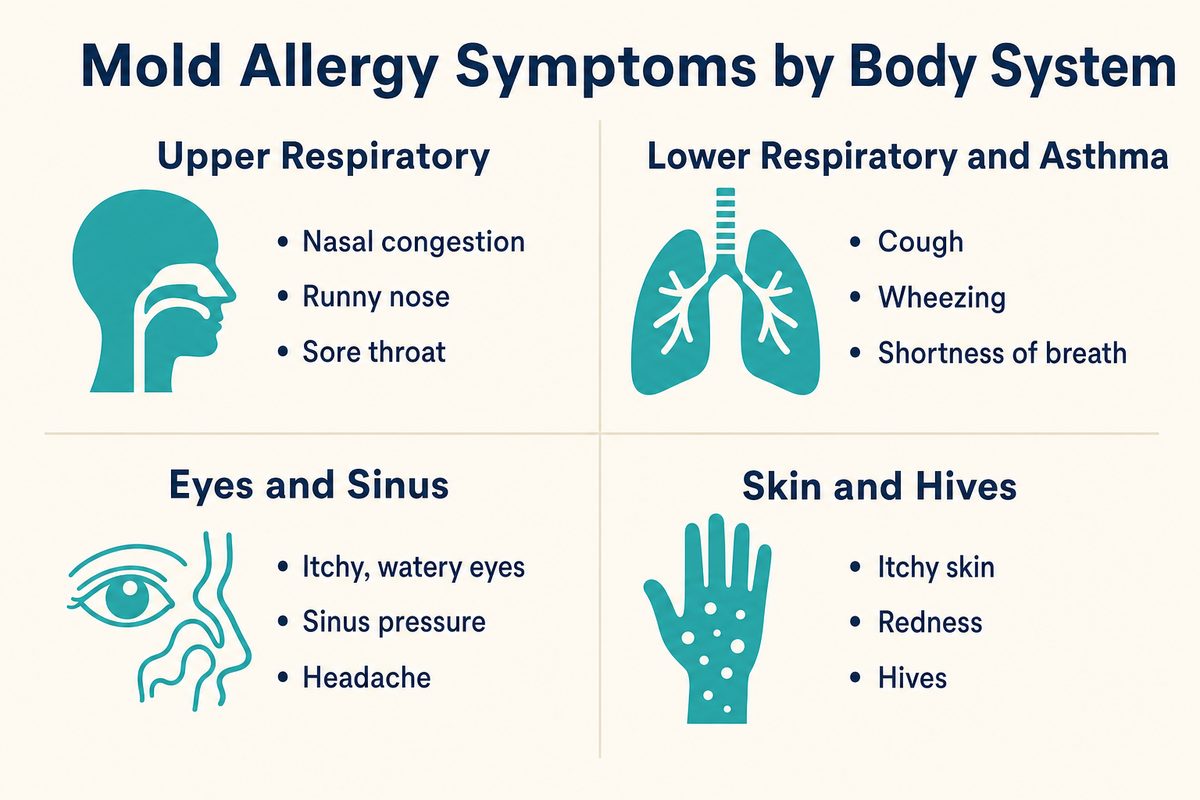
Upper respiratory
- Sneezing fits
- Runny or stuffed nose
- Postnasal drip, sore throat
- Itchy nose or ear canal
Mold allergy symptoms run the full spectrum from sneezing and itchy eyes to skin rashes, hives, and sinus headaches. In Canada they peak twice a year: snow mould in early spring, and damp basements through the winter. This guide covers the full pattern, how mold allergy is diagnosed, treatment, and the point at which medication is not enough and you need an inspector instead of another prescription.
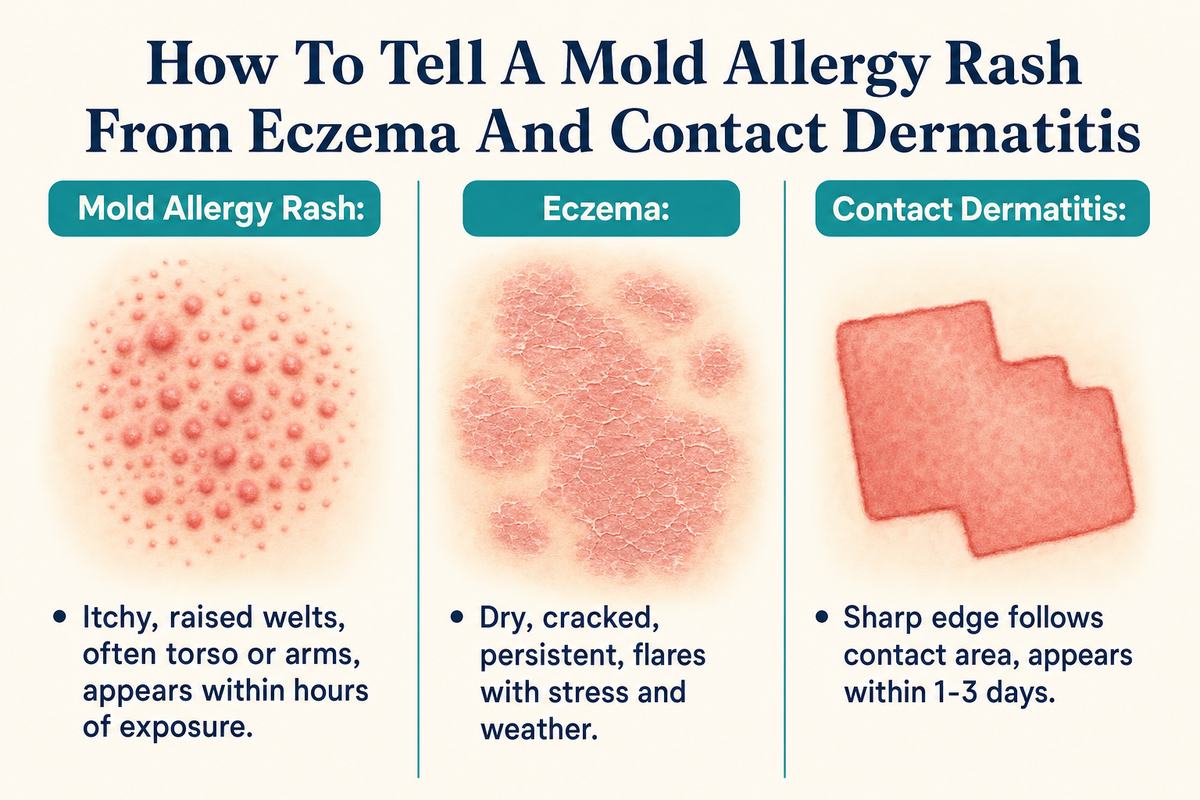
A mold allergy rash is itchy, red, raised, often patchy. It tends to appear on the torso, arms, neck, or face, within hours of exposure. It does not have the sharp border of contact dermatitis or the dry chronic pattern of eczema.
| Feature | Mold allergy rash | Eczema | Contact dermatitis |
|---|---|---|---|
| Texture | Itchy red welts, raised | Dry, cracked, scaly | Red, sharp-edged |
| Location | Anywhere airborne spores reach | Hands, elbows, knees | Only where skin touched trigger |
| Onset | Hours | Chronic | 1-3 days |
| Pattern | Better when away from home | Lifelong | Clears when trigger removed |
| First step | Allergy workup + mould check | Dermatologist | Identify trigger |
Localized itchy rash that improves when you’re away from suspected mould source. Antihistamine, cool compress, bland moisturiser.
Rash spreads, flares despite antihistamine, persistent hives, sleep disrupted by itch, or rash recurs every time you’re at home.
Swelling of lips/tongue/throat, trouble breathing, rapidly spreading hives, fever above 38.5 with rash, or blistering and infection.
Yes, mould can cause headaches. The mechanism for mould allergy is sinus headache from allergic rhinosinusitis: allergens swell the sinus lining, drainage shuts, pressure builds, the dull “forehead and cheekbone” ache appears.
| Feature | Mold sinus headache | Migraine | Tension headache |
|---|---|---|---|
| Location | Forehead, behind eyes, cheekbones | One-sided | Band around head |
| Quality | Dull, heavy, pressure | Throbbing | Tight, squeezing |
| Other symptoms | Stuffy nose, postnasal drip, itchy eyes | Nausea, light sensitivity | Neck and shoulder tightness |
| Pattern | Worse at home, better away | Hormones, sleep, food, stress | Stress, posture, screen time |
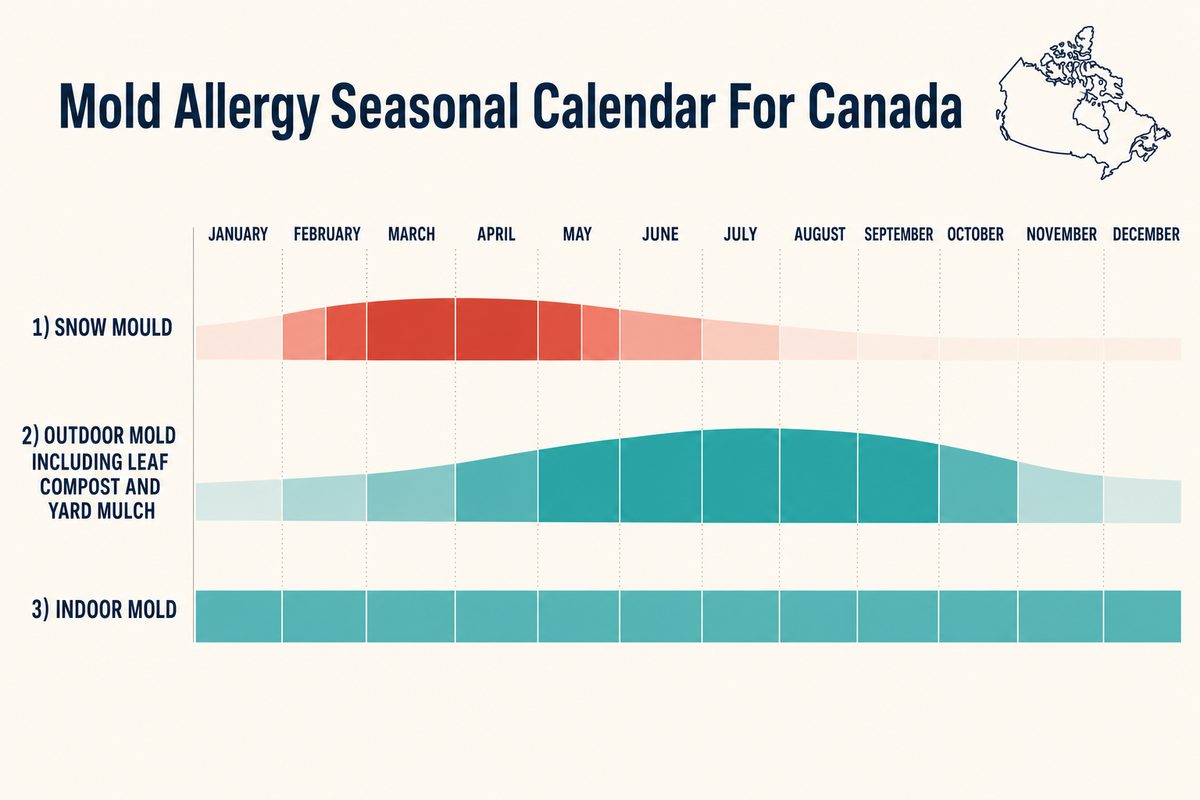
Snow mould is a uniquely Canadian outdoor allergen. Two species grow under the snow through winter; when the snow melts, they release billions of spores. People who are allergic spike weeks before pollen even starts.
Microdochium nivale. Pink-tinged matted patches on lawns and golf courses after snowmelt.
Typhula species. Greyish-white circular patches, common in colder regions with long snow cover.
CBC News has covered the snow mould phenomenon multiple times. The pattern is consistent: Canadians blame pollen for symptoms that actually start with the matted fungus the melting snow just uncovered.
These three terms get used interchangeably online. They mean different things and have different evidence bases.
The asthma, eczema, and hay fever triad. If you or family have any of these, mould allergy is meaningfully more likely.
Developing immune systems are more susceptible to mould sensitisation. Damp basements and bathrooms are common sources.
Cold concrete walls and the spring freshet make Canadian basements the highest-risk indoor environment. See Basement Mold.
Chemotherapy, immunosuppressants, HIV, transplant recipients face higher risk of allergy and fungal infection.
Atopy runs in families. A parent or sibling with confirmed mould allergy, asthma, or hay fever raises lifetime risk.
Mould is one of the most common indoor asthma triggers in Canada. Sudden control loss in a specific room is a flag.
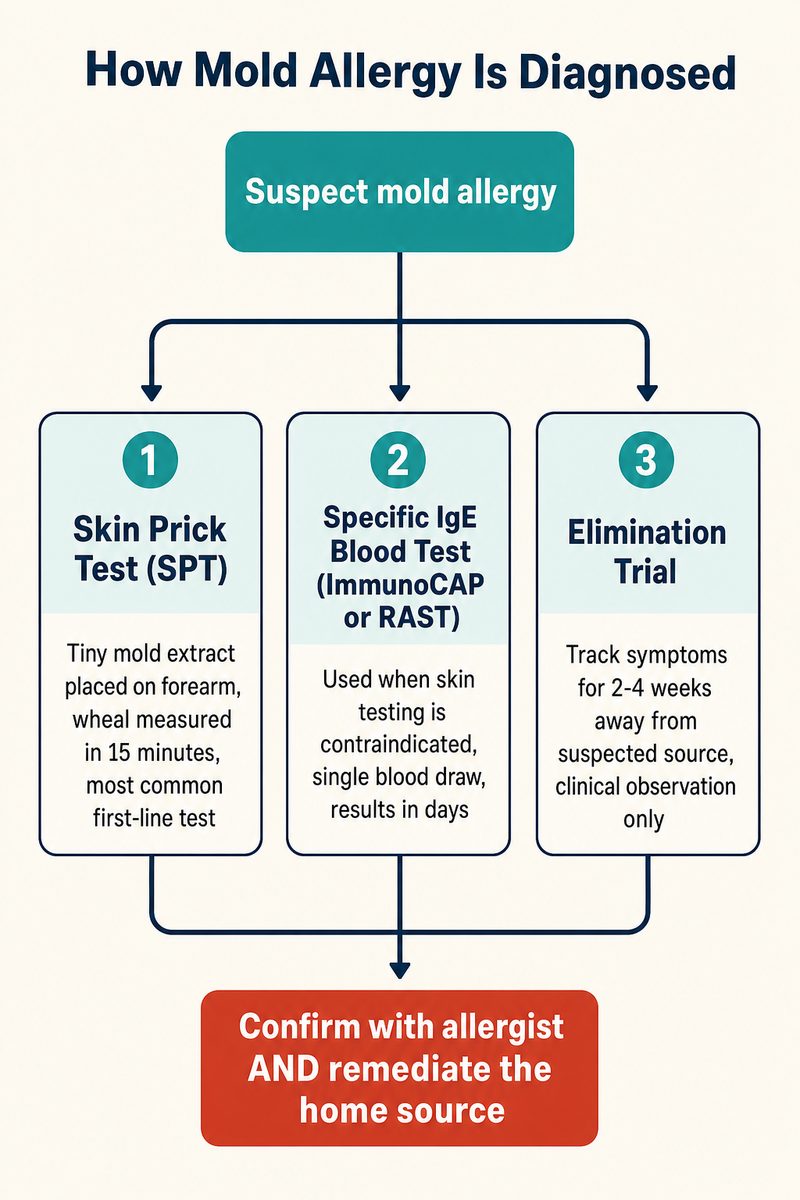
Mould extract placed on forearm, skin pricked through it. Wheal measured at 15 minutes. Quick, inexpensive, first-line. Stop antihistamines 5-7 days beforehand.
ImmunoCAP or RAST. Single blood draw measures antibodies to common moulds (Alternaria, Cladosporium, Aspergillus, Penicillium). Used when skin testing is contraindicated.
Spend 2-4 weeks away from suspected environment, track symptoms daily. Clear improvement followed by relapse on return is strong evidence of an environmental trigger.
Testing ordered by an allergist or family doctor is covered by provincial health insurance in Ontario and Quebec. Out-of-pocket private clinics offer faster access at a few hundred dollars per panel. For remediation cost if a source is confirmed, see our mold remediation cost guide.
Second-generation (cetirizine, loratadine, fexofenadine) block the histamine receptor downstream of the IgE reaction. Daily use through allergy season.
Fluticasone, mometasone, budesonide. Most effective single class for moderate-to-severe rhinosinusitis. Takes days to reach full effect.
SCIT shots or SLIT tablets. Gradually retrain immune tolerance over 3-5 years. The only treatment that changes the underlying allergy.
Oral antihistamines plus topical corticosteroids manage acute flares. Cool compresses and fragrance-free moisturisers between flares.
Daily Neti pot or squeeze bottle physically clears spores from nasal passages. Cheap, well-tolerated. Use distilled or sterile water only.
The piece most clinic articles skip. Antihistamines treat the body; they don’t remove the spore source. Mold removal services.
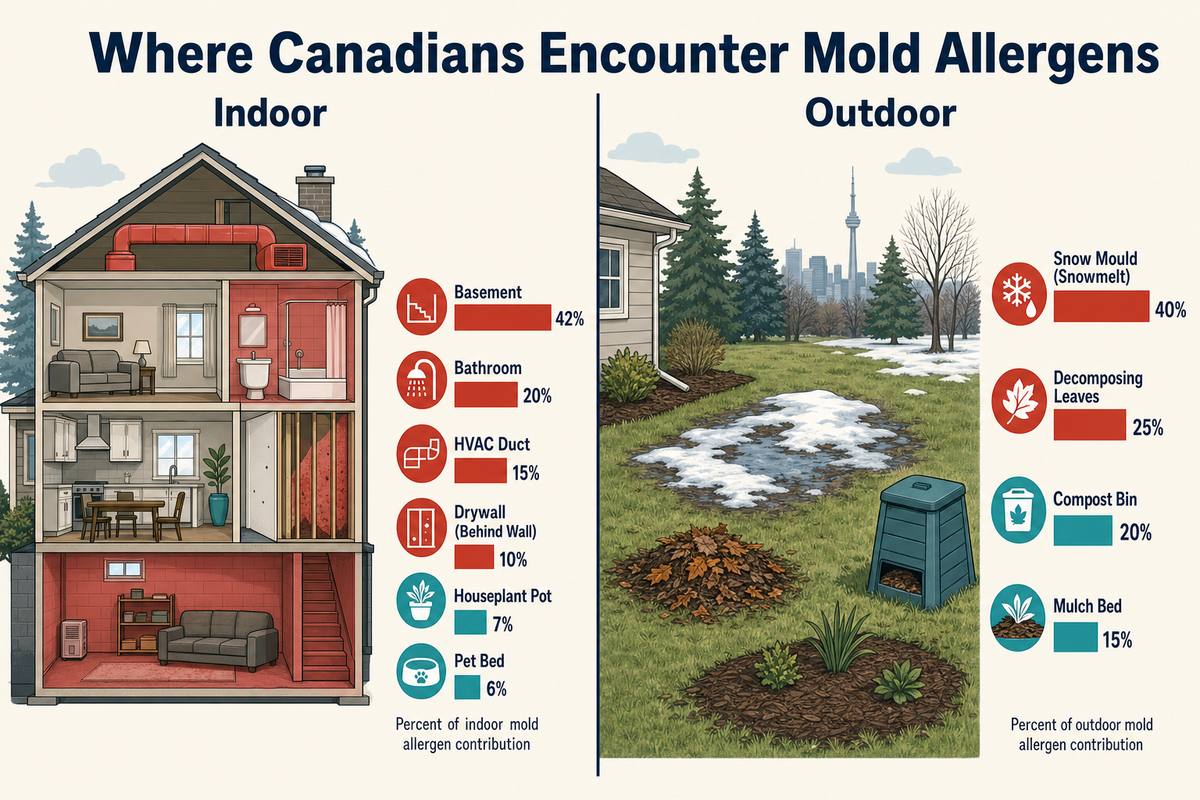
Biggest indoor source. Cold concrete, foundation cracks, spring freshet. Full guide.
Daily condensation, grout and caulking, ceiling corners. Full guide.
Damp coils, drip pans, dust-coated duct interiors. The system redistributes spores throughout the house.
Paper facing is pure cellulose, mould’s favourite substrate. Colonisation starts within 48 hours of moisture. Full guide.
Reservoirs collect organic dust. Humidifier tanks accumulate biofilm. Weekly cleaning required.
Houseplants, pet bedding, basement upholstery. Anything fabric that doesn’t dry fully between uses.
Snow mould peak. Late February through early May. The largest outdoor spike of the year.
Grass mowing aerosolises pollen and spores. Compost bins release high concentrations on hot humid days.
Leaf mould. September through November. Wet decomposing leaf piles generate dense spore clouds when raked.
Forest-floor mould under packed snow. Allergic hikers and skiers can be exposed during late-winter warm spells.
Bedroom first. Match CADR to room volume. Replace filters on schedule.
Tightly-woven mattress and pillow covers block spores and dust mites. Single most evidence-based bedroom intervention.
Physically clears spores from nasal passages during peak seasons. Use distilled or sterile water only.
No dry dusting (it aerosolises spores). HEPA-filtered vacuum. Damp-mop hard floors weekly during peaks.
Health Canada’s recommended range starves most household mould. A basement hygrometer is the cheapest diagnostic tool you can buy.
Raking and mowing during snow mould and leaf mould peaks deposits spores on skin, hair, clothing. Quick shower and clothes change keeps them out of upholstery.
Yes. The most common mould-related headache is a sinus headache driven by allergic rhinosinusitis: inflamed sinus linings produce pressure and pain across the forehead, behind the eyes, and across the cheekbones. The pattern is often worse at home and better when away.
Yes. Mould allergy can produce both itchy red rashes and hives. Both are IgE-mediated reactions. A rash pattern that flares at home and clears when you travel deserves an allergy workup plus a mould inspection.
Itchy, red, raised, often patchy, on torso, arms, neck, or face. Appears within hours of exposure. Does not have the sharp border of contact dermatitis or the dry chronic pattern of eczema.
No. Mould allergy depends on individual immune sensitisation, influenced by genetics, exposure history, and other atopic conditions. Many people live in mould-prone homes without symptoms. However, no one benefits from breathing high spore concentrations indoors.
An IgE reaction to spores from Microdochium nivale and Typhula species, two fungi that grow under the snow on Canadian lawns through winter. When the snow melts in late February through early May, they release huge quantities of spores. Symptoms mirror pollen allergy but arrive weeks before grass or tree pollen season.
Mild symptoms settle within hours to a day of leaving the environment. Skin rashes and hives can take 24-72 hours to clear. Severe asthma flares or continuous home exposure may take days to weeks of medication plus source remediation to resolve fully.
Mould allergy and mould toxicity are distinct conditions with different evidence bases. Allergy is a well-defined IgE-mediated reaction. Toxicity is a broader umbrella term with more contested medical support. See our Health Risks of Mold Exposure guide for the full disambiguation.
An allergist confirms mould allergy with a skin-prick test, a specific IgE blood test (ImmunoCAP or RAST), or a structured elimination trial. Most testing is covered by provincial health insurance.
Medication treats your body. It doesn’t remove the spore source in your home. If your mould allergy keeps flaring despite a full prescription regimen, the missing step is environmental. Mold Inspection Canada serves Montreal, Ottawa, Gatineau, Kingston, Cornwall, Belleville, and Brockville.