
Mold in Your Dehumidifier: Why It Happens and How to Clean It Safely
A dehumidifier is supposed to fight mold, not grow it. A musty smell every time it runs, or dark spotting inside the tank, means the machine has become part of the problem. Here is why it happens, how to clean it the right way, and when the real issue is the room.
Why Does Mold Grow in a Dehumidifier?
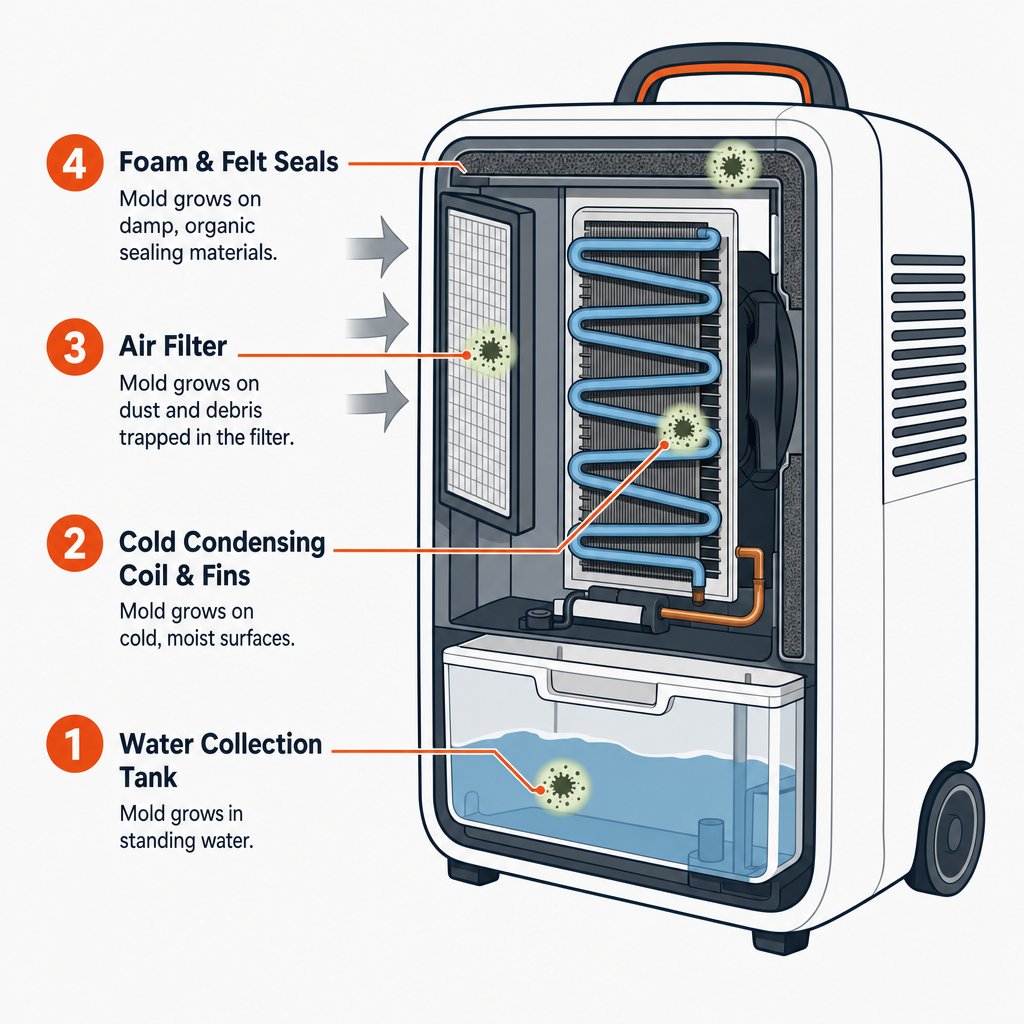
Mold grows in a dehumidifier because the unit creates the exact conditions mold needs: standing water, darkness, dust to feed on, and steady warmth. Every dehumidifier works by pulling damp air across a cold coil. Water condenses on that coil, drips into a tank or runs out a hose, and the now-drier air blows back into the room. That cold coil and that collection tank stay wet by design.
Now add what floats in the air of a basement or laundry room. Dust, skin cells, fabric fibres, and airborne mold spores all get pulled in with the damp air. Spores are already in every Canadian home, indoors and out, so they don’t need to find their way in. They just land on a wet surface with a food supply and start growing. The tank is the usual culprit because water sits there longest, but mold also sets up on the coil fins, the air filter, and the foam or felt seals inside the unit.
If your dehumidifier smells musty or you see dark spotting in the tank, mold is growing inside it. Unplug the unit, then scrub the removable parts with unscented dish detergent and water. Never bleach, per Health Canada. Dry everything fully before reassembling. If the smell returns after a proper clean, the mold has reached a sealed part and the unit is better replaced.
Empty the tank only once a week, run the machine in a room that’s too humid for it, or store it damp over winter, and you’ve handed mold an easy home. For the broader picture of what mold needs and where it shows up indoors, our guide on where mold grows maps the usual hiding spots.
What Are the Signs of Mold in a Dehumidifier?
The clearest sign is a musty or earthy smell that returns every time the dehumidifier runs, even after you empty the tank. That odour is the giveaway. It’s the same damp, dirty-sock smell mold gives off anywhere, and a clean machine shouldn’t produce it. Three signs are worth knowing.
The musty smell
A damp, dirty-sock odour that returns whenever the machine runs, even right after you empty the tank. A clean unit shouldn’t smell at all.
Visible growth
Pull the tank out and check the bottom and side walls. Mold reads as black, grey-green, or pink slimy patches, usually starting in the corners. Dark speckling on the filter is mold too, not dust.
Worse air, not better
If the unit triggers sneezing, a runny nose, or itchy eyes whenever it’s on, it may be blowing spores back into the room instead of trapping moisture.
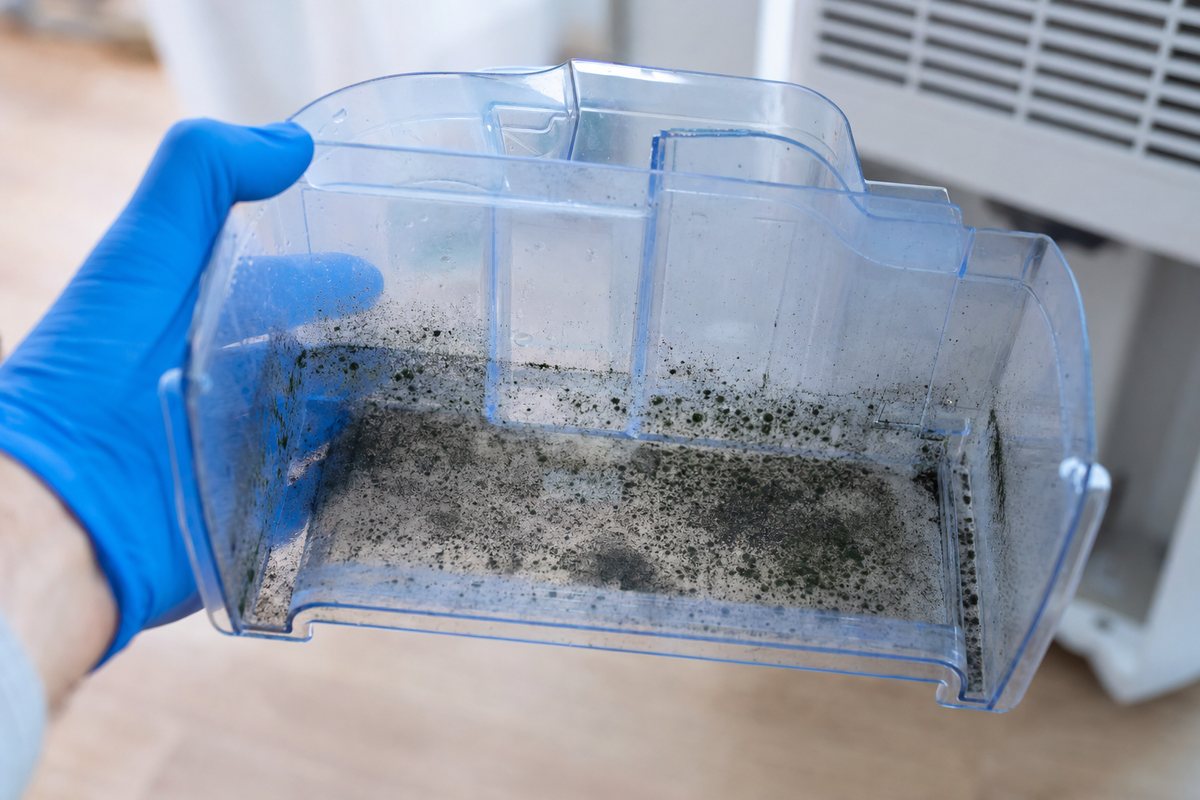
If the smell and symptoms track with the machine running, treat the machine as a suspect. Our guide to the checking the rest of your home for mold covers the wider clues worth checking while you’re at it.
Is Mold in a Dehumidifier Dangerous?
Mold in a dehumidifier can affect your health, and the risk is higher because the machine actively pushes air back into the room. A moldy tank sitting in a corner is one thing. A moldy unit running eight hours a day is moving spores around the space, which raises your exposure.
According to the US CDC, mold exposure can cause a stuffy nose, sore throat, coughing or wheezing, burning eyes, and skin rash. People with asthma or a mold allergy can have stronger reactions, and those who are immune-compromised or living with chronic lung disease face a higher risk of more serious lung problems.
People with asthma or a mold allergy, those who are immune-compromised or living with chronic lung disease, and young children. For these groups, a moldy dehumidifier running in a bedroom or basement is worth addressing quickly rather than living with.
Health Canada is direct on the broader point: there’s no safe level of indoor mould exposure, and any visible mould should be cleaned up regardless of the type. You don’t need to test the mold or identify the species before acting, because the response is the same either way: remove the visible growth and fix the moisture behind it. For a fuller breakdown of how mold affects the body, our page on the health risks of mold exposure goes deeper, and our coverage of black mold health risks addresses the species people worry about most.
How Do You Clean Mold Out of a Dehumidifier?
You clean mold out of a dehumidifier by unplugging it, taking out the removable parts, and scrubbing them with unscented dish detergent and water, then drying everything fully before reassembly. Skip the bleach. We’ll explain why below. Here’s the order that works.
Unplug it and put on protection
Never clean an appliance that’s plugged in. Both Health Canada and the US EPA recommend basic protection for any visible-mold cleanup: an N95 respirator, disposable gloves, and goggles. A moldy tank you’re scrubbing will release spores, so the mask earns its keep.
Take out the tank and the filter
These are the two parts that hold the most mold. Empty the tank, then slide out the air filter, which usually pops out from the front or back grille.
Scrub with detergent and water
Mix a few drops of unscented dish detergent into warm water and scrub the tank, paying attention to corners and the bottom seam. Wash the filter the same way unless it’s a disposable type, in which case replace it. The US EPA guidance for hard surfaces is simple: scrub the mold off with detergent and water, then dry completely.
Wipe the coil and intake
With the tank out, you can usually reach the cold coil fins and the air intake. Wipe them gently with a damp, detergent-dipped cloth. Don’t bend the fins or soak the electronics.
Dry everything fully
This is the step people skip, and it’s why the mold comes back. Let every part air-dry completely, or towel it dry, before you put the unit back together. A damp reassembly just restarts the cycle.
Wear an N95 respirator, gloves, and goggles for any visible-mold cleanup, the standard both Health Canada and the US EPA set. If you want a broader DIY framework for small mold jobs, our DIY mold remediation techniques guide covers the safe-scope rules.
Should You Use Bleach or Vinegar on Dehumidifier Mold?
Skip the bleach. Use unscented dish detergent and water, or white vinegar if you want something with a bit more bite. Bleach corrodes the plastics, rubber seals, and metal coil inside a dehumidifier, so you can damage the unit while trying to save it. It also isn’t the recommended way to clean mold in the first place.
Use these
- Unscented dish detergent and warm water, the first choice for any hard surface
- A half-and-half white vinegar and water mix for stubborn tank staining, left to sit an hour
- An N95 mask, gloves, and goggles while you scrub
- Full drying before you reassemble the unit
Avoid these
- Chlorine bleach, which the US EPA calls not recommended as a routine practice
- Mixing bleach with vinegar or ammonia, which releases toxic gas
- Harsh solvents that corrode plastic and rubber components
- Leaving any part damp, which just restarts the mold cycle
The US EPA states plainly that using a biocide like chlorine bleach is not recommended as a routine practice during mold cleanup. Health Canada is just as clear: don’t use bleach, and instead scrub visible mould off with unscented dish detergent and water, then dry the area quickly and fully. Stick to detergent or vinegar and you stay safe while the unit lasts longer.
When Should You Replace a Dehumidifier Instead of Cleaning It?
Replace the dehumidifier when mold has gotten into porous parts you can’t fully clean, or when the smell won’t leave after a thorough wash. The rule that guides professional remediation applies to the appliance too: non-porous surfaces can be cleaned, porous ones often can’t and should be discarded.
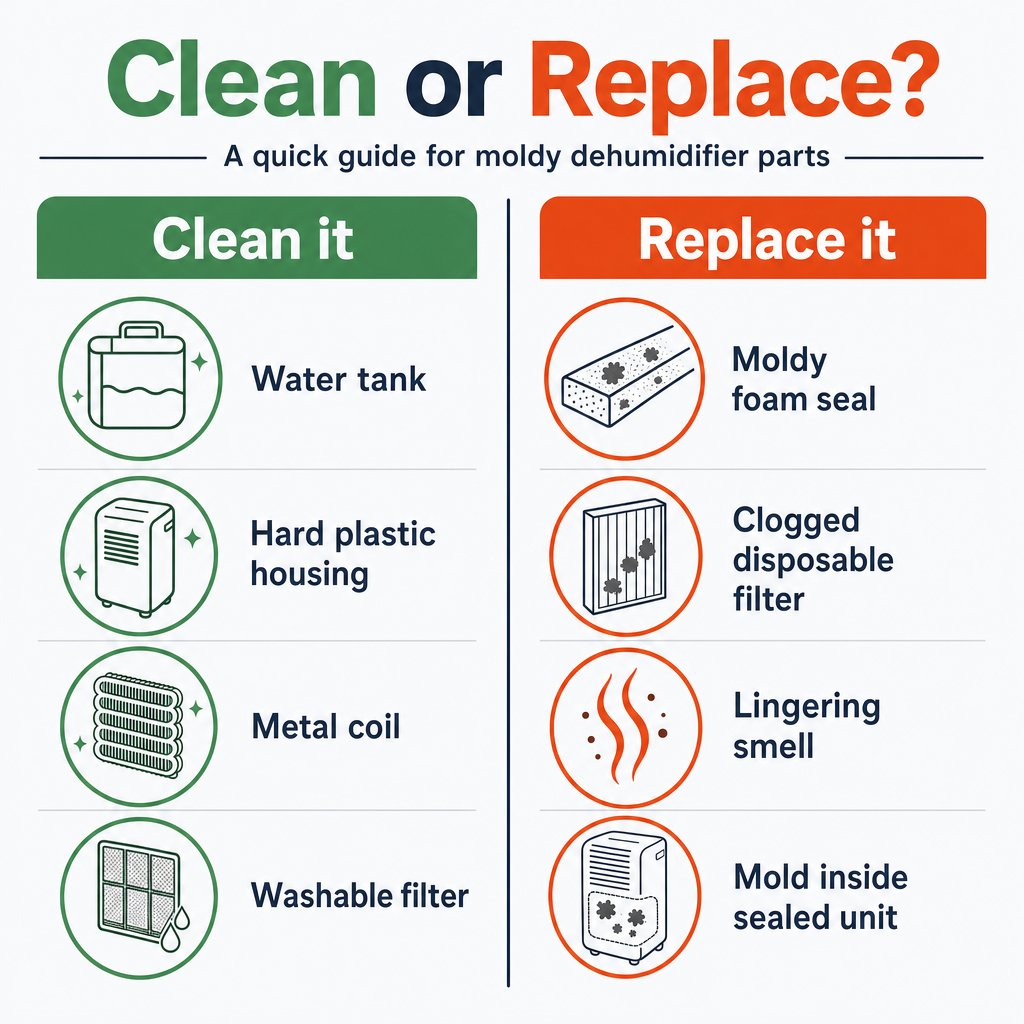
Clean it
- The water tank and hard plastic housing, which are non-porous and wipe clean
- The metal coil fins, scrubbed gently with a detergent cloth
- A removable, washable filter that rinses out fully
- Surface spotting that lifts off and doesn’t return after drying
Replace it
- Foam or felt seals that have soaked up mold you can’t reach
- A disposable filter medium that’s colonized and can’t be sourced new
- A musty smell that returns after a proper clean and full dry
- Mold inside the sealed internal housing where scrubbing can’t reach
There’s also the practical test. If you’ve cleaned the machine properly, dried it fully, run it for a few days, and the musty smell still comes back, mold has likely settled somewhere you can’t reach inside the sealed housing. At that point a replacement is cheaper and healthier than chasing it. A dehumidifier is a moderate-cost appliance. Your air quality isn’t worth nursing a unit that keeps reseeding the room with spores.
Does a Dehumidifier Actually Prevent Mold?
Yes, a dehumidifier helps prevent mold, but only by controlling humidity, and only if you keep it clean. A dehumidifier doesn’t kill mold and it won’t remove mold that’s already growing on your walls or floor. What it does is pull the moisture out of the air so new mold can’t establish. That’s prevention, not a cure.
Mold needs humidity above roughly 60% to take hold and thrive. Drop the room’s relative humidity into the target range and you starve it. Health Canada recommends keeping indoor humidity below 50% in summer and lower in cold weather, closer to 30%, to avoid condensation on cold windows and walls. The US EPA and US CDC land in the same zone: keep indoor humidity under 50%, ideally between 30 and 50%. A cheap hygrometer, the little $15 humidity gauge you can pick up anywhere, tells you exactly where your basement sits.
So a working, clean dehumidifier is a real mold-prevention tool. A neglected, moldy one is the opposite. It’s adding spores to the air while pretending to clean it. The same logic applies to the other appliance that handles your home’s moisture, since mold can grow in an air conditioner for the very same reasons. If your basement humidity is the root issue, our guide to basement mold covers the moisture sources worth hunting down before you blame the machine.
How Do You Keep Mold From Coming Back?
You keep mold out of a dehumidifier with a simple maintenance routine: empty it often, clean it regularly, and store it dry. None of it takes long, and it’s the difference between a unit that fights mold and one that grows it. The schedule below covers it.
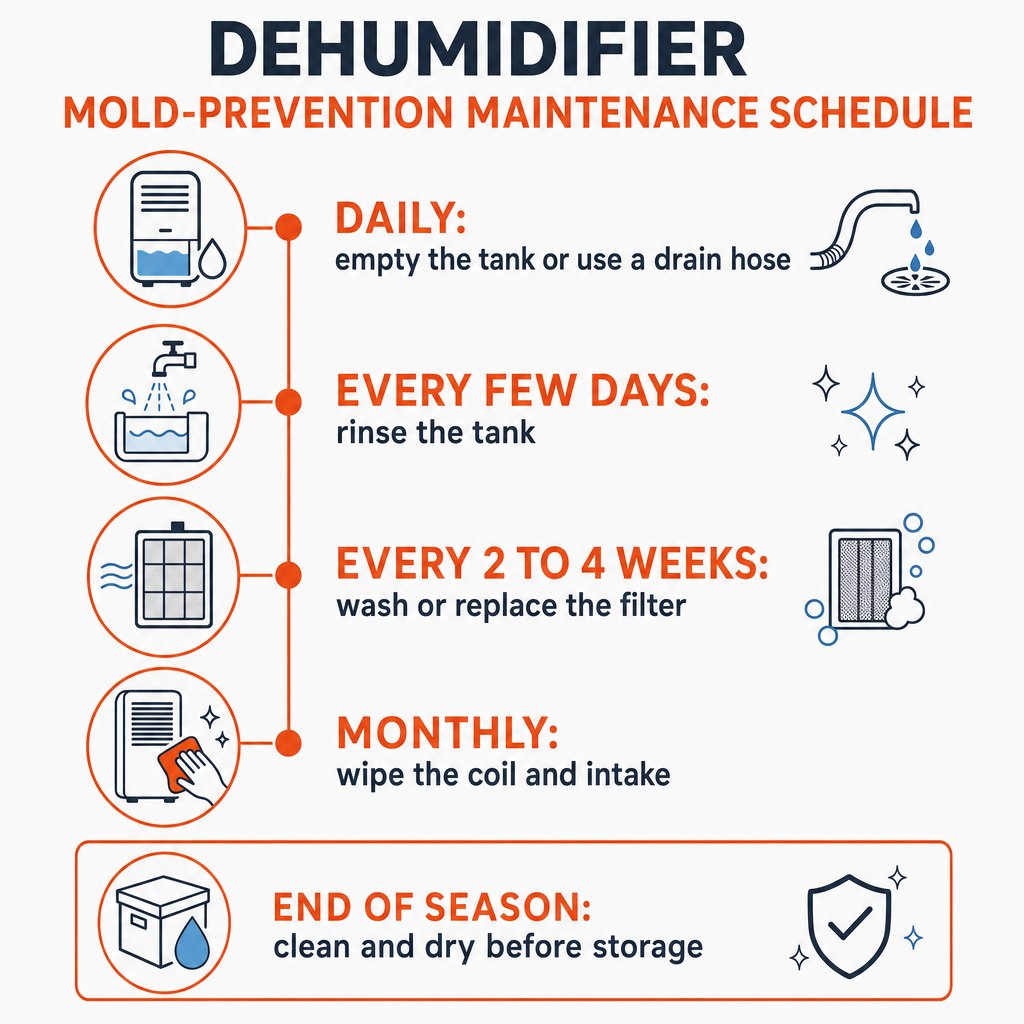
Empty the tank daily during humid stretches, or better, run a drain hose to a floor drain so water never sits. Rinse the tank every few days in peak season. Wash or replace the air filter every two to four weeks, since a clogged filter traps the dust and spores mold feeds on. Wipe the coil and intake every month or two. At the end of the season, before you store the unit, clean it fully and let it dry for a day or two with the tank out, then store it somewhere dry rather than in the damp basement it just spent the summer working in.
Keep an eye on the room’s humidity with that hygrometer and aim to stay under 50%. If the dehumidifier runs constantly and still can’t get the room below that, the unit may be undersized for the space, or you’ve got more moisture coming in than any machine can remove. That second possibility is the one worth taking seriously. A persistent musty smell in the house often points to a hidden source, and our guide to a musty smell in the house helps trace it.
When Is a Moldy Dehumidifier a Sign of a Bigger Problem?
A moldy dehumidifier is a warning sign when the room stays musty after you’ve cleaned the unit, or when you spot mold on walls, baseboards, or stored items nearby. The machine getting moldy means the air around it is damp enough to grow mold. That same damp air touches everything else in the room.
Here’s the part most homeowners miss. The dehumidifier is the canary, not the cause. If it’s colonizing fast, the room’s relative humidity is high enough that mold is probably establishing in places you can’t see: behind drywall, under flooring, inside wall cavities where a slow leak or foundation seepage keeps things wet. Cleaning the appliance does nothing for that. You can scrub the tank every week and still have a mold problem growing in the structure.
A musty smell that survives a deep clean of the unit. Visible mold on nearby walls, window frames, or stored cardboard. Condensation that keeps forming on cold surfaces. Health symptoms that don’t ease even after the machine is spotless. When the scope crosses about one square metre of visible mold, the Health Canada threshold for calling in help, or the US EPA roughly equivalent 10-square-foot guideline, it’s past a DIY job.
When Should You Call a Professional?
Call a professional when the mold extends beyond the appliance into the room, when the musty smell persists after cleaning, or when anyone in the home has unexplained respiratory symptoms. A moldy tank is a DIY fix. A moldy room is not.
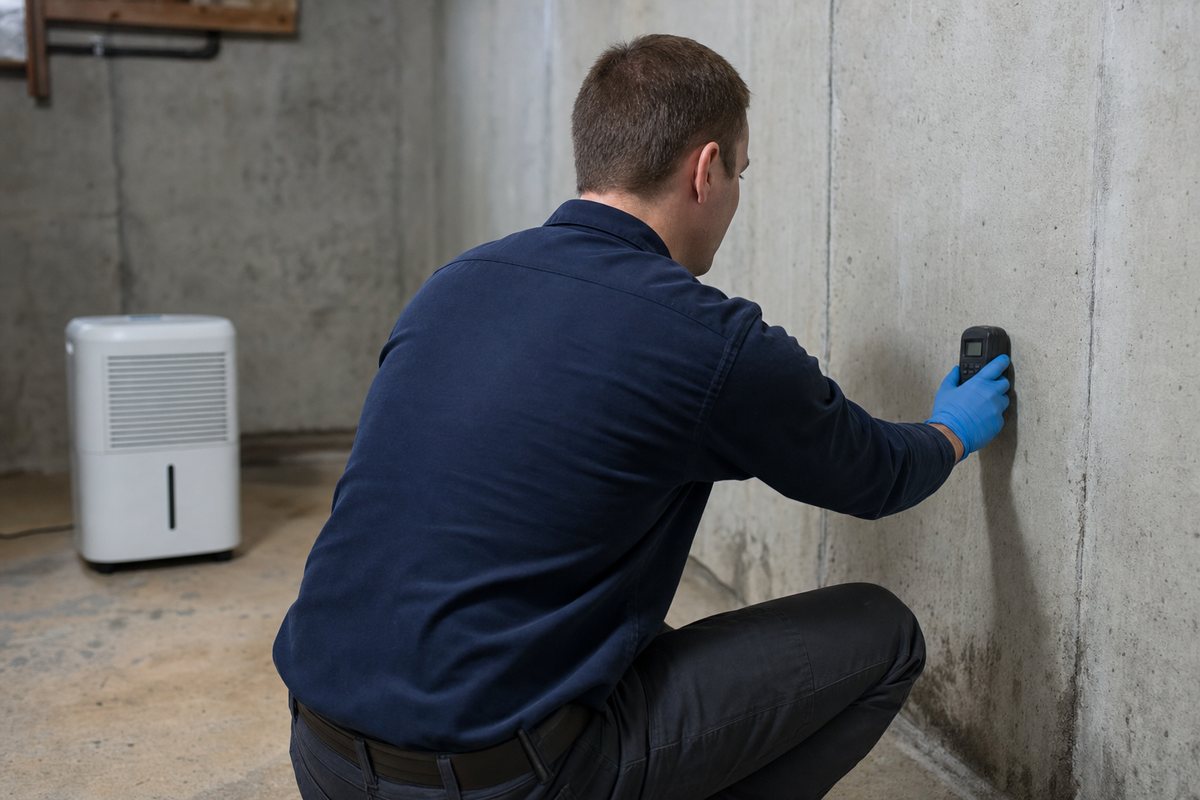
After 20 years of mold inspections across Ontario and Quebec, our certified inspectors have learned that the dehumidifier is often where a hidden moisture problem first shows itself. We use thermal imaging and moisture meters to find the wet building materials behind a wall or under a floor that a homeowner can’t see, the actual source feeding both the room and the machine. We don’t guess at it. We measure it, document it in a full report, and tell you exactly what needs to happen.
Mold Inspection Canada is certified by six industry bodies, including NORMI, InterNACHI, and IICRC, and we back every assessment with a price match guarantee. If your dehumidifier keeps growing mold no matter how often you clean it, that’s your cue.
Mold in Dehumidifier FAQ
Is mold in a dehumidifier dangerous to breathe?
It can be. A running dehumidifier blows air back into the room, so a moldy unit spreads spores rather than containing them. The US CDC links mold exposure to coughing, wheezing, a stuffy nose, burning eyes, and skin rash, with stronger reactions for people who have asthma, allergies, or weakened immune systems. Health Canada says there’s no safe level of indoor mould, so clean any visible growth promptly.
Why does my dehumidifier smell musty even after I empty it?
A musty smell that returns after emptying means mold has settled on a surface inside the unit, usually the tank walls, the coil, the filter, or an internal seal. Emptying the water doesn’t remove the growth producing the odour. You’ll need to take out the removable parts and scrub them with detergent and water, then dry everything fully. If the smell survives a thorough clean, mold has likely reached a sealed part you can’t reach, and replacement is the better call.
Can a moldy dehumidifier spread mold spores around my house?
Yes. A dehumidifier constantly draws air in and pushes it back out, so mold growing inside gets distributed into the room every time it runs. That’s what makes a moldy unit worse than a moldy object that just sits still. It actively circulates spores, which is why cleaning it promptly matters more than for most household items.
How do I clean black mold out of a dehumidifier tank?
Unplug the unit, put on an N95 mask, gloves, and goggles, then remove the tank. Scrub it with unscented dish detergent and warm water, working into the corners and the bottom seam where water pools. For stubborn staining, a half-and-half white vinegar and water mix left to sit for an hour helps. Rinse, dry the tank completely, and only then reassemble. Don’t use bleach, and never mix bleach with vinegar.
Should I use bleach or vinegar to clean mold in a dehumidifier?
Use detergent and water first, and white vinegar for tougher spots. Avoid bleach. Bleach corrodes the plastic, rubber, and metal inside the unit, and both the US EPA and Health Canada advise against bleach for routine mold cleanup. The EPA calls chlorine bleach not recommended as a routine practice, and Health Canada recommends unscented dish detergent and water instead. Never combine bleach with vinegar or ammonia, since that releases toxic gas.
How often should I clean my dehumidifier to prevent mold?
Empty the tank daily in humid conditions, rinse it every few days, wash or replace the filter every two to four weeks, and wipe the coil and intake every month or two. Before storing the unit at season’s end, clean it fully and let it dry for a day or two with the tank removed. A drain hose to a floor drain removes the standing water mold needs and cuts your maintenance considerably.
Does a dehumidifier actually help prevent mold in a room?
Yes, by controlling humidity, but it doesn’t kill existing mold. A dehumidifier pulls moisture from the air so new mold can’t establish, which is prevention rather than removal. Keep the room’s relative humidity under 50%, the range Health Canada, the US EPA, and the US CDC all recommend, and mold struggles to grow. A clean, working unit prevents mold. A neglected, moldy one adds to the problem.
When should I replace my dehumidifier instead of cleaning it?
Replace it when mold has reached porous parts you can’t fully clean, such as foam seals or non-replaceable filter media, or when the musty smell returns after a proper cleaning and drying. Non-porous parts like the tank, housing, and coil can be scrubbed clean. Porous parts hold mold deep in their structure where scrubbing can’t reach. If the unit keeps reseeding the room with spores after you’ve cleaned it, a replacement is cheaper and healthier than chasing the smell.
Book a Free Mold Inspection
If your dehumidifier keeps growing mold no matter how often you clean it, the room around it likely has a moisture problem worth checking. Tell us what you’re seeing and our certified inspectors will help you figure out whether it’s a dirty appliance or a damp house. Free virtual inspection, price match guarantee, serving Ontario and Quebec.