
DIY Mold Remediation Techniques: What You Can Safely Do Yourself

Most Canadian homeowners can safely handle a small mold problem themselves. Under ten square feet, on a hard surface, with the right gear and the right cleaner, DIY mold removal is realistic and cheap. What you cannot DIY is hidden mold inside walls or HVAC, toxic black mold that releases spores when disturbed, or any contamination past the ten-square-foot line. This guide covers the proven DIY techniques that actually work, the safety gear that is not optional, the mistakes that make mold worse, and the exact point where DIY stops and a professional has to take over.
What Causes Mold (and Why It Comes Back)
Mold is a moisture problem expressed visually. It thrives in warm, damp, poorly ventilated spaces, and it grows wherever water sits long enough. Leaky roofs, plumbing drips, condensation on cold walls, and basement humidity are the usual sources in Canadian homes. The single most important rule of DIY remediation: if you clean the mold but leave the moisture, the mold returns, often within weeks and often worse. Every technique below assumes you have already found and fixed the water source. See where mold grows and why moisture is the real cause for the full breakdown.
Safe DIY Mold Remediation Techniques That Work
For a minor mold issue under ten square feet, these proven cleaners do the job without the harshness or false confidence of bleach. Pick the one that matches your surface, work the area thoroughly, and let it dwell before scrubbing. Always work in protective gear (see the next section) and ventilate the room.
White vinegar
The workhorse of DIY mold removal. Undiluted white vinegar kills roughly 82 percent of common mold species and penetrates porous surfaces better than bleach. Pour it into a spray bottle straight, no water. Saturate the area, let it dwell for one hour, then scrub with a stiff brush and wipe clean. Repeat on stubborn spots. The smell clears within a few hours.
Hydrogen peroxide (3%)
Breaks down mold at the cell-structure level and works on a wider range of materials than vinegar. Use standard 3 percent drugstore peroxide in a spray bottle, apply generously, let it bubble and sit for ten minutes, then scrub. Test on a hidden patch first, because peroxide can lighten some fabrics and finishes.
Baking soda paste
Gentle, non-toxic, and useful as a finishing step or on surfaces you do not want to soak. Mix baking soda with a little water into a paste, scrub it into the moldy surface, let it dry, then rinse. It also absorbs residual odour and leaves a mild alkaline film that discourages regrowth. Safe around children and pets.
Borax solution
Creates an alkaline environment that kills mold and helps prevent it from returning. Mix one cup of borax into one gallon of hot water, apply to the surface, and scrub thoroughly. You do not need to rinse it off fully; the residue keeps working. Keep borax away from pets and food-prep surfaces.
Tea tree oil
A natural fungicide for small jobs and people sensitive to stronger cleaners. Add one teaspoon of tea tree oil to one cup of water in a spray bottle, shake well, spray the area, and leave it to air dry without rinsing. More expensive per use than vinegar, but effective and low-odour for spot treatment.
Discard what you cannot clean
Porous materials that have absorbed mold through their thickness cannot be saved by surface cleaning. Mold-soaked drywall, ceiling tiles, carpet, carpet pad, and insulation should be cut out, bagged, and thrown away rather than scrubbed. Cleaning the surface of contaminated drywall leaves the colony living inside it.
Safety Gear You Actually Need
Disturbing mold releases millions of airborne spores. Every item below is non-negotiable for any removal job where you will touch the growth or move contaminated material. Total cost is under $50, and it protects both your lungs and the rest of the house from cross-contamination.
N95 or P100 respirator
A cloth or surgical mask does not filter spores. An N95 blocks 95 percent of airborne particles down to 0.3 microns. Available at any Canadian hardware store for $10 to $15. Replace it after the job.
Nitrile gloves
Disposable nitrile, not latex, since some molds produce mycotoxins that pass through latex. Long-cuff if you can find them so cleaner does not run down your wrist. About $15 for a box.
Sealed safety goggles
Full-seal goggles, not open safety glasses. Spores and cleaning spray both reach the eye through open frames. Around $8 and reusable.
Disposable coverall
A Tyvek-style coverall with hood and elastic cuffs stops spores from settling into clothing you then track through the house. $10 to $18, single use, bag it when you finish.
HEPA vacuum
A standard vacuum blows spores back into the air through the exhaust. Only a true HEPA-filtered vacuum captures mold particles. Use it for cleanup after scrubbing, never on wet mold.
Plastic sheeting and bags
Sheeting seals off the work area and stops spores drifting to clean rooms. Contaminated material and used PPE go straight into sealed bags and out to the outdoor garbage.
The 10-Square-Foot Rule: When DIY Stops
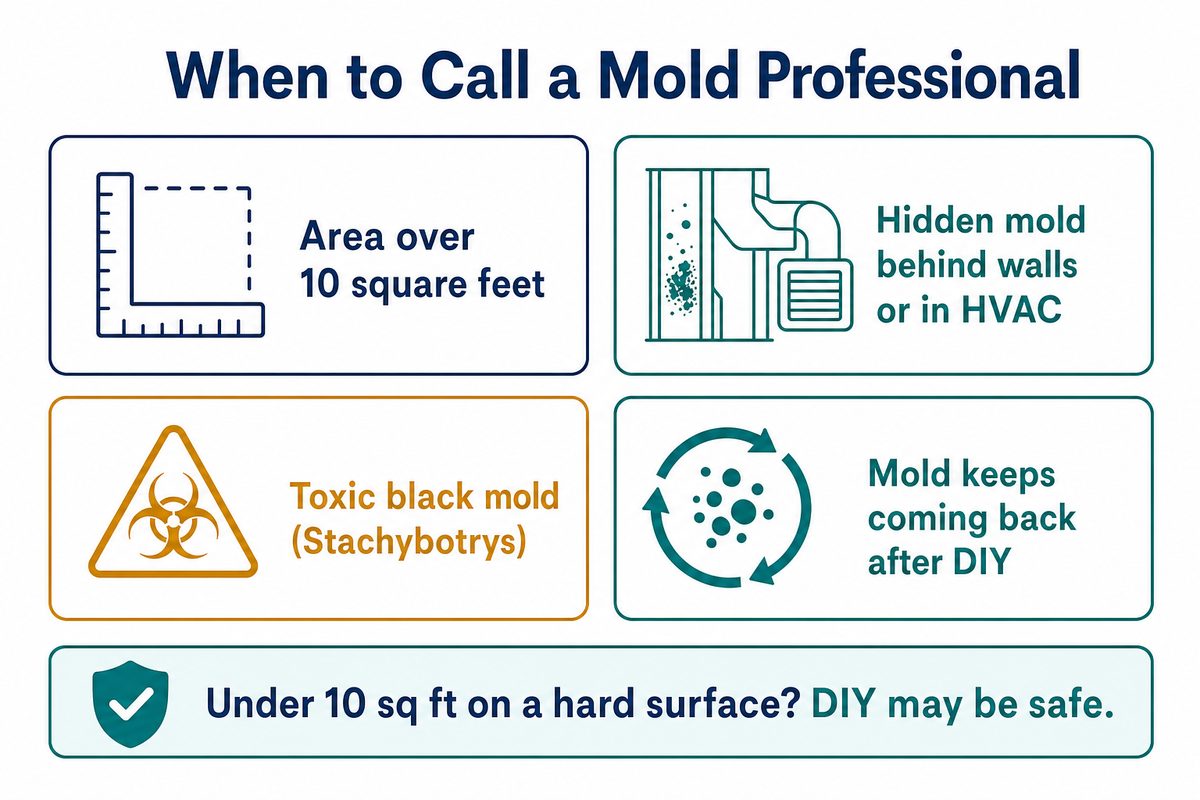
The Environmental Protection Agency draws a clear line, and Health Canada agrees: areas larger than ten square feet need professional remediation. The threshold is not arbitrary. A patch that size usually signals a deeper moisture problem, and removing it safely requires containment and HEPA air filtration that homeowners do not have. Past that line, DIY does not just fall short, it actively spreads the problem.
Green: DIY is reasonable
Visible mold under ten square feet on a hard, non-porous surface. The moisture source is obvious and already fixed. No one in the home has a respiratory condition. You have the right PPE and cleaner. This is a clean, contained job you can finish in an afternoon.
Orange: Get a professional assessment
Mold over ten square feet in any one area. A persistent musty smell with no visible source. Recurring mold in a spot you have already cleaned. Mold you suspect inside walls, in a crawl space, or behind cabinetry. Water damage older than 48 hours affecting drywall, insulation, or subfloor.
Red: Stop and call immediately
Toxic black mold (Stachybotrys chartarum), which releases dangerous spores when disturbed. Mold in HVAC ductwork being circulated through the home. Mold after sewage or flood-water exposure. Any mold in a home with an infant, an immunocompromised resident, or someone with severe asthma. Close the area off and book an inspection within 48 hours.
DIY vs Professional Mold Removal: Cost in Canada
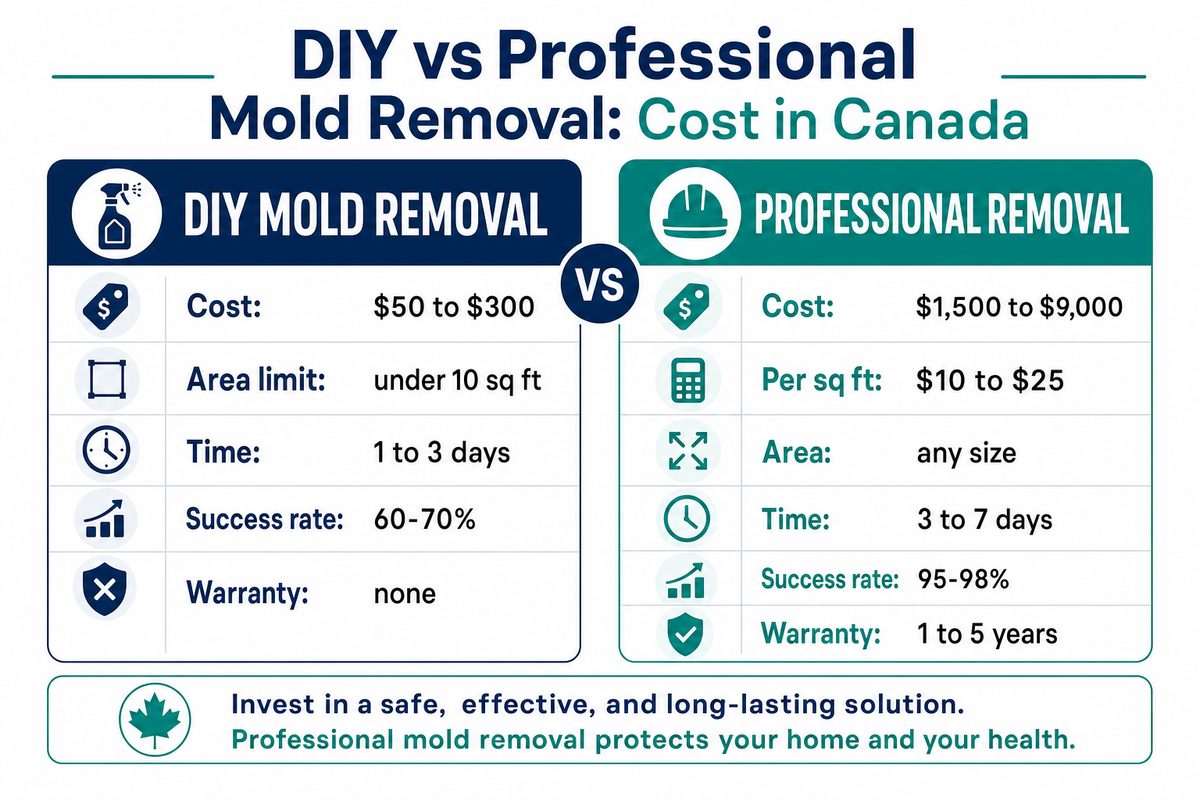
DIY is far cheaper on paper. The hidden cost is the price of getting it wrong: incomplete removal lets mold return stronger, spreading spores during a botched cleaning contaminates new rooms, and damage from improper technique adds repair bills. The table below shows the real comparison.
| Factor | DIY mold removal | Professional removal |
|---|---|---|
| Cost range | $50 – $300 | $1,500 – $9,000 |
| Per square foot | $5 – $30 (supplies) | $10 – $25 |
| Area limit | Under 10 sq ft (EPA guideline) | Any size |
| Time required | 1 – 3 days | 3 – 7 days |
| Success rate | 60 – 70% for small areas | 95 – 98% completion |
| Warranty | None | 1 – 5 years typical |
Common DIY Mistakes That Make Mold Worse
Three more mistakes turn a small job into a bigger one:
- Skipping containment. Opening windows during cleaning feels right but disperses spores to new rooms. Seal the work area with plastic sheeting and control the airflow instead.
- Ignoring the moisture source. Cleaning visible mold without fixing the leak or humidity behind it is a temporary patch. The mold returns to the same spot because the conditions never changed.
- Cross-contamination. Contaminated clothing, brushes, and tools carry spores through the house. Bag single-use PPE on the spot, and do not reuse a coverall or N95 after contact with visible mold.
Making Your Decision: A Clear Framework
Before you start scrubbing, run through these four checks. If any one of them points to professional help, stop and book an assessment rather than risk a job that gets worse.
Measure the area
Measure carefully, including any growth you suspect but cannot fully see. Under ten square feet on a hard surface is DIY territory. Over ten square feet is the EPA and Health Canada threshold for professional remediation.
Check who lives there
Anyone with asthma, allergies, COPD, or a weakened immune system should not be in the home during DIY removal, and ideally should not do it themselves. Toxic mold exposure hits vulnerable people hardest.
Identify the surface and location
Surface mold on bathroom tile is very different from contamination on a basement wall or inside drywall. Non-porous and accessible is DIY-friendly. Porous, structural, or hidden needs professional assessment.
Get a second opinion if unsure
A free virtual mold inspection gives you an expert read from photos and a description before you commit to anything. When you are on the fence, that is the cheapest way to decide.
When to Call a Professional
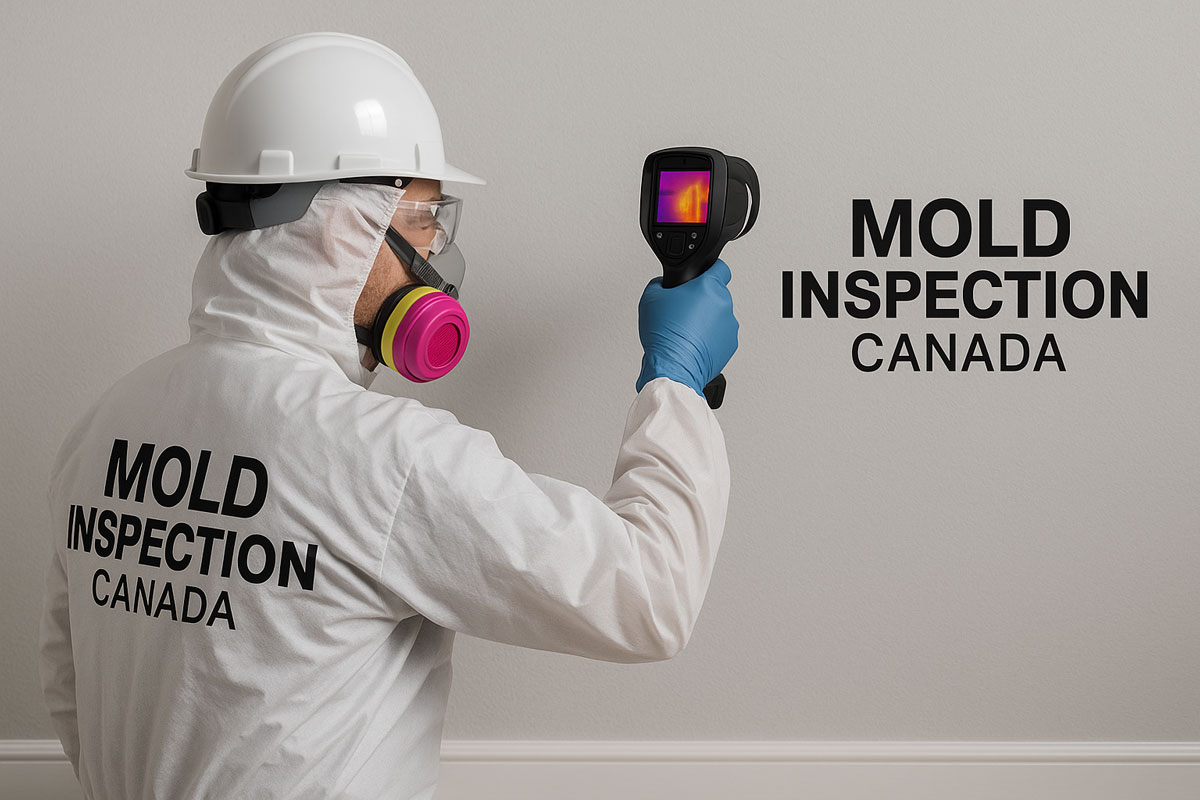
Past the DIY line, professionals bring what a homeowner cannot: certified training, containment, and detection equipment. Our inspectors hold IICRC, NORMI, InterNACHI, and CRMI certifications and follow EPA and Health Canada protocols. The work starts with an inspection that maps the full scope, including hidden growth, then moves through containment, HEPA-filtered removal, and prevention so the mold does not return.
Professional detection is the part DIY simply cannot match. Infrared cameras reveal moisture patterns behind walls, and air sampling measures spore concentrations invisible to the eye. That data drives the treatment plan and, when you need it, produces a written report for insurance claims or a real estate transaction. We serve Ontario and Quebec, from Ottawa and Montreal to Kingston, Gatineau, Cornwall, Belleville, and Brockville.
Prevent Mold From Coming Back
Removal is only half the job. These habits keep the conditions that grow mold from returning:
- Keep indoor humidity below 50 percent. A dehumidifier in the basement does most of the work in Canadian homes.
- Respond to any water damage within 24 to 48 hours, the window before mold begins to grow.
- Ventilate bathrooms, kitchens, and laundry areas to clear excess moisture at the source.
- Use a moisture meter or hygrometer to catch dampness early, especially after winter and during the spring thaw.
- Schedule a professional inspection if mold has been a recurring problem, to find the source you keep missing.
Frequently Asked Questions
When should I hire a professional instead of doing it myself?
Hire a professional when the affected area is larger than ten square feet (the EPA and Health Canada threshold), when you suspect hidden mold behind walls or in HVAC systems, for toxic black mold (Stachybotrys chartarum), or when mold keeps returning after you have cleaned it. Professional help is also strongly recommended when anyone in the home has asthma, allergies, or a compromised immune system. Below those thresholds, DIY removal on a hard surface is reasonable.
How much does professional mold remediation cost in Canada?
Professional mold remediation typically runs $10 to $25 per square foot, with total project costs from $1,500 to $9,000 depending on the size, mold type, location, and extent of contamination. DIY removal of a small area under ten square feet costs $50 to $300 in supplies and PPE. For a full breakdown by area type, see our mold remediation cost guide for Canadian homeowners.
Can I use bleach to remove mold?
Bleach only works on non-porous surfaces like tile and glass. It cannot penetrate porous materials such as drywall or wood, and the water it carries actually feeds the mold roots left inside them, causing faster regrowth. Better DIY options are white vinegar, hydrogen peroxide, or borax, which penetrate porous surfaces and do not feed the colony. Never mix bleach with vinegar or ammonia, since that releases toxic fumes.
What safety equipment do I need for DIY mold removal?
At a minimum: an N95 or P100 respirator, disposable nitrile gloves, sealed safety goggles, and a disposable coverall. Add plastic sheeting to contain the work area and a HEPA vacuum for cleanup. Total cost is under $50. Never attempt DIY removal without a respirator, because disturbing mold releases millions of spores into the air you breathe.
What is the 10 square feet rule for mold?
The EPA recommends professional remediation for any mold area larger than ten square feet, and Health Canada uses the same threshold (roughly one square metre). The rule exists because larger areas usually indicate a deeper moisture problem and require containment and HEPA-filtered air handling to remove safely. Areas under ten square feet on non-porous surfaces are generally suitable for careful DIY removal with proper safety gear.
How do I know if I have hidden mold?
Signs of hidden mold include a musty odour with no visible source, persistent allergic reactions that ease when you leave the house, dark stains bleeding through walls or ceilings, peeling paint or wallpaper, and ongoing moisture problems. A professional inspection using infrared thermal imaging and moisture meters can confirm mold behind walls without cutting them open.
How quickly does mold grow after water damage?
Mold can begin growing within 24 to 48 hours of water exposure, which is why fast drying matters so much. If you act inside that window, dry the area completely and you may prevent mold entirely. Past 48 hours, especially on drywall, insulation, or subfloor, assume mold has started and inspect accordingly. See our guide on water damage and mold for the full timeline.
What makes black mold dangerous?
Toxic black mold (Stachybotrys chartarum) produces mycotoxins linked to respiratory problems, neurological symptoms, and immune-system effects. It releases a heavy load of spores when disturbed, which is exactly what DIY scrubbing does. For that reason, suspected black mold should always be handled by professionals with proper containment rather than removed yourself. Learn more about the health risks of black mold.
Related Mold Resources
Get a Free Mold Removal Estimate
Serving Ontario and Quebec: Montreal, Ottawa, Gatineau, Kingston, Cornwall, Belleville, Brockville. Free virtual mold inspections available.