
Water Damage and Mold: How Fast It Grows and What to Do
Mold can take hold within 24 to 48 hours of water damage, long before the wet patch even looks dry. Here’s how fast it spreads, what to do first, how Canadian insurance handles it, and when to call a pro.
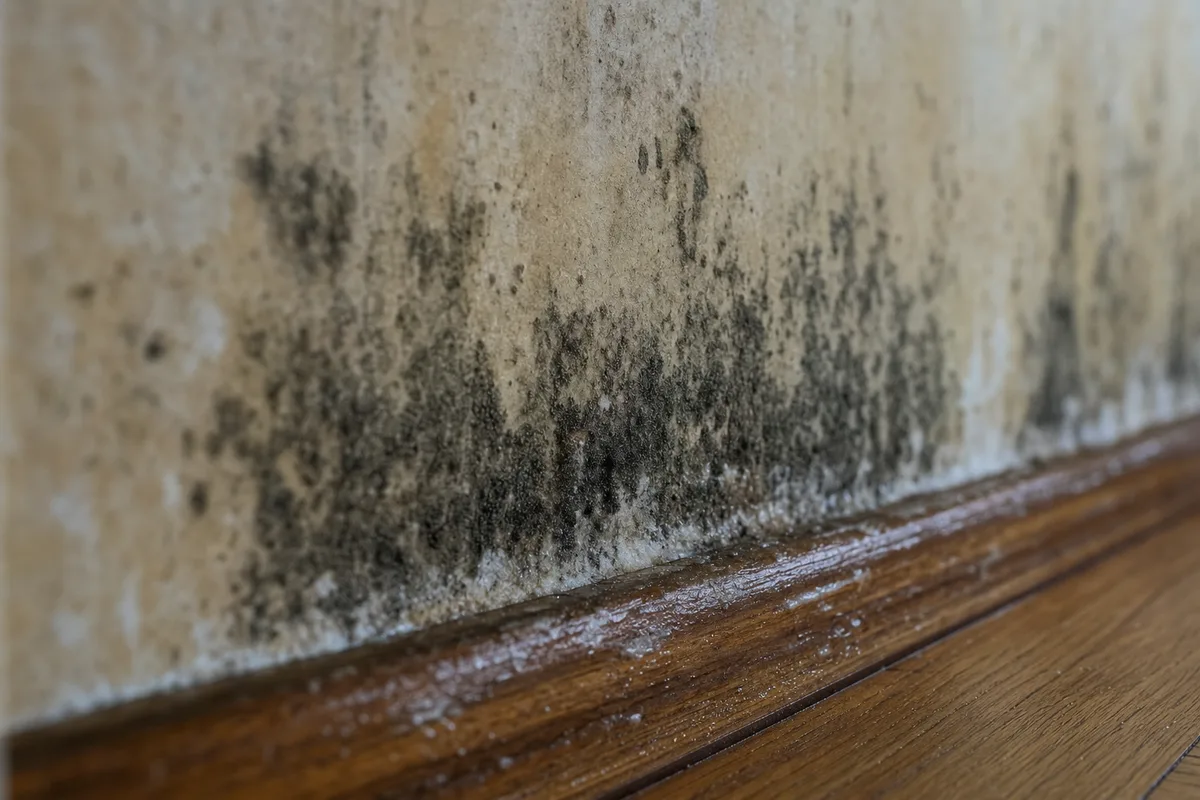
Water damage and mold travel together. Once water soaks into drywall, carpet, or framing, mold doesn’t wait around. It can take hold within a day or two, long before the wet patch even looks dry. That’s the part most homeowners miss. The flood gets cleaned up, the surface looks fine, and three weeks later there’s a musty smell and a dark bloom behind the baseboard.
We’ve inspected enough flooded basements and burst-pipe ceilings across Ontario and Quebec to know how this story usually goes. The timeline works in your favour if you move fast. This guide covers how mold from water damage starts, how quickly it spreads, what to do in the first 48 hours, and where the line sits between a job you can handle and one that needs a professional. We’ve kept it Canadian on purpose, because spring freshet and a frozen-pipe winter change the math in ways most American advice ignores.
How Water Damage Leads to Mold
Mold needs three things to grow: moisture, a food source, and a comfortable temperature. Water damage delivers the first two in one shot. The water itself is the moisture, and the soaked building materials (drywall paper, wood, carpet backing, insulation) are the food. Room temperature does the rest. That’s why mold from water damage is so common and so fast.
Not all water is equal, though. Restoration professionals sort it into three categories, and the category decides how dangerous the cleanup is. Category 1 is clean water from a supply line or an overflowing sink. Category 2, sometimes called grey water, carries some contamination, like discharge from a washing machine or dishwasher. Category 3 is black water: sewage backups, flooding from rivers, anything that’s been sitting and growing bacteria. The dirtier the water, the less you can safely save and the sooner you should stop doing it yourself.
Category 1 (clean) is from a clean supply source. Category 2 (grey) carries light contamination from appliances. Category 3 (black) is sewage or flood water and is a biohazard. The category sets how much you can save and whether you should call a professional.
The other thing that decides mold risk is what the water touched. Porous materials soak water deep into their structure and hold it. Drywall, carpet padding, insulation, and particleboard are sponges. Non-porous surfaces like tile, sealed concrete, glass, and metal shed water and dry on the surface. A flood across a tiled bathroom floor is a very different problem from the same flood across a finished basement with carpet and drywall. To understand the broader picture of what mold is and how it behaves indoors, our guide on what mold is covers the biology in plain language.
How Fast Does Mold Grow After Water Damage?
Mold can begin growing within 24 to 48 hours of water damage. That’s the number every homeowner should burn into memory, because it sets the whole clock for your response. Spores are already in the air and on surfaces in every building. They don’t need to arrive. They just need water, and you’ve handed them a flood.
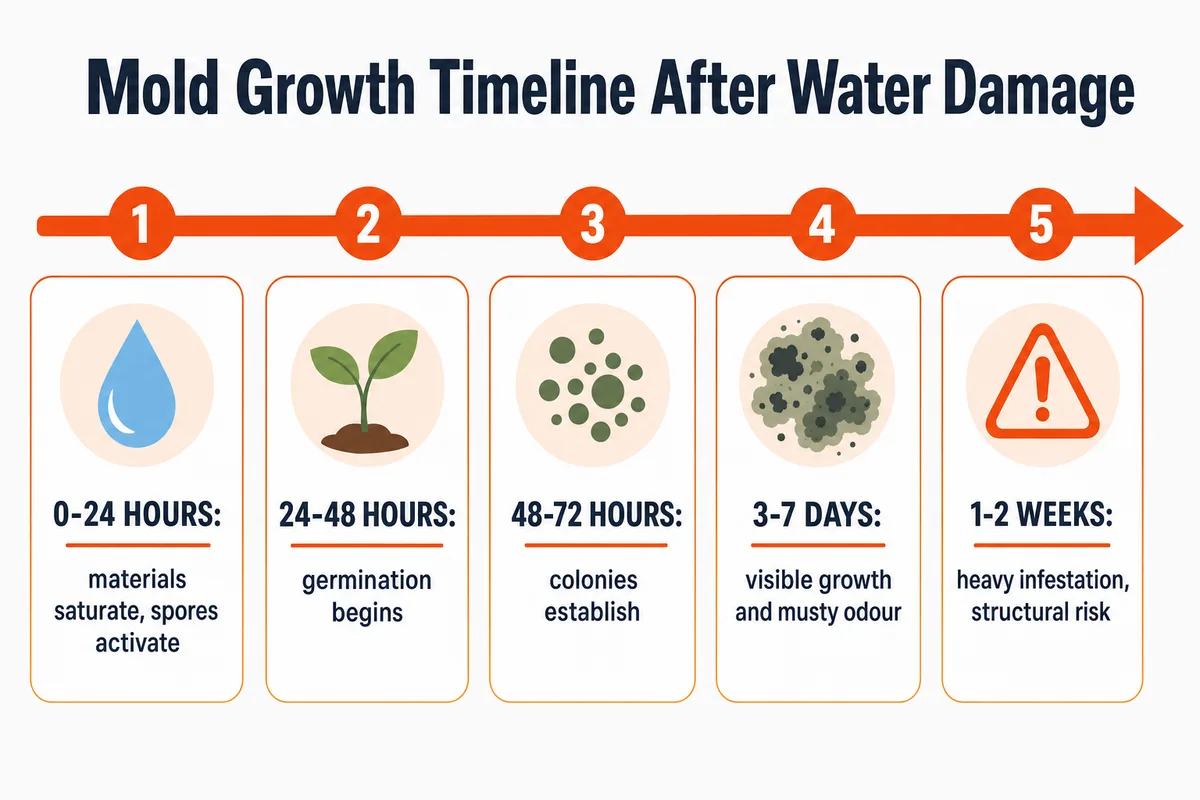
0 to 24 Hours
Water soaks deeper than the surface shows. Dormant spores start to activate on wet organic surfaces.
24 to 48 Hours
Germination begins on the wettest materials. This is the window where fast drying still prevents mold.
48 to 72 Hours
Colonies establish and start digesting the material they grow on. Cleanup becomes remediation.
3 to 7 Days
Growth becomes visible and the classic musty odour sets in. The problem is now obvious.
1 to 2 Weeks
Heavy infestation that can compromise drywall and framing, and spread to new areas.
Around day three to seven you’ll see it and smell it, that classic damp, earthy musty odour that tells you it’s been growing a while. Temperature and humidity shift this timeline. Warm, humid conditions speed it up. A cold concrete basement slows it slightly, but don’t count on the cold saving you, because Canadian basements stay warm enough year-round for mold to thrive once they’re wet. The 48-hour drying window is the difference between a cleanup and a remediation.
Common Mold Types After Water Damage
A few mold species show up again and again after water damage, and they’re worth recognizing. Identifying the type isn’t a DIY diagnosis tool, but it tells you how worried to be.
Stachybotrys chartarum
The species people mean by “black mold.” Needs prolonged saturation, which untreated water damage provides. Dark, often slimy, and most associated with mycotoxins.
Aspergillus
Extremely common indoors and shows up in many colours. Spreads quickly on damp building materials after a flood.
Cladosporium
Olive-green to brown. Tolerates cooler temperatures, so it’s right at home in a Canadian basement.
Alternaria
Dark and velvety. Turns up fast near damp spots like under a leaking window or around a tub.
Stachybotrys looks dark and often slimy, and it’s the species most associated with mycotoxins. If you want a deeper reference on identifying what you’re looking at, our breakdown of black mold and its health risks goes species by species.
The Canadian Water Damage Calendar
Water damage in Canada follows the seasons, and knowing the calendar helps you stay ahead of it. This is where generic advice falls short, because the threats here aren’t the same ones a homeowner in Florida deals with.
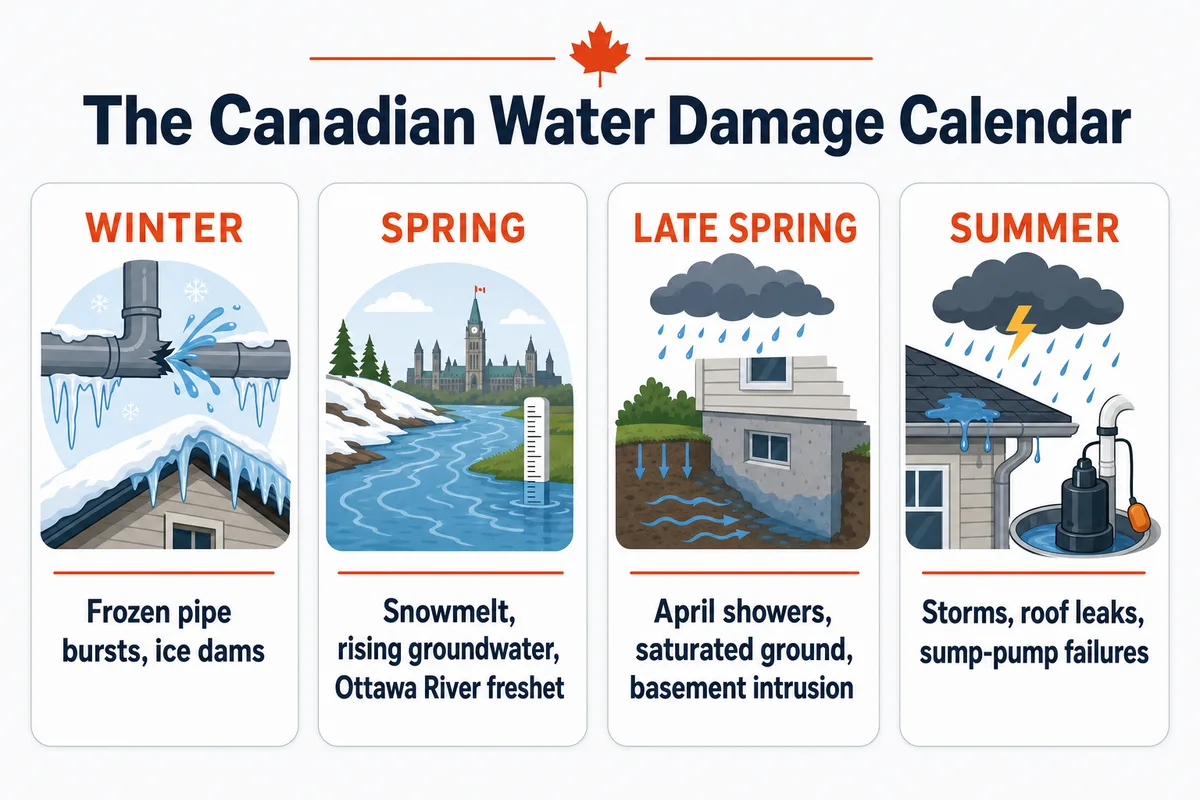
Winter is the sneaky one. Frozen pipes burst in January, but the damage often hides inside a wall or under a floor and isn’t discovered until spring. Ice dams force meltwater back under shingles and into ceilings. Then comes the real surge. Spring thaw brings snowmelt, rising groundwater, and the Ottawa River freshet, which floods river-adjacent properties most years. April showers land on already-saturated ground, and that water finds its way through foundation cracks into basements. Summer storms bring roof leaks and overwhelm sump pumps during power outages. Across Gatineau and the Montreal corridor, the spring freshet window is the single busiest stretch for water-damage mold calls we handle.
If you own a home in eastern Ontario or southern Quebec, check your basement early and often in spring. The flood you catch on day one is a wet-vac job. The one you find in May, weeks after the snow melted into your foundation, is a remediation.
What to Do in the First 24 to 48 Hours
The first two days after water damage decide everything. Act inside that window and you can usually prevent mold entirely. Here’s the order that matters.
Stop the Water Source
Shut off the main valve for a burst pipe, or barrier off external flooding. You can’t dry a room that’s still filling.
Kill the Power if Needed
Standing water near outlets or panels is a real hazard. If you can’t reach the breaker safely, stay out and call an electrician.
Document for Insurance
Photograph and video the standing water, the source, and every affected room before you touch anything. Your claim depends on it.
Remove Standing Water
Wet vacuum, pump, or mop. Get from flooded to merely damp as fast as you can.
Pull Out Wet Porous Items
Soaked rugs, cushions, and cardboard come out now. They hold water and feed mold.
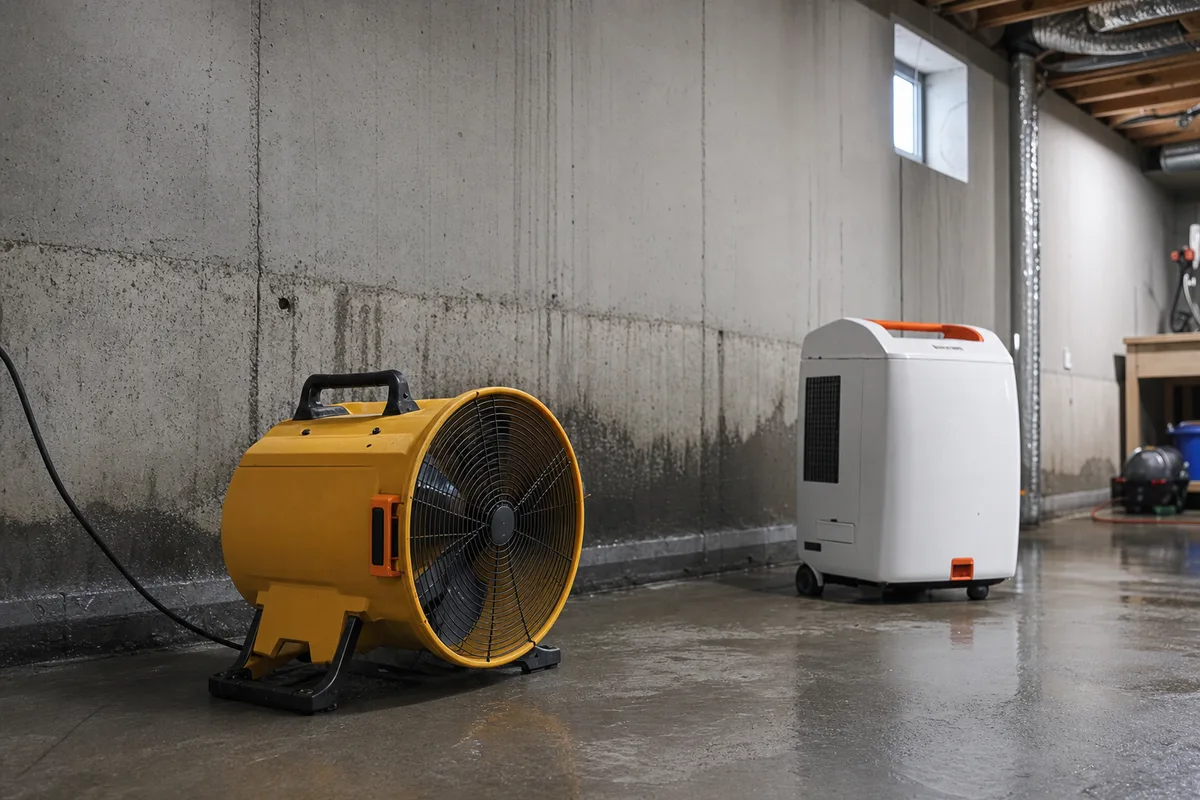
Dry and Dehumidify
Run fans and a dehumidifier, and aim to pull indoor relative humidity below 50%. This is the step that beats the clock.
Never enter standing water near electrical panels or outlets, and never run extension cords through water. If the flooding came from sewage or a river (Category 3 water), treat it as a biohazard and call a professional rather than wading in.
For a fuller walkthrough of drying and cleanup technique, our DIY mold remediation techniques guide breaks down the hands-on steps.
What to Save and What to Throw Out
After water damage, the hardest calls are about what’s salvageable. The rule comes back to porous versus non-porous, and how long things stayed wet. Anything porous that sat wet for more than 48 hours is usually safer to discard than to save.
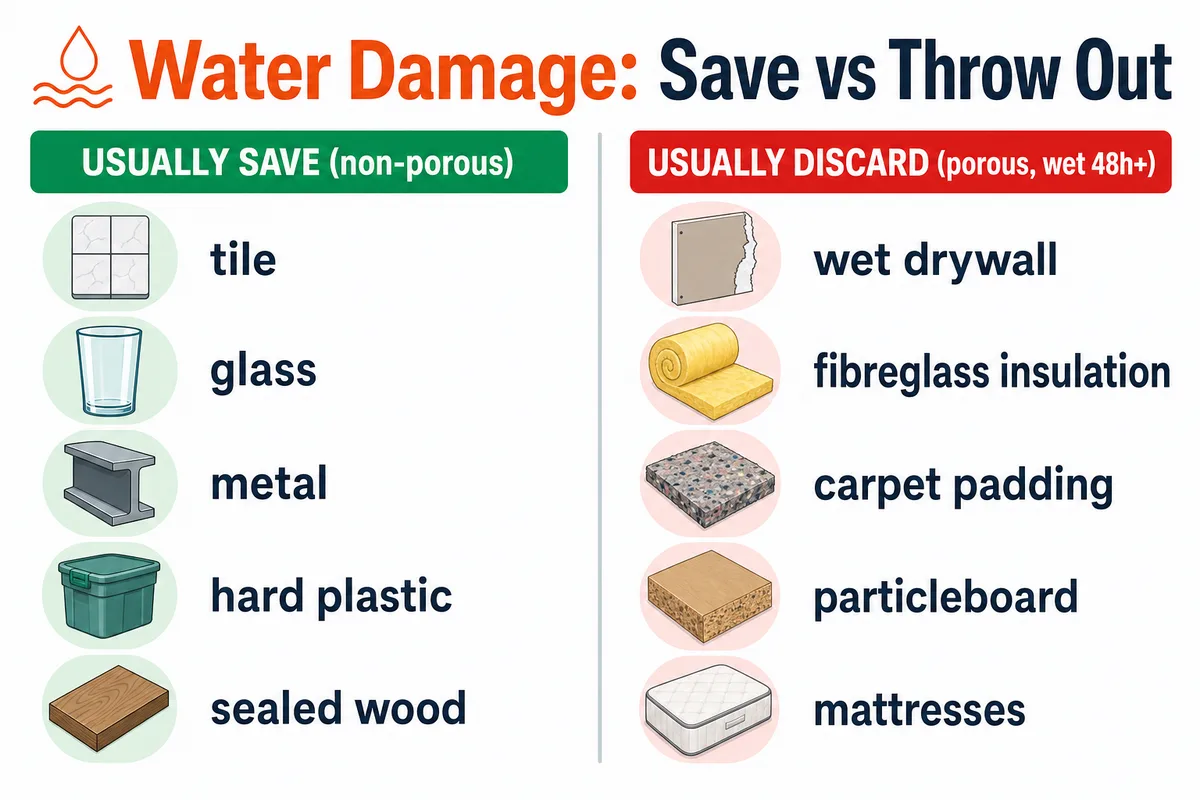
Non-porous and semi-porous items can often be cleaned and dried: tile, glass, metal, hard plastics, and solid sealed wood caught early. These shed water and can be disinfected on the surface. Porous items that soaked through should usually go: wet drywall (especially below the flood line), fibreglass insulation, carpet padding, particleboard, mattresses, upholstered furniture, and ceiling tiles. Drywall in particular wicks water well above the visible water line, which is why remediation crews cut it a foot or two above where the staining stops. You can’t reliably dry the inside of a wall cavity by wiping the surface.
When mold has already taken hold in drywall or spread across a basement, the affected material comes out rather than gets cleaned. Surface-scrubbing a porous material that’s colonized inside just spreads spores around.
DIY or Professional: Where’s the Line?
You can handle small, clean water-damage mold yourself. Beyond a certain point, you can’t, and trying makes it worse. The thresholds are clearer than most people expect.
You Can DIY When
- The mold covers less than about 10 square feet
- The water was clean (Category 1)
- It’s on a non-porous surface
- You caught it early, within a day or two
- Nobody in the home has asthma or a weak immune system
Call a Professional When
- The mold covers more than 10 square feet
- The water was Category 3 (sewage or river flooding)
- Materials stayed wet longer than 48 hours
- There’s mold inside wall cavities or HVAC
- You smell mold but can’t find the source
Health Canada and the EPA both point to roughly 10 square feet as the practical DIY ceiling for mold cleanup. Under that, with proper PPE, you can manage it. Ventilate the area and never mix cleaning chemicals (bleach and ammonia together produce toxic gas). That persistent musty smell with no visible source matters. A smell with no visible mold almost always means it’s growing somewhere you can’t see, and that’s exactly what our inspectors find. Our comparison of professional versus DIY mold removal lays out the trade-offs.
An N95 respirator (not a cloth or surgical mask), nitrile or rubber gloves, and sealed goggles. If you’d need more protection than that to feel safe, the job is past DIY.
Does Home Insurance Cover Mold in Canada?
Sometimes, and the details decide it. Most Canadian home insurance policies cover water damage and resulting mold only when the cause was sudden and accidental, not gradual. This single distinction is why so many mold claims get denied, and it’s worth understanding before you ever need to file.
A burst pipe, a failed water heater, or an appliance that suddenly floods your kitchen is typically a covered “sudden and accidental” event, and the mold that follows is usually covered as a consequence. A slow leak under the sink that dripped for months, long-term seepage through a foundation, or poor maintenance is typically excluded as “gradual damage.” Insurers take the position that you should have caught and fixed it. Many policies also cap mold remediation specifically, or only cover it if you’ve added a mold rider or endorsement, so the dollar limit can be far lower than your overall water-damage coverage.
| Usually Covered | Usually Excluded |
|---|---|
| Burst or frozen pipe | Slow, long-term leaks |
| Sudden appliance failure | Gradual foundation seepage |
| Water heater rupture | Poor maintenance or neglect |
| Mold resulting from a covered event | Mold without a covered cause |
| Accidental overflow | Overland flooding (needs add-on) |
Photos and video of the source and the standing water are what separate a paid claim from a denied one. The faster you act and the better you document, the stronger your position.
Flooding from an overflowing river or heavy surface water (overland flooding) is a separate add-on coverage in Canada and isn’t included in standard policies. Given how routine spring freshet flooding is here, it’s worth checking whether you carry it. The remediation itself, once a claim is approved, follows standard pricing, and our mold remediation cost guide for Canadian homeowners breaks down what to expect.
Drying It Out Properly in a Cold Climate
Drying a flooded space in Canada isn’t the same as drying one in a warm climate, and following warm-weather advice can backfire. The goal is the same (get relative humidity below 50% and keep it there) but the method has to suit the season.
A lot of American guidance says to open the windows and let fresh air move through. In a Canadian winter, that often makes things worse. Cold outdoor air carries little moisture, but when it hits warm indoor surfaces it drives condensation, adding a humidity problem on top of the water problem. The reliable cold-weather approach is to seal the space, run a dehumidifier, and use air movers to keep air circulating across wet surfaces. Heat helps, but only paired with active dehumidification to capture the moisture you pull out of materials.
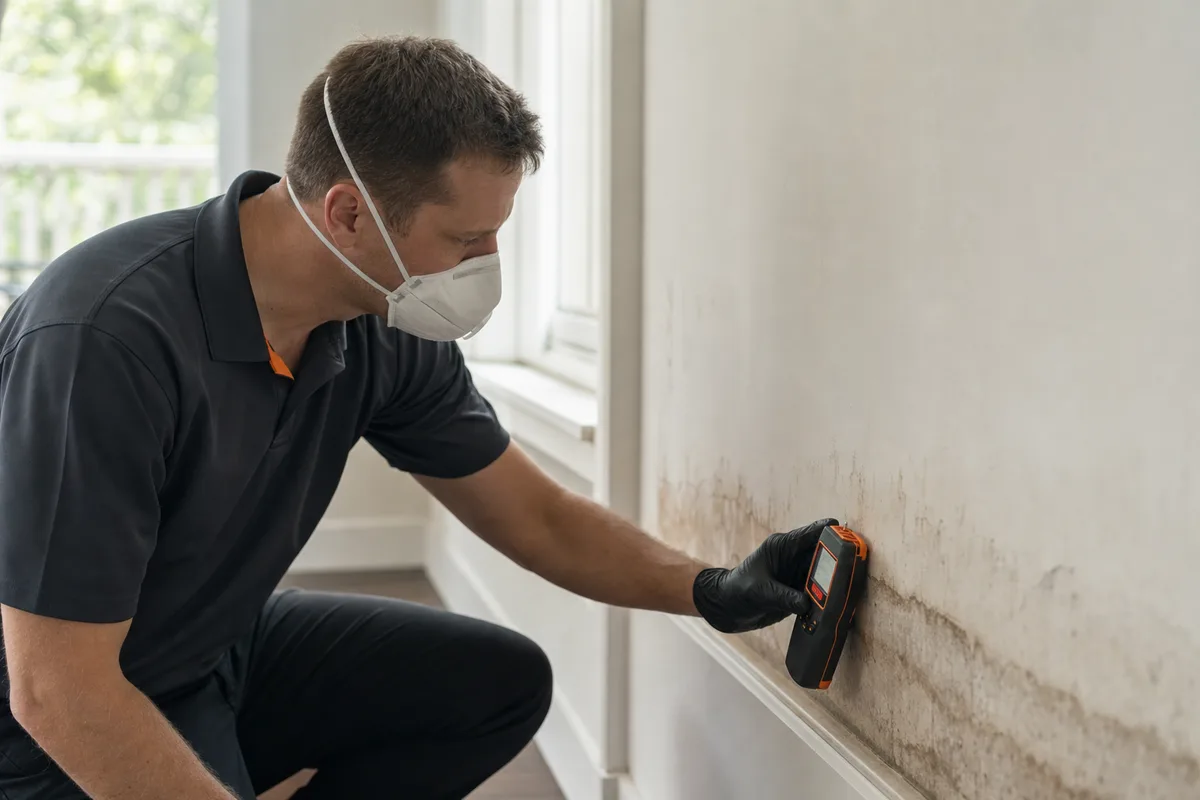
A wall can read dry on the surface while the cavity behind it is still saturated. A basic moisture meter is the single best tool a homeowner can buy for drying out after water damage.
That’s why professionals use moisture meters and infrared thermography to map where the water actually went. If you’re drying it yourself, our DIY home mold inspection guide explains how to use a moisture meter properly.
Health Risks of Mold After Water Damage
Mold from water damage can affect your health, and the risk climbs the longer it grows and the more porous material it colonizes. For most people the effects are allergy-like: sneezing, congestion, coughing, itchy eyes, and skin irritation. For people with asthma, allergies, or weakened immune systems, and for infants and the elderly, the effects can be more serious, including persistent respiratory problems.
Certain molds that flourish in long-standing water damage, Stachybotrys among them, can produce mycotoxins that raise the stakes further. We keep this section short on purpose, because our dedicated guides go deeper. For the full picture, see the health risks of mold exposure and learn to spot the early signs of mold in a home before they become a health issue. Mold also doesn’t stay where it started, so knowing where mold tends to grow after a flood helps you check the right places.
When to Call a Professional Inspector
Call us when the water damage is more than you can dry in 48 hours, when you can smell mold but can’t find it, or when you want to know what’s hiding behind the walls before it spreads. After a flood, visible mold is usually the smallest part of the problem. The colonies inside wall cavities, under flooring, and in insulation cause the lingering smell and the health complaints, and finding them takes moisture mapping and trained eyes.
Our inspectors serve the Ottawa and Montreal corridor, and we offer a free virtual mold inspection that’s ideal for an emergency, you can show us the damage over video and get fast guidance on whether it needs hands-on attention. For confirmed problems, a full on-site mold inspection maps the moisture and the spread, mold testing confirms the species and airborne levels, and mold removal and remediation handles the cleanup properly. Catch it early and the whole thing stays small.
Frequently Asked Questions
How fast does mold grow after water damage?
Mold can begin growing within 24 to 48 hours of water damage. Spores are already present in every building, so they only need the moisture and food a flood provides. By day three to seven you’ll usually see and smell it. Dry the space fully inside two days and you can often prevent mold entirely.
Can mold from water damage be removed completely?
Yes, when it’s addressed properly. Mold on non-porous surfaces can be cleaned and disinfected, while colonized porous materials like wet drywall and insulation are removed and replaced rather than cleaned. Complete removal means eliminating both the mold and the moisture source that fed it. If the moisture isn’t fixed, the mold comes back, which is why professional remediation always addresses the water problem first.
Does home insurance cover mold damage in Canada?
It depends on the cause. Most Canadian policies cover mold from sudden and accidental water damage, like a burst pipe, but exclude mold from gradual leaks or poor maintenance. Many policies also cap mold remediation or require a mold rider, and overland (river or surface) flooding needs separate add-on coverage. Always document the damage the moment it happens to support your claim.
What should I throw away after water damage?
Porous materials that stayed wet for more than 48 hours usually need to go: wet drywall, fibreglass insulation, carpet padding, particleboard, mattresses, and upholstered furniture. Non-porous items like tile, glass, metal, and sealed wood can typically be cleaned and saved. When in doubt, materials that absorb water and can’t be fully dried inside are safer discarded than kept.
Is it safe to stay in a house with water damage and mold?
For small, fresh, clean-water damage, usually yes, as long as you’re drying it quickly. For larger infestations, Category 3 (sewage) water, or if anyone in the home has asthma, allergies, or a weakened immune system, it’s safer to limit exposure and get a professional assessment. A persistent musty smell, worsening allergy symptoms, or visible mold over a large area all signal it’s time to take it seriously.
How do I dry out my home after water damage in winter?
In cold weather, seal the affected space and run a dehumidifier with air movers rather than opening windows. Cold outdoor air can cause condensation indoors and make humidity worse. Aim to keep relative humidity below 50%, use heat alongside active dehumidification, and check inside wall cavities with a moisture meter, since surfaces can read dry while the structure behind them is still wet.
How much does water damage mold removal cost in Canada?
It varies with the size of the affected area, the materials involved, and how far the mold spread. Small surface cleanups are modest, while remediation that requires removing drywall, insulation, and flooring across a flooded basement costs considerably more. Our mold remediation cost guide breaks down the pricing factors and typical ranges for Canadian homes.
When should I call a professional after water damage?
Call a professional when the mold covers more than 10 square feet, the water was contaminated, materials stayed wet longer than 48 hours, you smell mold but can’t find it, or anyone in the home has health vulnerabilities. Professionals find hidden moisture inside walls and under floors that surface drying misses, which is the part that causes most lingering problems after a flood.