
Mold on Ceiling: Diagnose, Remove and Stop It Coming Back
Mould on a ceiling is a moisture problem with a ceiling-shaped symptom. Find the source, fix it, and the mould stays gone — this is the Canadian-climate diagnostic and removal guide we use on real inspections.
Why You Found Mould on Your Ceiling
Mould on a ceiling is almost never a ceiling problem. It is a moisture problem with a ceiling-shaped symptom. Something above the drywall — a leak, condensation against a cold surface, or sustained indoor humidity — is feeding a microscopic colony, and the dark spots you can see from the floor are the late warning sign.
After 20 years of inspecting Canadian homes, our team has learned that the species, the colour, and the size of the patch matter far less than the answer to one question: where is the water coming from. Get that right and the rest of the work is straightforward. Get it wrong and the mould returns in eight to twelve weeks, regardless of how thoroughly you scrubbed the surface or how many coats of stain-blocking primer you painted over it.
This guide walks you through how to read a ceiling mould patch as a diagnostic clue, how to tell white from black mould on a ceiling and why it matters, the most common Canadian causes — including one that no general DIY site covers — how to remove it safely, and how to keep it from coming back. We also cover what mould on a ceiling means for your health and your home insurance.
If you see mould on your ceiling, the colony is being fed by a leak from above, condensation on a cold surface, or sustained indoor humidity above 60%. Diagnose the moisture source first. Cleaning a ceiling without fixing the source guarantees the mould returns. Patches over ten square feet (about three feet by three feet) warrant professional remediation under both Health Canada and US EPA guidance.
For a primer on the biology, see what mould actually is.
Diagnose the Cause: Leak vs Condensation vs Humidity
Three things put water on the back of a ceiling: an active leak from above, condensation forming on a cold surface, or sustained indoor humidity high enough that moisture migrates through the paint film. Each one points to a different fix. Misdiagnosing the cause is the single most expensive mistake homeowners make on ceiling mould, because the visible cleanup looks the same in all three cases.
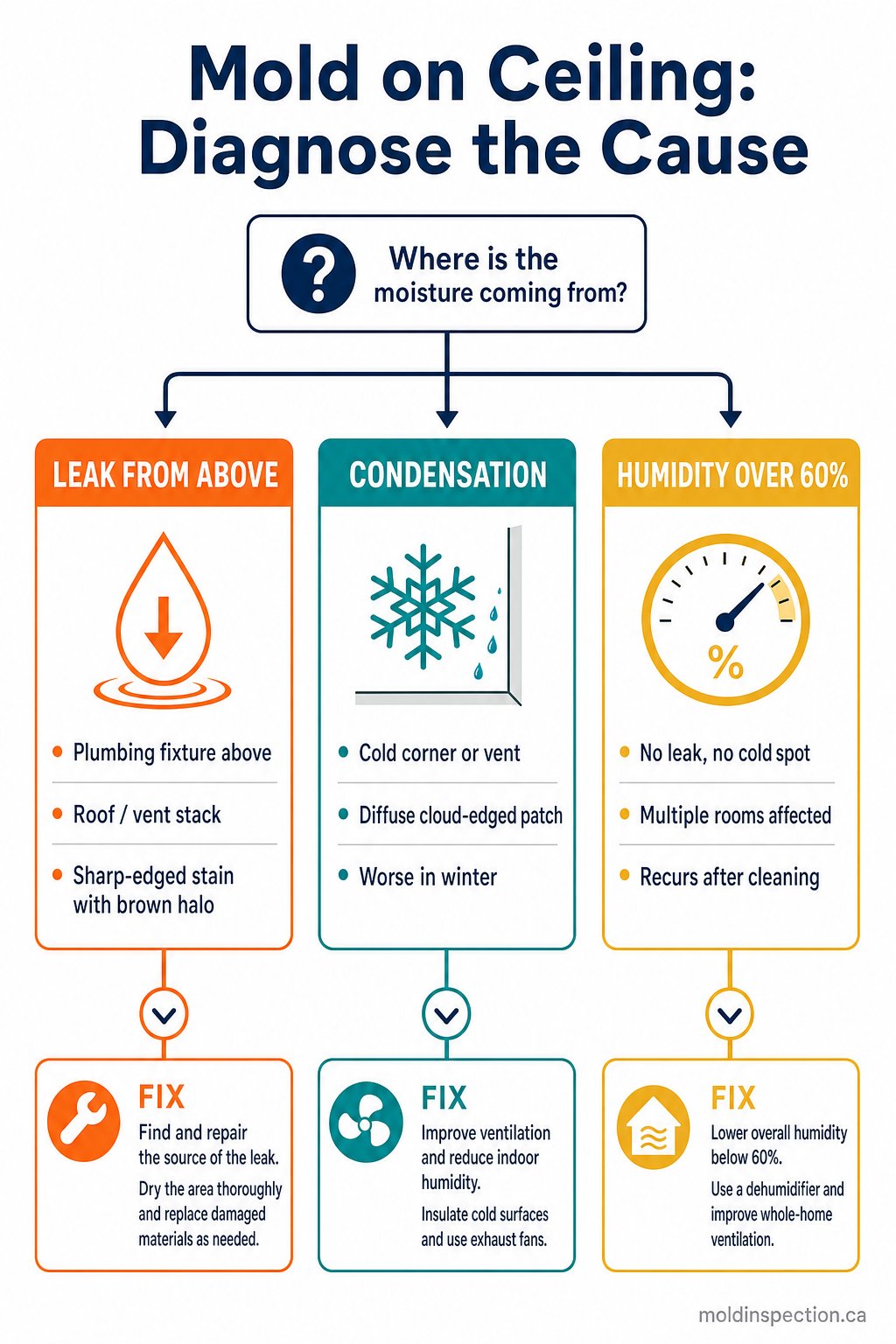
Run this five-question diagnostic before you do any cleaning work. The answers tell you what you are actually dealing with.
Is the patch directly under a bathroom, kitchen, or roof feature?
If yes — under a second-floor bathroom, an upstairs laundry, a roof valley, a vent stack, or a skylight — treat plumbing or roof leak as the first suspect. Active leaks produce sharp-edged stains with a brown or amber halo, often with the mould concentrated at the leak point and radiating outward.
Is the patch in a corner, along an exterior wall, or around a ceiling vent?
If yes, condensation is the most likely cause. Condensation patches grow in cold spots — where two exterior walls meet, where ceiling drywall touches an under-insulated attic, or where humid air hits the cold metal of a bathroom exhaust vent. The mould forms a diffuse cloud rather than a sharp halo, and it gets worse in winter.
Has indoor humidity been above 60% for weeks?
Pick up a hygrometer (under thirty dollars at any hardware store) and check the reading. Sustained relative humidity above 60% will produce mould on ceilings even without a leak, especially on the upper edges of poorly ventilated rooms. Health Canada and the Canada Mortgage and Housing Corporation both recommend keeping indoor humidity below 50% in winter and below 60% year-round.
Does the patch recur after you clean it?
Recurrence within four to eight weeks confirms that the moisture source is still active. Cleaning the surface without solving the moisture problem is a temporary fix — the mould comes back almost on schedule.
Is there staining along the ceiling-wall joint or running down the wall?
Drip stains and tide-marked water lines indicate liquid water — almost always a leak rather than condensation or humidity. Follow the water uphill to find the source before you do anything else.
Match your answers to the matching section below. If your diagnosis points to a complete inspection, our DIY mould inspection checklist walks through the same logic in more detail.
White vs Black Mould on Ceilings: How to Tell
The colour of mould on a ceiling tells you something useful about what species you are looking at, how serious it is likely to be, and how aggressive your removal needs to be. It does not, however, tell you whether the mould is “toxic” — that is a marketing claim, not a clinical one, and Health Canada is explicit that no indoor mould of any colour belongs in your home.
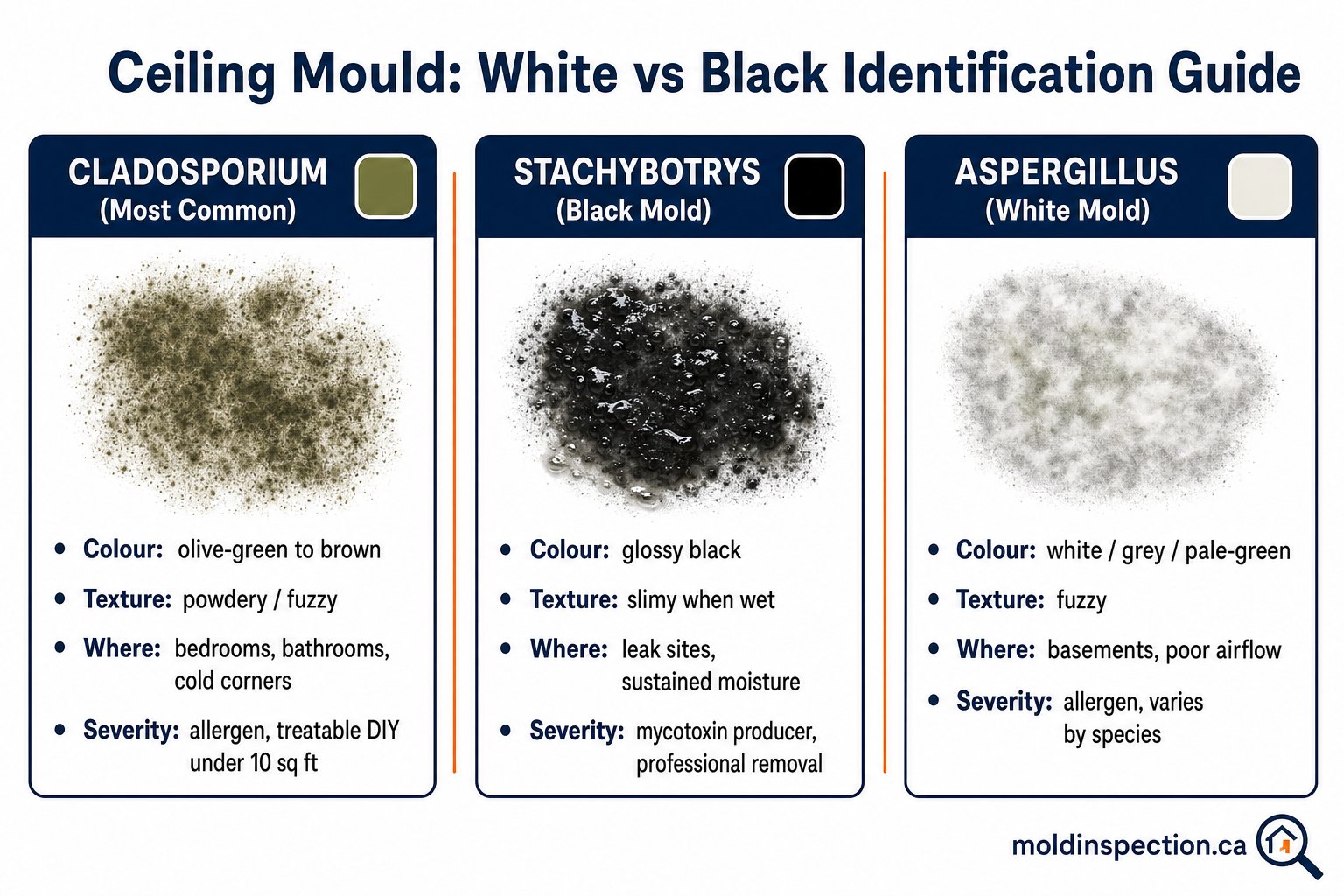
That said, three species cover almost every ceiling-mould case we inspect in Ontario and Quebec.
Cladosporium — Most Common
Olive-green, brown, or black, often with a slightly fuzzy texture and a powdery surface. Cladosporium grows readily on painted drywall and prefers cool conditions, which is why it shows up on bedroom and bathroom ceilings during cold-weather condensation events. Allergen, asthma trigger, not classified as toxigenic.
Stachybotrys — Black Mould
Glossy black, often slimy or wet-looking when active. Grows on cellulose-rich materials — paper-faced drywall, ceiling tiles, wallpaper backing. Requires sustained moisture, usually from a leak. Produces mycotoxins and is the species most associated with the health risks of black mould exposure.
Aspergillus — White Mould
White, grey, or pale-green fuzzy patches, sometimes with darker centres. White mould on a ceiling is most often Aspergillus, and it is more common in basements and rooms with poor air circulation. Allergenic; a small subset of species are toxigenic.
Mould on Bathroom Ceilings (Brief Overview)
Bathrooms are by far the most common location for ceiling mould in a Canadian home. The combination of frequent humidity spikes during showers, exhaust fans that vent into unconditioned attics instead of outside, and bathroom ceiling drywall that often runs uninsulated against the underside of the roof deck creates near-ideal mould-growth conditions on a daily cycle.
The cause is almost always one of three things: an exhaust fan that does not actually vent outdoors (a common building defect, especially in homes built before 2005), an exhaust fan sized too small for the bathroom volume, or a habit of leaving the fan off during and after showers. The fix is mechanical, not chemical — running the fan for at least twenty minutes after every shower, verifying it actually vents through the roof or soffit (not just into the attic cavity), and replacing under-rated fans with a unit sized to move at least 80 cubic feet per minute for a standard residential bathroom.
Bedroom Ceiling Mould
Bedroom ceiling mould is the second most common case we see, and it almost always traces to either condensation or sustained humidity rather than an active leak. The contributing factors are sleeping bodies (two adults sleeping in a closed room release nearly a litre of moisture into the air over an eight-hour night), poor air circulation if the bedroom door is closed, and cold spots on the ceiling where it meets exterior walls.
The pattern is recognizable. Bedroom mould tends to form in the corner where the ceiling meets two exterior walls, or along the perimeter of the ceiling within twelve to eighteen inches of the exterior wall. The patch is usually diffuse, cloud-edged, and grey-green or olive — typical Cladosporium. It rarely involves a sharp halo or a single drip point.
Basement Ceiling Mould (Joists and Drywall)
Mould on a basement ceiling is a different problem from upstairs mould, because the cause is usually below the ceiling rather than above it. Rising humidity from a damp basement floor, foundation moisture, or a dehumidifier that cannot keep up creates conditions for mould to colonize the underside of floor joists and basement-ceiling drywall.
The species you see down here is more often Aspergillus or Penicillium — white, grey, or pale-green — because basements run cooler and the substrate is often wood framing rather than paper-faced drywall. Visible mould on the joist surfaces, on the basement side of insulation, and on the rim joist where the wall framing meets the basement ceiling is common in older Ontario and Quebec homes.
Attic-Bypass Condensation: The Canadian Wedge
If your ceiling mould is on the top-floor ceiling, in a winter-prone room, with no plumbing fixtures or roof penetrations above it, the cause is almost certainly attic-bypass condensation. This cause is specific to cold-climate countries and almost completely absent from the general English-language coverage of ceiling mould, which is dominated by US sources writing for milder climates.
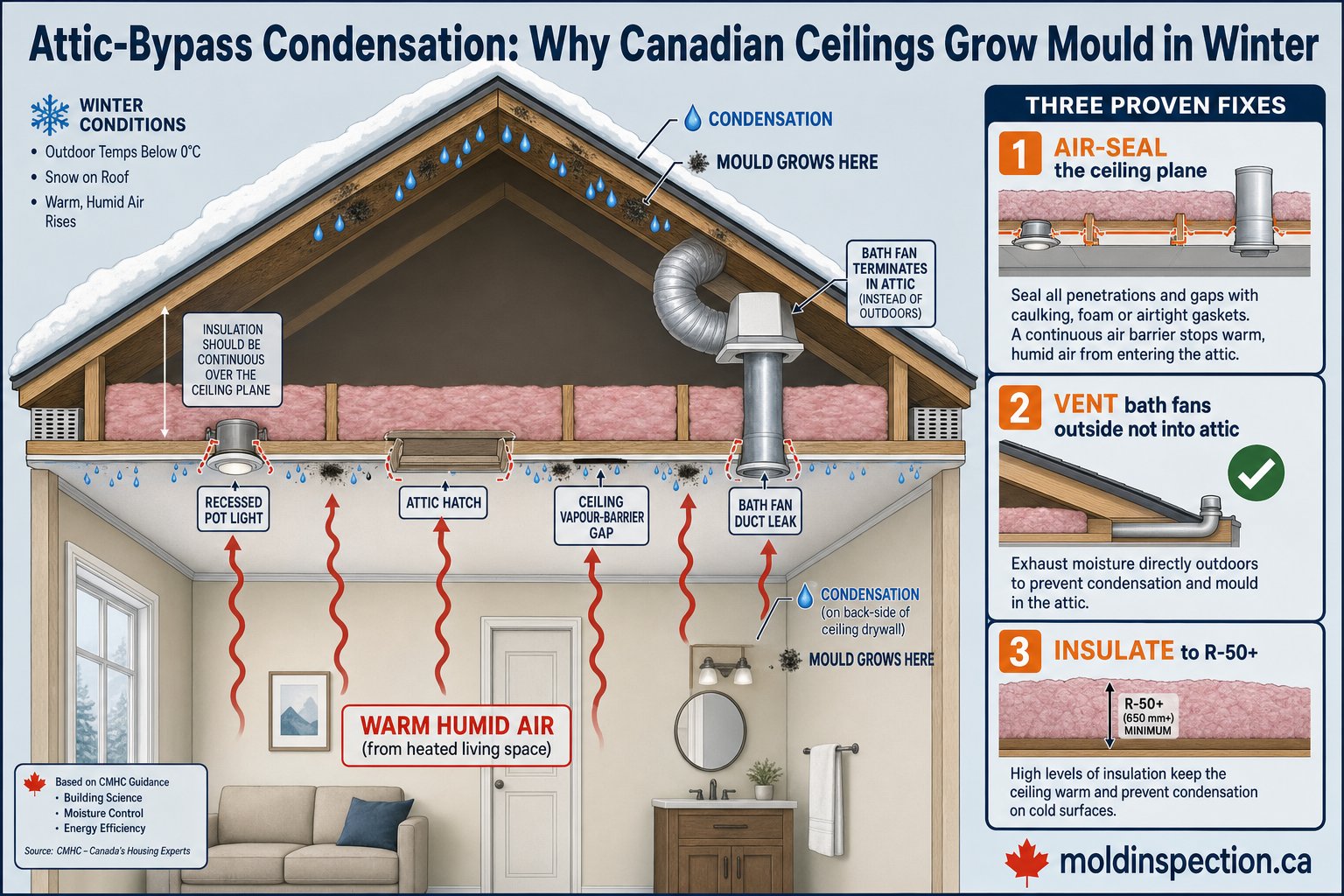
Here is what happens. Warm, humid air from the heated part of the house leaks into the cold attic through small air gaps — around recessed light fixtures, attic hatches, plumbing chases, electrical penetrations, bathroom exhaust ducts that terminate in the attic, and gaps in vapour barriers. When that humid air hits the cold underside of the roof deck or the cold attic-side of the ceiling drywall in winter, the moisture condenses. Over weeks and months, that condensation soaks the back of the ceiling drywall and feeds mould growth that homeowners only see from inside the house months later, often during the spring melt.
The diagnostic signature is recognizable: the patches form in winter, often along framing lines (where wood conducts cold faster than insulation), they show up in rooms below the attic rather than under bathrooms or plumbing, and they get worse year over year as the air leaks widen and the attic vapour load grows. The companion problem is usually ice damming along the eaves.
How to Remove Ceiling Mould (DIY)
For mould patches under ten square feet, without active water damage, on accessible ceilings, with no vulnerable occupants in the household, DIY removal is reasonable. Anything beyond those limits warrants a professional inspection. The protocol below assumes you have already diagnosed and fixed the moisture source — skip that step and the mould will return within two months.
Set up containment and ventilation
Lay plastic sheeting on the floor and over any furniture you cannot move. Open a window in the room to provide makeup air, but close interior doors to other rooms so you do not spread spores through the house. Turn off the HVAC system and tape over any return-air grilles in the work area.
Put on personal protective equipment
A properly fitted N95 respirator is the minimum; for larger patches or visible black mould, step up to a P100 elastomeric respirator. Wear safety glasses, nitrile gloves, and old clothes you can launder hot or discard. Set up a stable, rated stepladder and do not work alone — falls are the most common ceiling-mould injury, not chemical exposure.
HEPA-vacuum the patch dry
Before you wet anything, vacuum the visible mould with a HEPA-filtered vacuum to capture loose spores. Skipping this step turns the next stage into a slurry that smears spores across the ceiling instead of removing them.
Clean with a porous-surface-appropriate solution
The US EPA explicitly advises against bleach for porous materials like drywall — bleach disinfects the surface but cannot penetrate the paper backing where the colony actually lives. Use a commercial mould-remediation cleaner, a dilute solution of dish detergent and warm water, or a vinegar-and-water solution. Apply with a microfiber cloth or sponge, wipe in one direction, and rinse with clean water.
Inspect the substrate and decide on replacement
If after cleaning the drywall surface is soft, sagging, or visibly stained through, the paper backing is compromised and the section needs to be cut out and replaced — paint will not hold and mould will recur. For minor surface staining without substrate damage, seal with a shellac-based stain-blocking primer (oil-based and water-based primers both fail to block tannin staining and embedded spores reliably). Then paint with two coats of standard ceiling paint.
Dispose and clean up
Bag all cleaning materials, cloths, and any drywall removed in heavy-duty contractor bags, seal them, and dispose with regular waste. HEPA-vacuum the room, including walls and floors. Launder work clothes separately in hot water.
When to Call a Professional
The Health Canada Residential Indoor Air Quality Guideline on Moulds and the US EPA Mold Remediation in Schools and Commercial Buildings both use ten square feet — about a three-foot-by-three-foot patch — as the threshold above which professional remediation is recommended. That threshold is a useful starting point but it is not the only signal.
Level 1 — Minor (DIY range)
Patch under ten square feet, single location, no active leak, no vulnerable occupants. Clean within a week using the protocol above. Verify the moisture source is fixed before painting.
Level 2 — Moderate (Inspection recommended)
Patch over ten square feet, or multiple smaller patches across rooms, or recurrence within two months of a previous cleanup. Indicates a building-envelope or ventilation problem that needs diagnosis before more cleaning. Schedule a professional inspection.
Level 3 — Extensive (Stop and call)
Visible water damage, sagging drywall, active dripping, mould on a ceiling with HVAC ductwork running through it, or any household member with asthma, COPD, severe allergies, immune suppression, pregnancy, or under three years old. Stop DIY work, leave the area, and call a certified remediation team.
Call a certified mould inspector when any of the following apply: the patch is larger than ten square feet, there is visible water damage or sagging, the mould keeps coming back within two months of cleaning, someone in the household is in a vulnerable category, or the mould is on a ceiling with HVAC ductwork that can spread contamination to other rooms.
For typical professional remediation pricing in Canadian homes, including a breakdown by patch size and substrate, see our ceiling mould remediation cost in Canada guide.
Prevent It from Coming Back
Three habits prevent more than 90% of the ceiling-mould recurrences our inspectors see on follow-up visits.
Keep humidity below 50%
Health Canada and CMHC both publish 30–50% relative humidity as the indoor-air target. A $15 hygrometer measures it; a properly sized dehumidifier in basements and bath fans run for twenty minutes after every shower fix high readings. Summer humidity reliably climbs above 60% in basements without active dehumidification.
Vent moisture outdoors
Bathroom, kitchen, and laundry exhaust fans must terminate outdoors — through a roof cap, a soffit cap, or a gable wall — not into the attic. Venting moist air into an attic is a building-code violation in every Canadian province and a leading cause of attic-bypass condensation. Climb into the attic and follow the duct if you do not know where yours vents.
Maintain the attic
Adequate soffit-to-ridge ventilation, uninterrupted vapour barriers, and Canadian-climate-appropriate insulation levels are the long-term defence against the attic-bypass condensation that drives most top-floor ceiling mould. CMHC recommends a minimum effective R-50 for attic ceilings in most of Ontario and Quebec.
| Province | Winter target RH | Summer target RH | Recommended attic R-value |
|---|---|---|---|
| Ontario | 30–40% | 45–55% | R-50 to R-60 |
| Quebec | 30–40% | 45–55% | R-50 to R-60 |
| British Columbia | 35–45% | 50–60% | R-40 to R-50 |
| Alberta | 25–35% | 40–50% | R-50 to R-60 |
| Manitoba & Saskatchewan | 25–35% | 40–50% | R-60 to R-70 |
| Atlantic provinces | 30–40% | 50–60% | R-50 to R-60 |
Source: synthesized from CMHC About Your House: Moisture and Air and Health Canada Residential Indoor Air Quality Guideline on Moulds. Consult your provincial building code for current insulation requirements.
Frequently Asked Questions
What causes mould on the ceiling?
Mould on a ceiling is caused by a moisture source above or adjacent to the ceiling drywall, combined with a food source (paper-faced drywall, paint film, or wood framing) and time. The three most common moisture sources are an active leak from above (plumbing, roof, or appliance), condensation forming on cold drywall where humid indoor air contacts a cold ceiling surface, and sustained indoor humidity above 60%. Diagnosing which of the three is the cause is the first step in any effective remediation.
How do you remove mould from ceiling?
For patches under ten square feet, the protocol is: contain the area with plastic sheeting and closed doors, put on an N95 respirator and gloves, HEPA-vacuum the dry mould, wipe with a porous-surface cleaner like dish soap or vinegar (not bleach on drywall), inspect the substrate for soft or sagging material that needs cutting out, prime with a shellac-based stain-blocking primer, and repaint. For patches over ten square feet, professional remediation is recommended by Health Canada and the US EPA. Fix the moisture source before any cleanup — otherwise the mould returns within two months.
Is mould on ceiling dangerous?
Mould on a ceiling is not immediately dangerous to most healthy adults at small patch sizes, but it should not be ignored. It produces spores and microbial volatile organic compounds that affect indoor air quality and trigger allergic and asthmatic reactions in sensitive people. Health Canada classifies any indoor mould as a health concern and recommends remediation regardless of species. The risk is higher for children under three, pregnant individuals, people with asthma or COPD, and anyone with immune suppression — they should leave the home during cleanup.
Can mould on ceiling make you sick?
Yes, ceiling mould can cause symptoms in susceptible people: chronic coughing, sinus congestion and irritation, headaches, eye and skin irritation, and asthma flares. About 10% of the population is allergic to indoor moulds, and about 5% experience asthmatic responses. Stachybotrys chartarum, the species most associated with “black mould,” produces mycotoxins linked to more serious respiratory symptoms in case reports, though the evidence on long-term toxicity at residential exposure levels remains under active scientific debate. For details on symptoms and risk groups, see our guide to health risks of black mould exposure.
What does mould on ceiling look like?
Ceiling mould most often appears as olive-green, grey-green, brown, or black patches with a fuzzy or powdery surface texture. Diffuse, cloud-edged patches in corners and along exterior walls usually indicate condensation-driven Cladosporium growth. Sharp-edged stains with a brown or amber halo around the centre indicate an active leak, often with Stachybotrys (glossy black, sometimes slimy when wet). White or grey fuzzy patches on basement ceilings are usually Aspergillus or Penicillium. Surface staining without raised texture is more likely to be water staining than mould, but moisture damage often precedes mould growth and warrants the same investigation.
Can you paint over mould on ceiling?
Painting over visible mould without removing it is the single most common ceiling-mould mistake. Mould pushes through paint within weeks because the colony is alive on the paper backing of the drywall, not just on the surface. The right sequence is: HEPA-vacuum the mould, clean the surface with an appropriate solution, inspect the drywall for soft or sagging material (replace if compromised), apply a shellac-based stain-blocking primer (not water- or oil-based, which fail at blocking tannin and spore staining), and only then paint two finish coats. Painting first and hoping the mould stays under the paint guarantees recurrence.
Does homeowners insurance cover mould on ceiling?
Homeowners insurance in Canada generally covers mould only when it results directly from a sudden, accidental, named-peril event — for example, a burst pipe, a sudden roof leak from a windstorm, or an appliance failure that floods a ceiling. Mould caused by gradual leaks, ongoing humidity, condensation, or building maintenance issues is almost universally excluded as “gradual damage” or “wear and tear.” Many Canadian insurers also cap mould coverage even on covered claims (typical limits run $5,000 to $25,000). Document the source of the moisture, photograph the damage immediately, and read your policy’s mould endorsement carefully before filing — insurer denial rates on mould claims are higher than for almost any other peril.
How do I prevent mould on the ceiling?
Keep indoor relative humidity between 30% and 50% year-round using dehumidifiers in basements and consistent use of bath and kitchen exhaust fans. Verify that every moisture-producing exhaust fan in the home vents directly outdoors, not into the attic. Maintain attic insulation at the Canadian-climate-appropriate R-value for your province (R-50 to R-70 in most of Ontario, Quebec, and the Prairie provinces) and ensure soffit-to-ridge or soffit-to-gable attic ventilation is unobstructed. Inspect the roof and any second-floor plumbing for leaks twice a year, especially after winter and after heavy spring rain. These four habits prevent the moisture sources that cause more than 90% of the ceiling-mould cases our inspectors see.
Talk to a Mould Inspector
If you are not sure whether the mould on your ceiling is a DIY job or needs a professional, a free virtual inspection gives you a certified opinion before any on-site cost. Send a few photos, describe the room, and we tell you what you are looking at and what to do next.