
Basement Mold: Removal, Prevention & Cost in Canada
Basement mold (also spelled “basement mould” in Canadian and British English) is fungal growth on the walls, floor, framing, or stored items inside a basement — almost always caused by long-term moisture from foundation seepage, plumbing leaks, or condensation. In Canadian homes, the basement is the single most common place to find mold in basement spaces because of below-grade humidity, spring snowmelt, and cold concrete walls that meet warm indoor air. Once a damp surface stays wet for 24 to 48 hours, a basement mold colony can establish, and a mature colony releases millions of spores into the air your family breathes.
This guide covers basement mold removal, basement mold remediation, basement mold prevention, basement mold control, the most common basement mold types, the safe humidity range for a Canadian basement, and the basement mold removal cost you should expect in Ontario and Quebec. White mold and mold on concrete — the two most-asked basement-specific questions — each get their own dedicated section below. If you already see or smell mold in your basement, our team offers a free virtual mold inspection across Ontario and Quebec — no service-call fee, results in 24 to 48 hours.
Health Canada states there is no safe exposure level for indoor mold and recommends keeping indoor humidity below 50%. Persistent visible mold should be removed regardless of species. Treat any patch larger than a sheet of paper as a problem worth investigating.
How to Spot Basement Mold Before It Spreads
Basement mold rarely arrives all at once. The early warning signs of mold in basement environments are visual, olfactory, and structural — you usually see, smell, or feel something wrong before any health symptoms appear. Catching basement mold early keeps a $150 cleanup from becoming a $5,000 remediation.
Visual Warning Signs
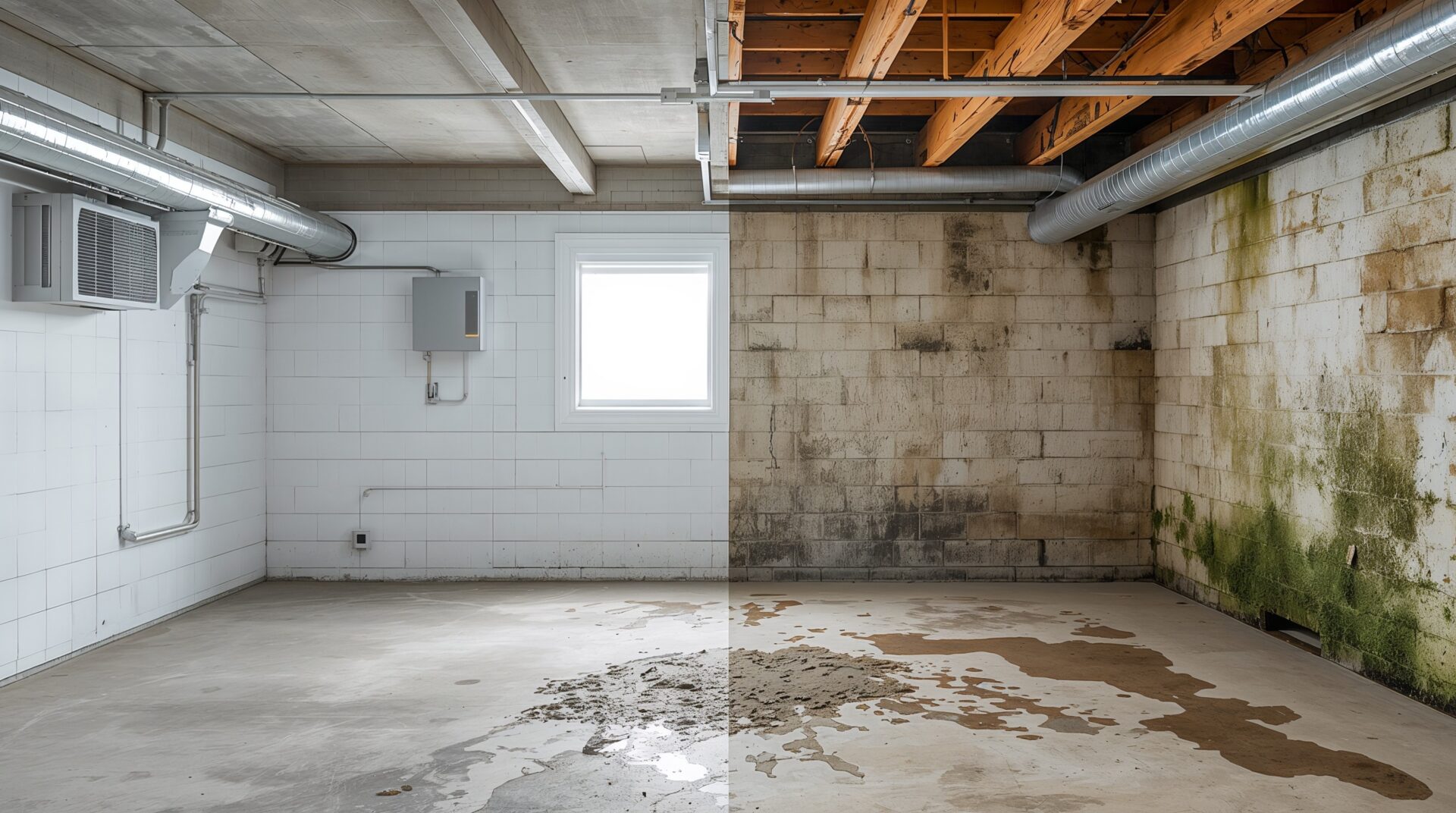
- Black, green, white, yellow, or pink-orange patches — classic visual signs of mold in basement walls, floor, framing studs, joists, or insulation backing.
- Water staining or efflorescence — the white salt residue that wicks through concrete is not mold itself, but it confirms the moisture migration that lets mold grow.
- Peeling or bubbling paint, warped baseboards, or drywall that gives way under finger pressure — mold colonies often hide behind these surfaces.
- Visible spores on stored items — cardboard boxes, fabric, leather, books, and wooden furniture pick up mold faster than the basement structure itself.
The Smell Test
A musty, earthy, “old-book” odour is the most reliable early signal of mold in basement environments. The smell is caused by microbial volatile organic compounds (MVOCs) that the colony releases as it grows. If the basement smells musty even when it looks dry, hidden mold behind drywall, under flooring, or inside HVAC ducts is the most common explanation. We cover this in detail in the musty smell in basement section below.
Where to Look First for Mold in Your Basement
- Behind and under stored boxes pushed against exterior walls.
- Around the base of the furnace, water heater, sump pump, and laundry hookups.
- The lower 12 inches of all concrete walls (where moisture wicks up from the slab).
- Under wall-to-wall carpet, especially if the carpet has ever been wet.
- Above suspended ceiling tiles — pipe leaks often appear there first.
- Inside the cold-air return duct and around HVAC condensation lines.
If you find growth in any of these spots, our professional mold testing services can identify the species and concentration so you know exactly what you are dealing with.
What Causes Mold in a Canadian Basement
Every basement mold problem — whether you call it basement mold or basement mould — traces back to one of three moisture sources. Identifying which one is feeding the colony is the first step of any basement mold remediation that actually holds.
1. Foundation Seepage
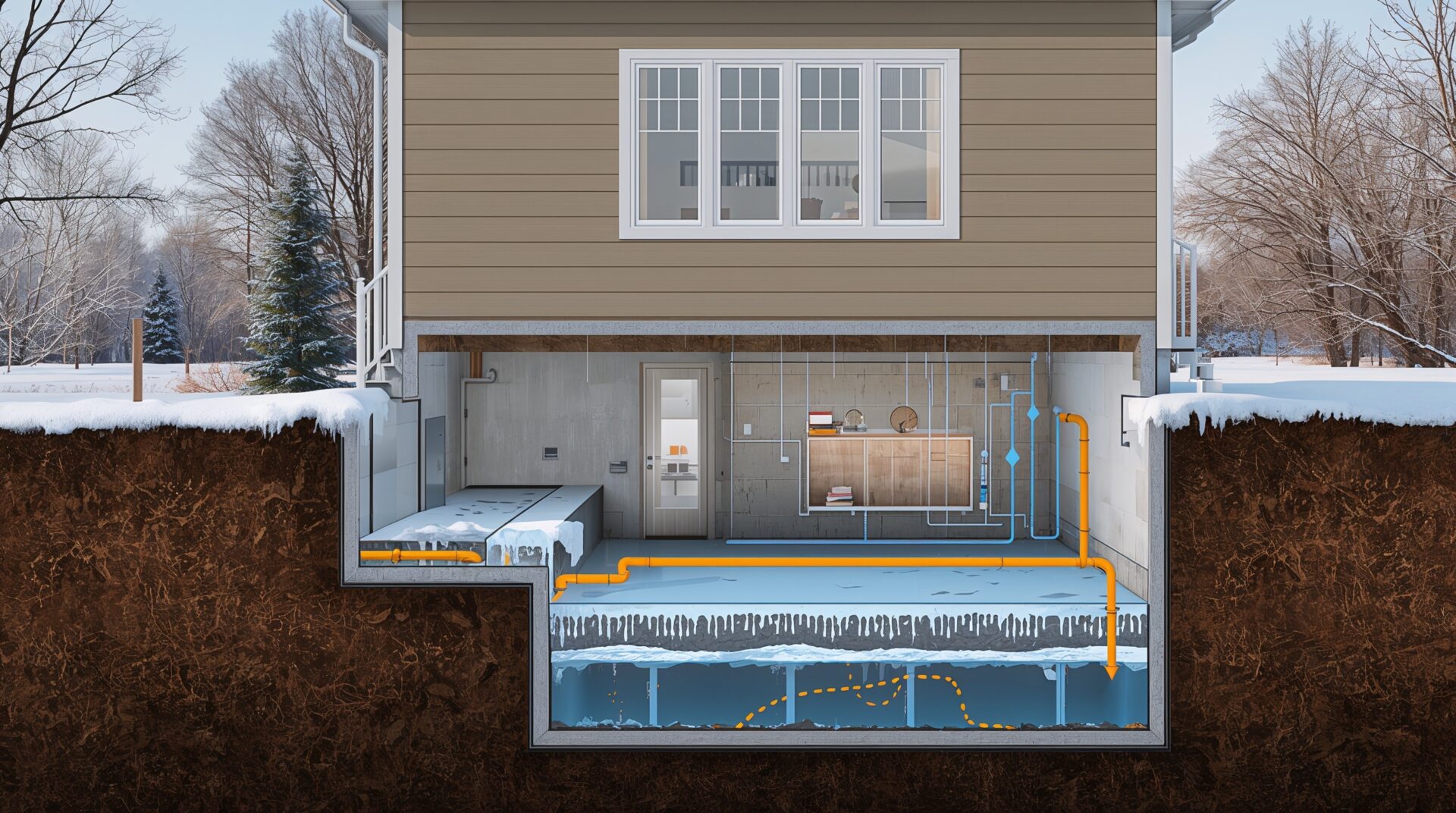
Foundation seepage is the leading cause of mold in basement walls. Hairline cracks in poured concrete, crumbling parging in older Ottawa and Montreal homes, and clogged weeping tile around the footing all let groundwater migrate inward. Spring snowmelt and Ottawa-River-watershed freshet conditions in March and April raise the water table and put hydrostatic pressure on the entire foundation perimeter. Even a “dry” basement can absorb enough moisture through the concrete to support mold on the inside face of the wall.
2. Plumbing and Appliance Leaks
Slow pinhole leaks behind washing machine hookups, dishwasher supply lines, water heaters, and ABS drain joints feed mold for months before anyone notices. Burst pipes during a Canadian deep-freeze are the single most common emergency cause of basement mold — the water sits, the colony establishes within 48 hours, and the homeowner discovers the damage weeks later.
3. Condensation and High Humidity
This is the source most homeowners underestimate. Warm indoor air carries water vapour. When that vapour meets a cold concrete wall, an uninsulated cold-water pipe, or the metal jacket of a window well, it condenses into liquid water on the surface. Repeat that cycle every winter day for a few months and you have a mold colony, even with no leak anywhere in the building. Signs of mold in homes covers the broader pattern across the rest of the house.
In Ontario and Quebec, the worst basement-mold conditions stack up in late March through May (snowmelt + warming air) and August (peak humidity). Winter looks safe but actually drives more condensation problems than any other season because indoor heating widens the indoor-outdoor temperature gap.
Safe Basement Humidity Levels for Canadian Homes
Basement humidity is the single most controllable risk factor for mold in basement spaces, and basement mold control starts with knowing the safe range. The basement humidity level numbers below are pulled from Health Canada and the Canadian Home Builders’ Association and apply to homes across Ontario and Quebec year-round.
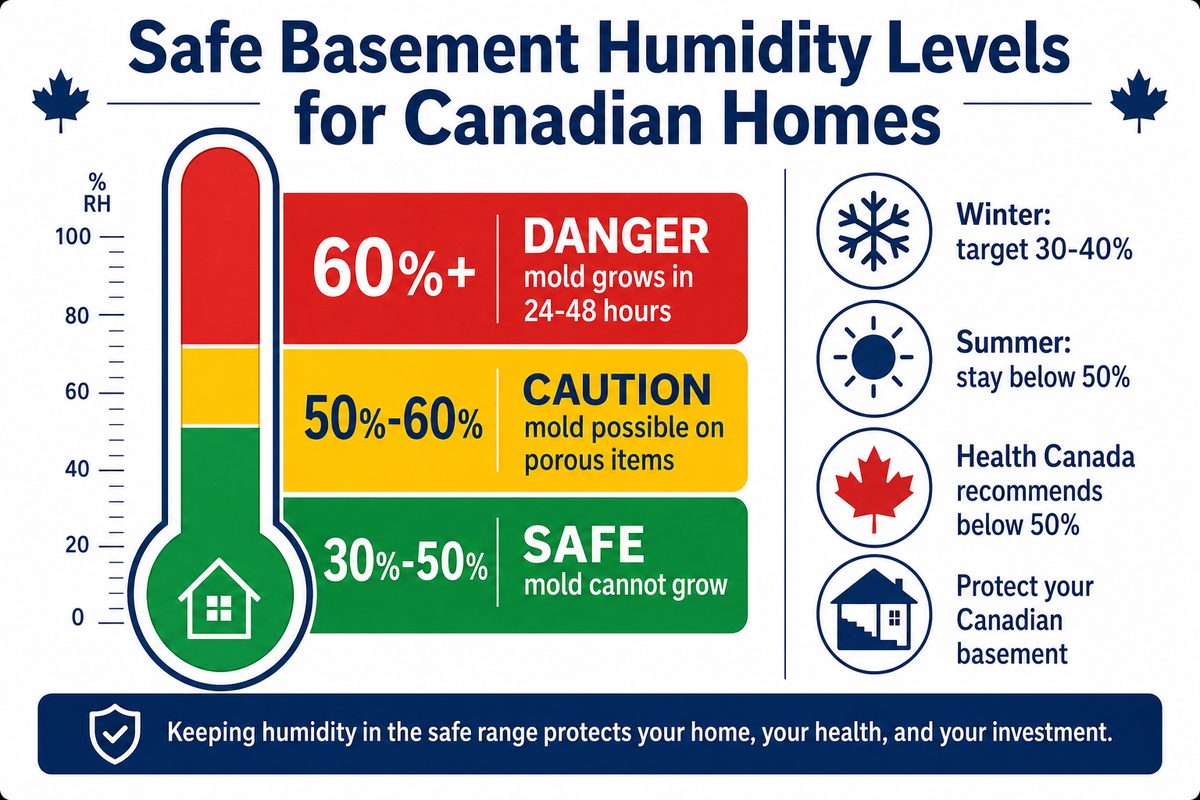
- 30%–50%: the safe zone. Mold spores are present in the air but cannot germinate at these levels.
- 50%–60%: caution. Mold is unlikely on hard surfaces but can grow on porous items (cardboard, fabric, untreated wood) over time.
- Above 60%: danger. Active mold growth is possible on any organic surface within 24–48 hours.
- Above 70%: infestation conditions. Multiple species can establish simultaneously.
A $20 digital hygrometer placed in the centre of the basement gives you a continuous basement humidity level reading. Take the measurement at the worst time of year for your home — July or August in southern Ontario, March in older Montreal homes — and aim for the lower half of the safe zone if anyone in the household has asthma or allergies. The Canadian Home Builders’ Association notes that basement humidity level Canada-wide should sit comfortably under 50% during winter heating and under 60% during summer cooling.
How to Bring Basement Humidity Down
- Run a dehumidifier sized for the space. A 50-pint unit covers a typical 1,000–1,500 sq ft Canadian basement. Empty the bucket daily during shoulder seasons or run a hose to the floor drain.
- Insulate cold-water pipes. Foam pipe sleeves cost about $1 per foot at any Canadian Tire and stop the condensation drip that adds litres of water to the air every day.
- Direct downspouts at least 6 ft (1.8 m) from the foundation with rigid extensions. Most homes ship with 4-ft splash blocks that aren’t long enough for clay-heavy Ontario and Quebec soils.
- Run the bathroom and kitchen fans for 20 minutes after every shower or boil. The water vapour eventually settles in the lowest, coolest part of the house: the basement.
- Seal the dryer vent. A loose dryer hose dumps moist air directly into the basement instead of outside.
If humidity stays above 60% even with a dehumidifier running 24/7, the moisture is coming in faster than the unit can pull it out. That points to a foundation, plumbing, or HVAC problem that needs a professional mold inspection rather than another appliance.
Basement Mold Types: Six Species We See Most Often
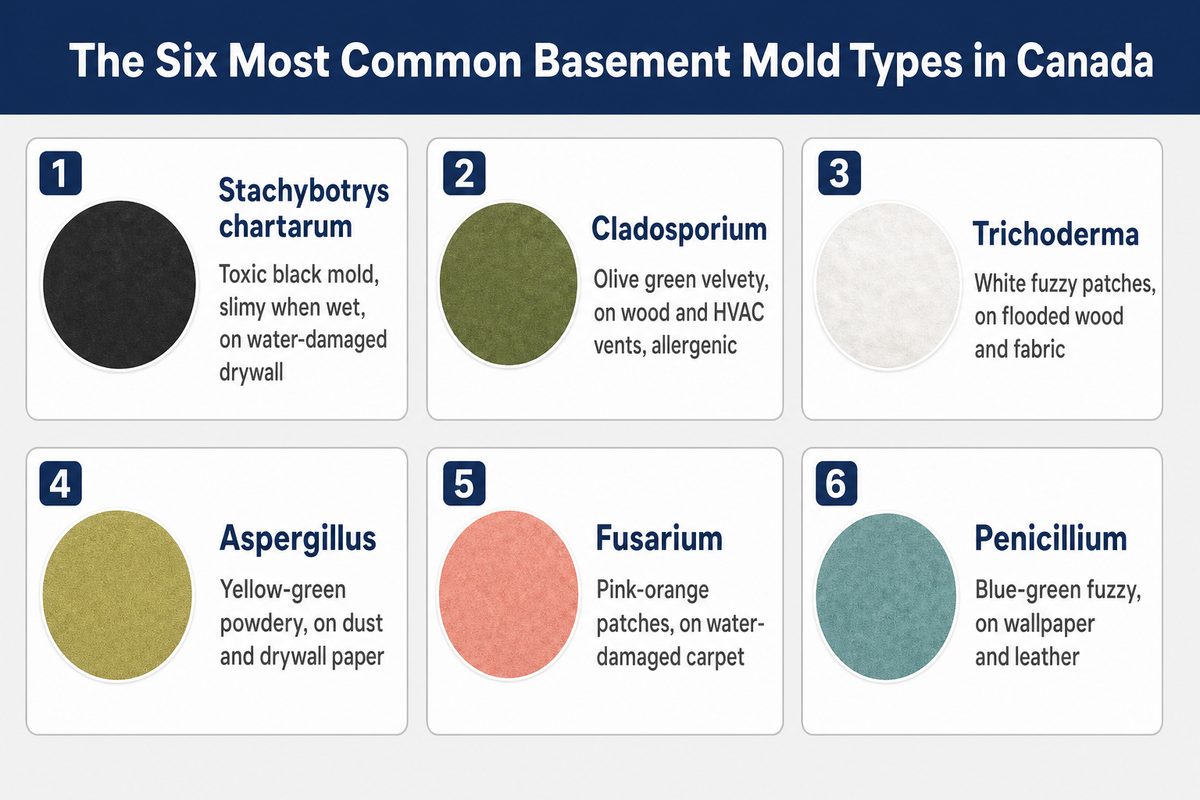
The six basement mold types below cause almost every residential mold in basement situation we inspect in Ontario and Quebec. Colour is a clue, not a diagnosis — only a lab test confirms a species — but the visual ID below covers what you are most likely seeing on a basement wall, floor, or stored item.
Stachybotrys chartarum (black mold)
Greenish-black, slimy when wet, dry and powdery when old. Needs sustained water damage on cellulose — drywall paper, wallpaper backing, soaked wood. The species most commonly called “toxic black mold.”
Cladosporium
Olive-green to brown, velvety. The most common indoor mold in Canada. Grows on damp wood, fabric, HVAC vents, and the back of stored furniture. Allergenic but rarely toxic.
Trichoderma & Aspergillus (white mold)
White, fuzzy, cottony patches on damp wood, drywall, and stored fabric. Often confused with efflorescence (the salt residue on concrete). Covered in detail in the white mold section below.
Aspergillus (yellow)
Powdery, yellow-green to dark grey. Common on stored food, dust, and damp drywall paper. A few species produce mycotoxins that affect immune-compromised individuals.
Fusarium (pink-orange)
Pink, salmon, or orange patches. Grows on water-damaged carpet padding, drywall, and humidifier reservoirs. Produces mycotoxins; treat any pink basement growth seriously.
Penicillium
Blue-green, fuzzy. Found on water-damaged carpet, wallpaper, and stored leather. The same genus that produces penicillin, but indoor species are common allergy triggers.
The most common basement mold types in Canadian homes line up with humidity and material exposure: Cladosporium on damp wood and HVAC vents, Penicillium on water-damaged carpet, Aspergillus on dust and drywall paper, and white-coloured Trichoderma on flooded areas. Stachybotrys — the species most people mean when they search “types of mold in basement” with concern — only appears after at least seven days of sustained water on cellulose. For the deep dive on the most dangerous species, read our health risks of black mold guide.
White Mold in Basements
White mold is one of the most-searched basement mold questions in Canada, and it is also the most-misidentified. The white fuzzy growth you see on a basement wall could be one of three completely different things: active white mold, efflorescence (mineral salt), or aged Cladosporium or Aspergillus that has lost pigmentation.
How to Tell the Difference
- White mold is fuzzy, raised, and three-dimensional. Touch it (with a glove) and the fibres flex; spray it with water and it stays put.
- Efflorescence is flat, crystalline, and powdery. Touch it and it crumbles to dust; spray it with water and it dissolves. It is harmless — just dissolved minerals leaching through the concrete — but it confirms moisture migration that can support real mold elsewhere.
- Aged colonies of green or grey species sometimes turn white as they dry out. Look for an active growth edge in colour (greenish, fuzzy) and white only in the older centre.
Common White Mold Species in Basements
Trichoderma is the most common true white mold we identify in Ottawa and Montreal basements after flood events. Some Aspergillus species also appear white in early growth stages. Both feed on cellulose — drywall paper, wood framing, cardboard boxes, books, fabric — which is why white mold often appears on stored items before it appears on the basement structure itself. White mold on fabric in a basement almost always indicates that the fabric (clothes, linens, upholstery) was packed away damp or stored in a basement above 60% humidity for an extended period.
Is White Mold Dangerous?
Yes. White mold produces the same airborne spores as darker species and can trigger allergic reactions, asthma attacks, and respiratory irritation. Some Aspergillus strains produce mycotoxins. Health Canada’s position applies to all visible indoor mold regardless of colour: remove it, and remove the moisture source feeding it.
If you find white mold on stored fabric, books, or wooden furniture, the items themselves are usually salvageable if the growth is surface-only and the items can be air-dried fully — but anything with embedded mold (paper-faced cardboard, upholstered furniture, particleboard) usually needs to be discarded. For larger or persistent white mold problems, our mold testing services can confirm the species and our team can scope a remediation plan.
Mold on Concrete Basement Walls and Floors
Concrete itself is inorganic and mold cannot digest it directly. But concrete is porous and dusty, and any organic film — settled dust, soap scum, drywall paper from prior renovations, paint binder, or efflorescence-treated coatings — gives mold the food it needs to colonise the surface.
Is Mold on Concrete Dangerous?
The mold is just as dangerous as the same species would be on any other surface. The colour is a guide: black or dark green growth on a basement floor or wall should be treated as a potential Stachybotrys or Cladosporium situation and removed promptly. The concrete itself does not need to be replaced — only the surface film and the moisture source.
How to Remove Mold From Concrete
- Vacuum loose growth with a HEPA-rated shop vacuum. Do not use a regular household vacuum — it spreads spores through the exhaust.
- Mix one part distilled white vinegar to one part water (or a commercial concrete-safe mold cleaner) and saturate the area. Vinegar kills roughly 82% of common mold species on hard surfaces.
- Scrub with a stiff nylon brush. Rinse, then dry the area with a fan within 24 hours.
- Find and fix the moisture source — condensation, foundation seepage, or floor drain back-up — before the colony returns.
- Re-inspect at 7 and 30 days. If growth returns, the moisture source has not been resolved and you need a professional inspection.
Bleach is widely recommended online but penetrates porous concrete poorly and can leave moisture that feeds new growth. Avoid bleach on concrete unless you are pairing it with thorough drying.
If the mold returns within weeks of a thorough cleaning, or you find it spreading along multiple sections of a basement floor or wall, the moisture source has not been resolved. Book a professional mold inspection — finding the moisture source is the part DIY almost always misses, and it is the only thing that stops concrete mold from coming back.
Musty Smell in Basement: Cause and Cure
A musty smell in a basement almost always means one of three things: active mold growth, dormant mold colonies on porous materials, or persistent high humidity that is about to cause a colony. The smell is created by microbial volatile organic compounds (MVOCs) released by living mold and by stored materials that have absorbed mold spores.
Does a Musty Smell Always Mean Mold?
Not always — but more than 80% of the time, yes. The other two common causes are stagnant water in a floor drain trap (the trap evaporates and sewer gas escapes; this smells more like sulphur than musty) and old paper, fabric, or cardboard that absorbed moisture and now releases the smell back into the air. The fastest way to tell: bring two of the suspected items upstairs into a dry room for 48 hours. If the basement smell improves, the items were holding it. If the smell persists, you have a structural mold or moisture problem.
How to Get Rid of the Musty Smell
- Find and remove the source. Air fresheners and ozone generators only mask MVOCs — the molecules return as soon as the freshener wears off. Pull every cardboard box, every old rug, and every piece of paper out of the basement and inspect it.
- Run a dehumidifier 24/7 until indoor humidity is consistently between 30% and 50%. The smell often disappears within a week of stable low humidity.
- HEPA-vacuum every horizontal surface — floor, baseboards, top of furnace, top of joists. Settled spores release MVOCs even when not actively growing.
- Wipe walls and floor with a 1:1 vinegar-and-water solution on hard surfaces, then dry thoroughly.
- Replace porous items that smell musty after drying — carpet underlay, drop-ceiling tiles that have water-stained, paper-faced insulation. The smell is embedded.
- Run a HEPA air purifier for 2–4 weeks while you fix the underlying moisture problem.
If the musty smell returns within days of cleaning — or the smell is strongest in one corner you cannot see behind — there is hidden mold somewhere you have not opened up. Infrared moisture mapping finds these hidden colonies without opening walls.
Black Mold in Basement Walls
Black mold in a basement is the result every homeowner fears, and finding black mold in basement wall surfaces is genuinely the most serious basement mold scenario. The species commonly called “toxic black mold,” Stachybotrys chartarum, only grows on cellulose surfaces that have stayed wet for at least seven days. In a basement, that almost always means soaked drywall paper, water-logged wood framing, or saturated carpet underlay — not bare concrete.
How to Identify Black Basement Mold
- Greenish-black, slimy, and shiny when actively growing.
- Dries to a dark, dusty appearance in older patches.
- Almost always paired with visible water staining or warped material around it.
- Found on the lower 2–3 feet of basement walls (where flood water sat) or on the underside of subfloor and joists after a leak.
Black Mold on Concrete Basement Walls
Real Stachybotrys rarely grows directly on concrete — the mineral surface does not feed it. What homeowners usually identify as “black mold on concrete” is one of three things: Cladosporium (still allergenic, less toxic), soot from a furnace or candle, or efflorescence darkened by trapped dust. A surface sample lab test, sent through our mold testing services, definitively distinguishes them.
What to Do When You Find Black Mold
Stop using the basement, turn off the HVAC system to prevent spore distribution, close the basement door, and book a professional inspection within 48 hours. Do not attempt DIY removal on areas larger than 10 square feet (the EPA threshold) or on any black-mold growth if anyone in the home has asthma, COPD, immune issues, or respiratory sensitivities. The health risks of black mold guide covers the full symptom list.
Basement Mold Prevention: A Year-Round Plan
Basement mold prevention is dramatically cheaper than basement mold remediation — the average $50–$200 in prevention supplies stops the $1,500–$15,000 problem before it starts. The basement mold prevention plan below is sequenced for the Canadian climate, with seasonal callouts for Ontario and Quebec homeowners.
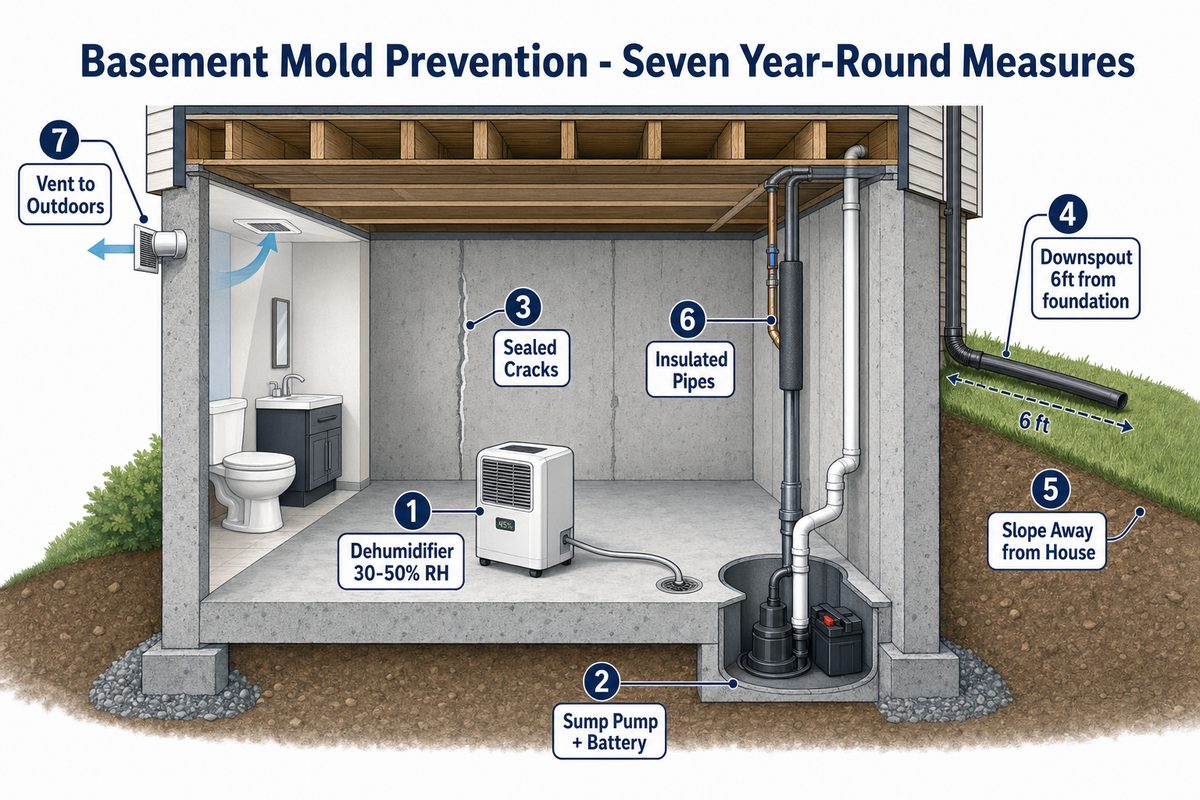
Year-Round Basement Mold Control Essentials
- Hold basement humidity between 30% and 50% with a 50-pint dehumidifier, hosed to the floor drain so it runs unattended. This is the single most important basement mold control measure.
- Insulate every cold-water pipe with foam sleeves to stop the condensation drip.
- Verify the sump pump every six months and add a battery backup in flood-prone neighbourhoods (most of Ottawa-Vanier, Lachine, Pointe-Claire, parts of Hull).
- Extend downspouts at least 6 feet from the foundation. Slope grading away from the house.
- Seal foundation cracks larger than 1/8 inch with hydraulic cement or call a foundation specialist for anything wider.
- Vent the dryer to the outdoors — never into the basement — and clean the duct annually.
- Run bathroom and kitchen exhaust fans for 20 minutes after every shower or boil.
Seasonal Adjustments for Ontario and Quebec
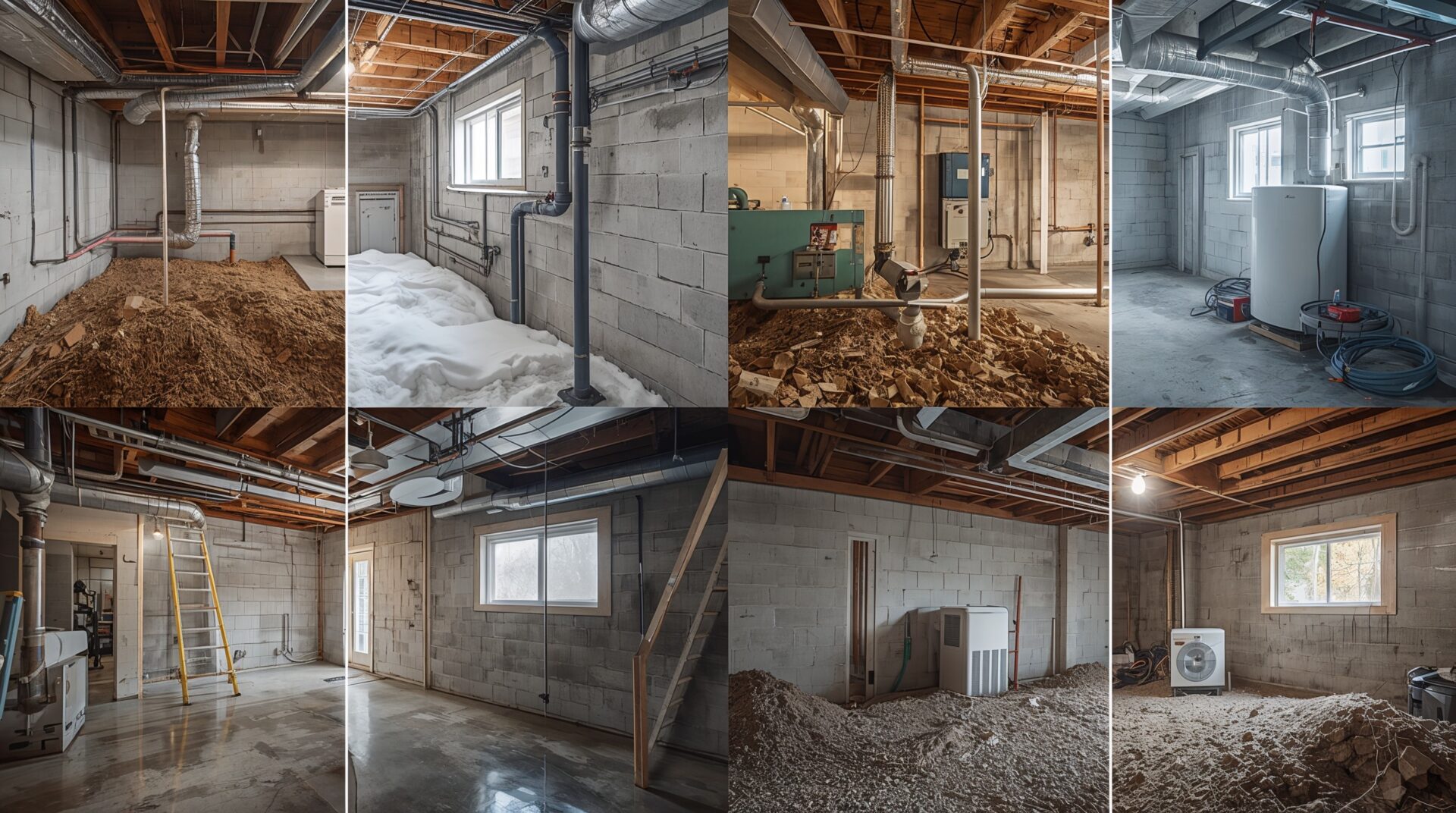
- Winter (Dec–Feb): Keep basement above 15°C to prevent pipe freeze; inspect for condensation on cold-water pipes weekly.
- Spring thaw (Mar–May): Test the sump pump before the first warm day. Clear snow from within 3 feet of the foundation. Watch for foundation seepage during heavy rain.
- Summer (Jun–Aug): Peak humidity season. Run the dehumidifier 24/7. Ventilate during cool evenings, not humid afternoons.
- Fall (Sep–Nov): Clean gutters before leaves fall. Service the furnace before the heating season — a clean filter prevents condensation problems through winter.
For the broader prevention checklist across the rest of the house, see our signs of mold in homes guide.
Basement Mold Removal: DIY vs Professional
Basement mold removal divides cleanly into two scenarios: small DIY-safe areas and full basement mold remediation by a certified crew. The Environmental Protection Agency draws the line at 10 square feet — anything below that area, in a non-porous setting, with no health-sensitive occupants, can usually be cleaned safely by a homeowner. Anything above it — or any black mold growth, regardless of size — needs professional basement mold remediation.
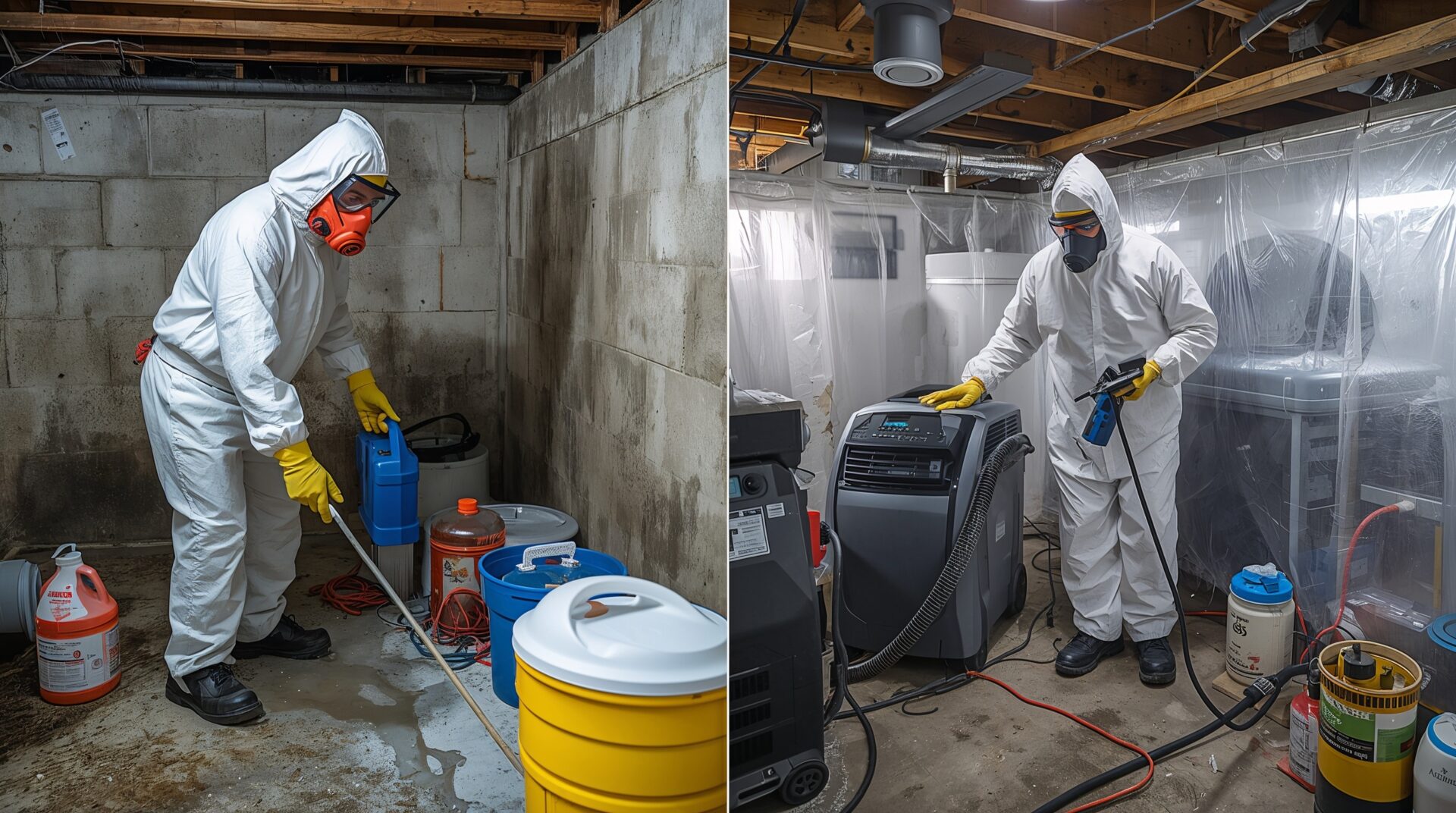
When DIY Cleanup Is Safe
- The growth is on a hard, non-porous surface (sealed concrete, glazed tile, glass, metal).
- The total affected area is under 10 sq ft (about a 3 ft × 3 ft patch).
- No one in the household has asthma, COPD, allergies, or a weakened immune system.
- The moisture source is identified and fixed.
- You have N-95 or P-100 respirator, nitrile gloves, and eye protection.
When to Call a Professional
- Affected area larger than 10 sq ft.
- Growth is on porous material (drywall, carpet, insulation, wood framing) that needs removal rather than cleaning.
- Black mold (Stachybotrys) is suspected.
- HVAC ducts or air handlers are involved (spores spread through the whole house).
- Anyone in the household has respiratory or immune issues.
- The mold returned within weeks of a previous cleaning — the moisture source is hidden.
- Insurance documentation is required for a claim.
| Affected area | Recommended approach | Safety equipment | Typical cost (CAD) |
|---|---|---|---|
| Under 10 sq ft | DIY cleaning safe | N-95 mask, gloves, eye protection | $50–$200 |
| 10–100 sq ft | Professional remediation | Certified crew, containment | $1,500–$4,000 |
| 100–1,000 sq ft | Full remediation + structural work | HEPA filtration, negative air, PPE Level C | $4,000–$15,000 |
| HVAC contaminated | Specialised duct cleaning | Sealed system, certified technicians | $2,000–$6,000 (additional) |
Safe DIY Steps
- Ventilate to the outside, not to the rest of the house. Open a basement window with a box fan blowing outward.
- Wear N-95 or P-100 respirator, nitrile gloves, eye protection, and clothes you can wash in hot water.
- Mix 1:1 white vinegar and water (or a commercial mold cleaner). Avoid mixing bleach with anything else — the gases are toxic.
- Saturate the growth, wait 10 minutes, scrub with a stiff brush, rinse, and dry with a fan.
- Bag any porous waste (cardboard, fabric, drywall scraps) in a sealed plastic bag and take it to the curb the same day.
- HEPA-vacuum the surrounding area — spores have already spread.
- Return at 7 and 30 days to confirm the colony has not regrown.
For full project estimates and what your home insurance is likely to cover, see our mold remediation cost guide. For when professional removal is the right call, our mold removal services page covers what a remediation project actually involves.
Finished vs Unfinished Basements: Different Mold Challenges
The same humidity problem causes mold in both, but the way you find and remove it is very different.
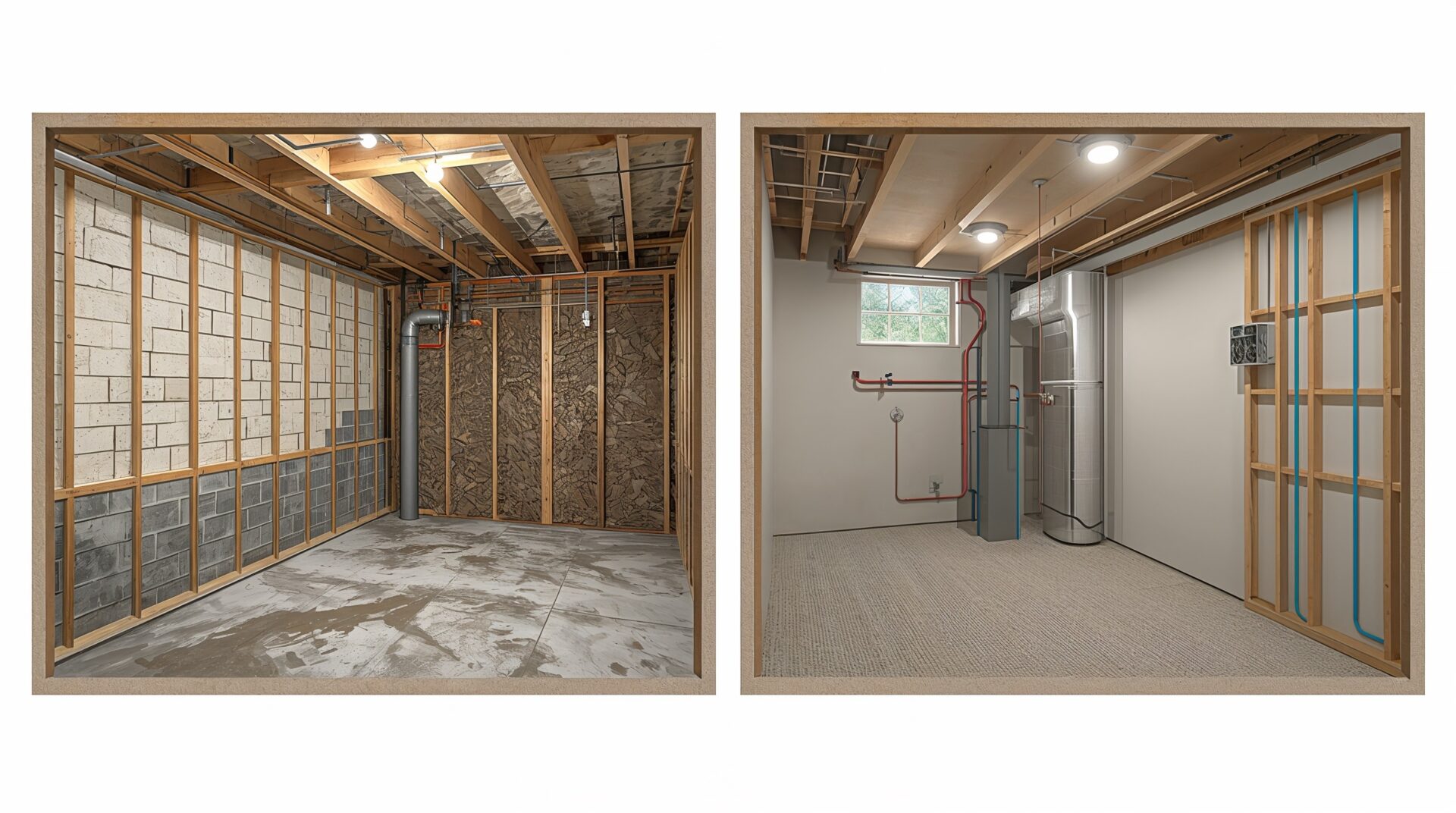
Unfinished basement
- Bare concrete walls and exposed framing
- Mold appears on the surface — visible immediately
- Easier to clean (hard surfaces, no demolition)
- Condensation on cold concrete walls is the main driver
- HVAC ducts often run exposed and collect dust
Finished basement
- Drywall, carpet, drop ceilings, paneled walls
- Mold often hides behind finished surfaces — smell appears before sight
- Remediation usually requires demolition of porous materials
- Water-damaged carpet must be replaced within 48 hours
- Drop ceilings hide pipe leaks until the tile bows or stains
Inspection Approach for Each
Unfinished basements respond well to a visual + smell inspection — what you see is usually what you have. Finished basements need air sampling and infrared moisture imaging to find hidden colonies behind drywall and under flooring without destructive testing. The same technique applies to commercial basement spaces and finished basement apartments.
Basement Mold Removal Cost in Ontario and Quebec
Basement mold removal cost varies by area size, contamination level, and whether porous materials need replacement. Below are typical 2026 ranges for residential basement mold removal in Ottawa, Montreal, Gatineau, Kingston, and surrounding Ontario and Quebec markets.
- DIY supplies (under 10 sq ft): $50–$200 for cleaner, masks, brushes, and disposal bags.
- Prevention equipment: $300–$1,000 for a quality dehumidifier, hygrometer, sump pump backup battery, and pipe insulation — one-time, lasts 10+ years.
- Small basement remediation (10–100 sq ft): $1,500–$4,000 with containment and HEPA filtration.
- Large basement remediation (100+ sq ft): $4,000–$15,000 depending on whether drywall, framing, insulation, or flooring needs replacement.
- Mold inspection and air sampling: typically free virtually with our team; in-home assessments are priced in this guide.
Insurance: What’s Usually Covered
Sudden water damage from a burst pipe, appliance hose failure, or sewer back-up (with a rider) is usually covered. Gradual seepage, condensation, and maintenance-related humidity problems are almost always excluded. Insurance also requires professional documentation — lab reports, photos, scope of work — before a claim is processed. Document everything before remediation begins.
For a full breakdown of remediation pricing across Canada, see our mold remediation cost guide for homeowners in Canada.
Basement Mold FAQ
The questions Canadian homeowners ask most often about basement mold, with direct answers.
Is mold in the basement harmful?
Yes — mold in the basement is harmful. Health Canada states there is no safe exposure level for indoor mold and recommends prompt removal of any visible growth. Spores from a mold in basement colony travel up through HVAC ducts, stairwells, and gaps in the floor, exposing the rest of the house to the same air. People with asthma, allergies, COPD, weakened immune systems, infants, and elderly residents are at the highest risk and should avoid the affected area until it is remediated.
What are signs of mold in your basement?
The four most reliable signs of mold in your basement are: visible patches of black, green, white, yellow, or pink-orange growth on walls, floor, framing, or stored items; a persistent musty or earthy smell that returns after cleaning; warped, peeling, or bubbling paint and drywall; and unexplained respiratory symptoms (coughing, congestion, sinus irritation) that worsen when you spend time downstairs and improve when you leave the house. Any one of these alone warrants a closer inspection; two or more warrants a professional.
Does a musty smell in the basement always mean mold?
Most of the time, yes — over 80% of the musty-smell cases we inspect involve active or dormant mold in basement materials. The other common sources are stagnant water in a floor drain trap and old paper or fabric items that absorbed moisture and now release the smell. If the smell persists after you remove every cardboard box, paper item, and old rug from the basement, treat it as mold until proven otherwise.
How do I get rid of white mold in my basement?
First confirm it is actually mold and not efflorescence (mineral salt) by spraying the area with water — mold stays put, salt dissolves. For real white mold under 10 sq ft on a hard surface, vacuum with a HEPA shop vac, scrub with a 1:1 vinegar-and-water solution, rinse, and dry with a fan within 24 hours. Then fix the moisture source feeding it — without that step, white mold returns within weeks. For larger areas or growth on drywall, carpet, or framing, book a professional inspection.
Is mold on concrete dangerous?
The mold itself is just as dangerous as the same species would be on any other surface — black mold on concrete carries the same health risk as black mold on drywall. The concrete itself does not need to be replaced; the surface film and the moisture source do. Treat any black or dark green growth on a basement floor or wall as a potential Stachybotrys situation and have it tested before assuming it is harmless.
What is the safe humidity level for a Canadian basement?
Health Canada and the Canadian Home Builders’ Association both recommend keeping indoor humidity between 30% and 50% year-round. In a basement specifically, aim for the lower half of that range — 30% to 40% — if anyone in the household has asthma or allergies. Above 60%, active mold growth becomes possible on any organic surface within 24 to 48 hours.
Is it safe to live in a house with mold in the basement?
Living in a house with active mold in the basement (or mould in the basement, in Canadian spelling) is not advisable, especially for children, seniors, anyone with respiratory or immune conditions, or pregnant people. Spores travel through the HVAC system and the air column rising up the stairwell. If the affected area is small (under 10 sq ft), isolated, and the moisture source is fixed, the rest of the house is generally safe while you complete basement mould removal. For anything larger, vacate the basement and consider temporary relocation until the remediation is complete.
How quickly does basement mold grow after water damage?
Visible basement mold can appear within 24 to 48 hours on any damp organic surface, and a mold in basement colony matures and starts releasing millions of spores within 7 to 10 days. This is why the first 24 hours after a basement flood, pipe burst, or sewer back-up matter so much more than anything done a week later. Drying everything with industrial fans and dehumidifiers in the first day is the single most effective basement mold prevention step a homeowner can take.
Get a Free Basement Mold Inspection
If you see mold in basement spaces, smell musty air, or suspect a hidden colony anywhere downstairs, our certified inspectors can confirm what you are dealing with and quote remediation in 24 to 48 hours. Free virtual mold inspections are available across Ontario and Quebec — you send photos, our team identifies likely species and severity, and we give you a no-obligation scope and price for in-home testing or remediation if needed.
For full information on what an in-home assessment involves, see our mold inspection, mold testing, and mold removal service pages.
Our Service Areas
Basement mold inspection, testing, and remediation across Ontario and Quebec. Click your nearest city for local service details.