
Mold in Walls: Detect, Remove and Keep It Out
Mould inside a wall is a moisture problem you cannot see from the room. Find it with the right tools, fix the source, and remediate the cavity properly. This is the Canadian-climate guide we use on real inspections.
Why Mold Grows Behind a Wall
By the time mold is visible on the room side of a wall, it has usually been growing on the inside for weeks or months. Wall cavities are dark, humid, full of organic material (drywall paper, dust, wood framing), and routinely fed by a slow leak or a winter condensation cycle no homeowner sees.
After 20 years of inspecting Canadian homes, our team has learned that the species and colour of wall mould matter far less than two questions: where is the water coming from, and how far has the colony spread. Answer those right and remediation is straightforward. Skip them and you tear out half a wall only to find the source was two studs over.
If you suspect mould inside a wall, do not cut the drywall first. Start with a moisture meter and an infrared thermal scan to confirm hidden moisture, then use a borescope through a 10 mm hole to look inside the cavity. Patches over ten square feet of contiguous mould warrant professional remediation under both Health Canada and US EPA guidance. Cleaning visible mould without solving the moisture source guarantees the colony returns within eight to twelve weeks.
For a primer on the biology before you read on, see what mould actually is.
Signs of Mold in Walls
You almost never see mould inside a wall directly. You see the wall reacting to the moisture and the colony underneath. These are the six signals that consistently turn up on Canadian inspections where we later confirm wall-cavity mould by cutting an inspection port.
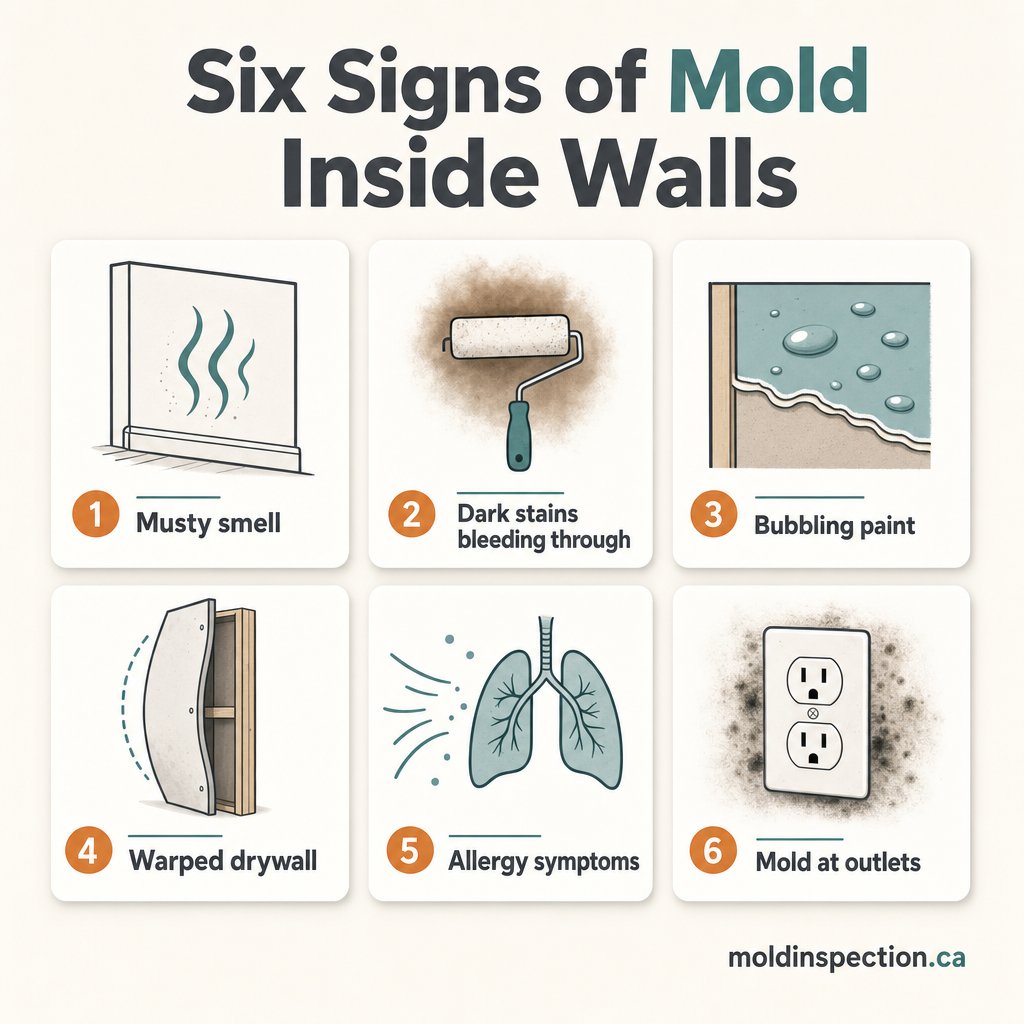
Musty smell in one room
A persistent earthy odour strongest in one room, especially near one wall, almost always means active microbial growth nearby. The smell is microbial volatile organic compounds released through the paint film long before any visible mould appears.
Dark staining bleeding through
Brown, yellow or grey halos showing through paint, especially around outlets, switch plates or baseboards, are mould colonies pressing tannins through the drywall paper. Stain-blocking primer covers them temporarily, then the stain returns.
Bubbling or peeling paint
Trapped moisture lifts paint off drywall. Bubbling concentrated on one wall, especially an exterior wall in winter or behind a shower, means the cavity is almost certainly damp.
Warped or soft drywall
Press gently on a suspicious area. Damp drywall goes soft, spongy or bowed. Plaster develops a hollow tap and may show fine cracking along the lath lines.
Allergy symptoms in one room
Sinus congestion, itchy eyes or headaches that ease when you leave the room and return when you go back often indicate localized mould exposure. Health Canada treats indoor mould as a respiratory hazard regardless of species.
Mold at outlets or baseboards
Black or grey spots peeking out from behind a baseboard, around an outlet cover or at the floor joint is the late signal. The cavity above is almost certainly worse. Outlet openings are the easiest path for mould to escape a wall.
One or two signs alone is not proof. Old leaks leave the same marks. Two or more together in the same room is the threshold at which we recommend confirming with a moisture meter and a thermal scan rather than cutting drywall to look.
How Moisture Gets Behind a Wall
Mould in a wall cavity needs four things, but in Canadian housing only one varies meaningfully: water. The drywall paper, the wood framing and the dust are all already in there. Temperature inside an occupied home is fine for mould year-round. What changes is whether the cavity is dry or damp, and there are four common ways water gets in.
Hidden plumbing leak
A drip from a supply line, a slow trap leak, a sweating cold-water pipe or a failed shower valve can release a quarter-litre a day into a cavity for years. Drywall absorbs it, insulation holds it against the framing, and mould gets a stable food source until the leak is found.
Winter condensation in the cavity
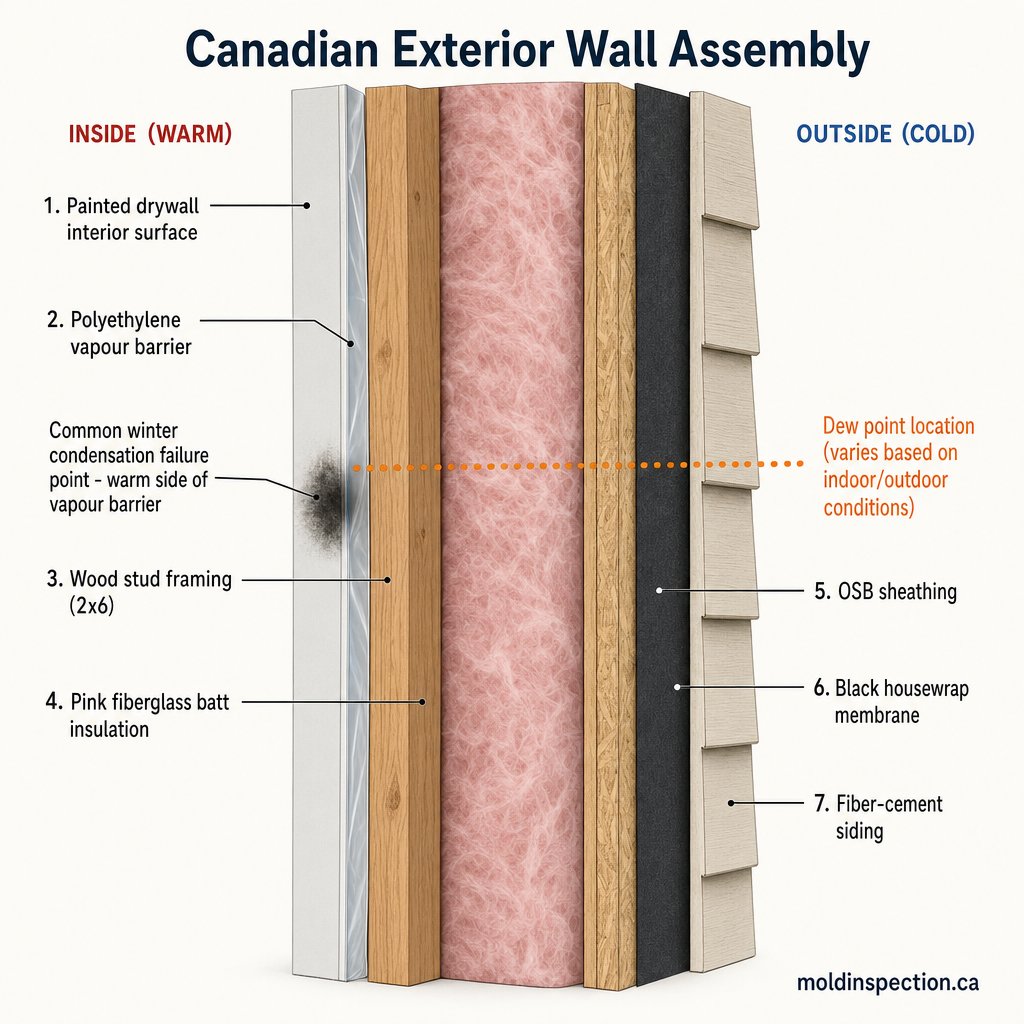
Canadian winters drive warm humid indoor air outward through walls. When that vapour hits the cold side of an exterior wall, usually behind a flawed vapour barrier, it condenses on the back of the sheathing. Canada Mortgage and Housing Corporation documents this as the most common moisture failure in Canadian wood-frame homes.
Flooding or water intrusion
A burst pipe, an overflowing washer, an ice dam pushing water under shingles, or a storm getting past failed flashing can soak a wall in minutes. If the cavity is not dried out within 48 hours, mould begins growing on the back of the drywall paper within a week.
Exterior envelope failure
Cracked window caulking, failed flashing over a deck ledger, a brick wall that has lost its weep-hole drainage, or a downspout discharging next to a foundation can drive water into walls from outside. The leak is often seasonal, worst during driving rain or spring melt, which makes these the slowest to diagnose.
In our inspection records, plumbing leaks account for roughly 40% of wall-cavity mould cases, winter condensation accounts for another 30%, and the remaining 30% splits between flooding events and envelope failures. The diagnostic order matters. If your home is mid-winter and the affected wall is an exterior one, condensation jumps to the top of the list.
How to Detect Mold in Walls Without Cutting Drywall
The mistake we see most often is homeowners cutting an exploratory hole before they have confirmed there is anything to find. There is a better order. The four tools below let you confirm hidden moisture and, in most cases, hidden mould without removing any wall material. The first three are now available to homeowners for under $300 combined; the fourth is what a professional inspector adds.
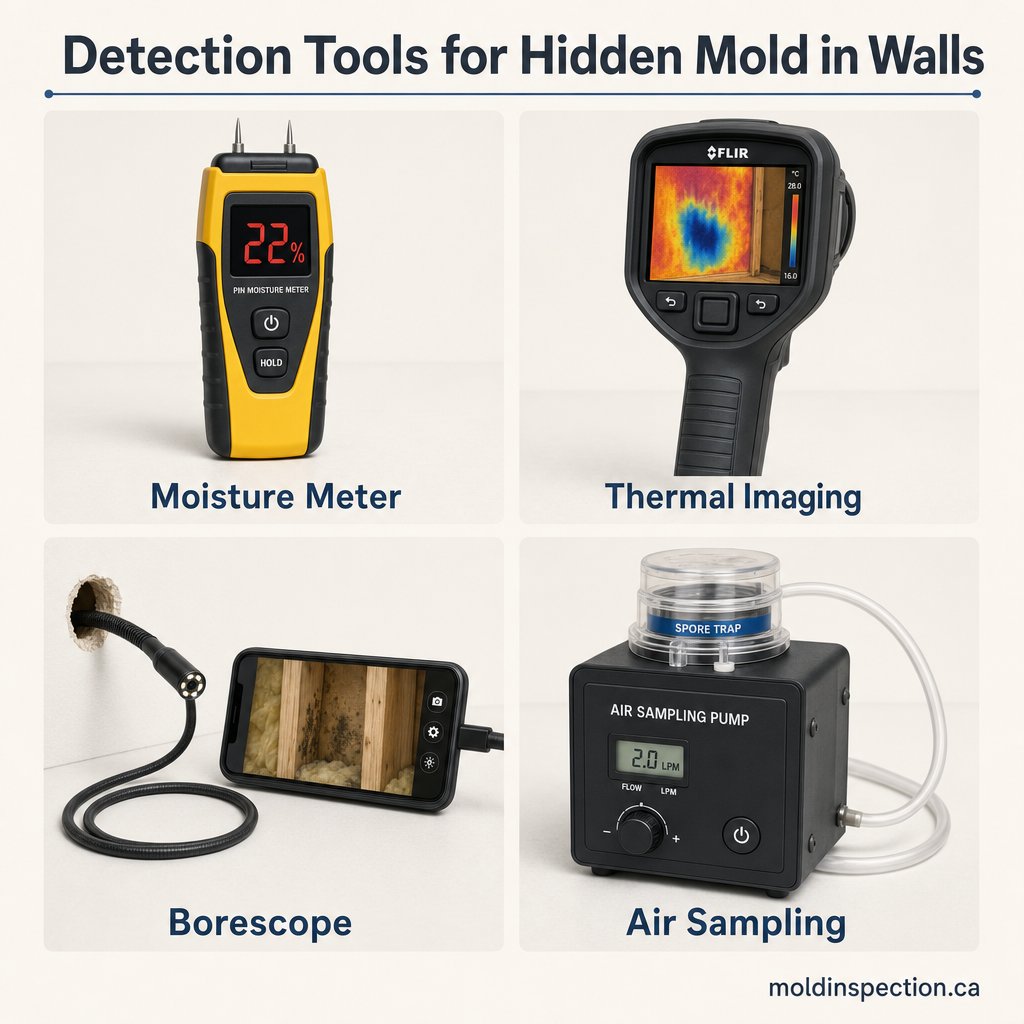
Pin moisture meter
A pin moisture meter measures electrical resistance between two probes pressed into the wall. On drywall, a reading under 15% is dry, 15–20% is concerning, and over 20% is wet, almost always with mould active or about to start. Take readings every 30 centimetres across the suspicious wall. The high readings reveal the shape of the wet area inside the cavity.
Infrared thermal imaging
An infrared camera (clip-on smartphone units start around $200) sees temperature differences. Damp drywall is cooler than dry drywall because evaporation cools the surface. A thermal scan of an exterior wall in winter shows wet cavities as distinct cold patches. This is the single most useful non-destructive tool for mapping wall-cavity moisture.
Borescope through a 10 mm hole
If the meter and thermal scan flag a hot spot, a borescope, a thin flexible camera that connects to your phone, lets you look inside through a pencil-sized hole. Drill the access port in an inconspicuous spot, slip in the borescope, and you can confirm mould without cutting drywall. The hole is patched with a dab of compound and paint.
Air sampling (professional)
When the visual evidence is ambiguous (old stains, MVOC odours without surface signs, or sensitive occupants), a spore-trap air sample tells you whether indoor air carries elevated mould spore counts compared to outdoors. Two cassettes, 5 minutes each, lab results in 48 hours.
Drywall, Plaster and Bare Framing: What Changes
Most Canadian homes built after about 1955 have drywall on the interior walls. Older homes, a lot of Toronto, Montreal and Halifax stock, have plaster on wood lath. A small number of basements and detached garages have bare wood framing exposed. Each material handles mould differently and changes the remediation approach.
| Wall material | How mould behaves | Remediation reality |
|---|---|---|
| Drywall (gypsum board) | Mould feeds on the paper face on both sides. Once the paper is colonized, the drywall cannot be salvaged. Bleach kills surface colonies but leaves hyphae embedded in the paper fibres. | Cut out and replace any drywall with visible mould or a moisture reading over 20% after drying. Contiguous patches over ten square feet warrant professional containment under US EPA guidance. |
| Plaster on wood lath | Plaster itself is mineral and does not support mould. But the lath behind it is wood and the dust between the lath and the back of the plaster does. Older plaster walls can hide colonies on the lath without staining the painted surface for a long time. | Plaster can usually be salvaged once the lath is treated. Cut access ports, dry the cavity fully, treat the lath with a registered fungicide, then patch with a lime or gypsum plaster repair. Replacement is the last resort. |
| Bare wood framing | Mould grows directly on the wood and into the surface grain. The colour you see is usually surface growth, but hyphae can penetrate two to three millimetres into the wood. | Sand the affected surface back to clean wood, HEPA-vacuum, treat with a registered fungicide. Replace the stud only if the wood is structurally compromised. Surface mould rarely is. |
For drywall-only surface mould without cavity involvement, see our guide to surface mould on drywall. For below-grade walls and concrete foundations, see basement-specific moisture and below-grade walls.
When You Can DIY and When to Call a Pro
DIY is appropriate when
- Visible patch is under ten square feet
- Moisture source has been identified and fixed
- No one in the household has asthma, immunosuppression or chronic respiratory illness
- No HVAC ductwork inside the affected cavity
- The wall is not load-bearing or part of a fire separation
Call a pro when
- Patch is over ten square feet or spans multiple bays
- Moisture source is unknown or recurring
- Anyone in the household has respiratory vulnerability
- Mould extends into HVAC, electrical or plumbing chases
- Insurance claim is involved, so you need a documented remediation
If you are still unsure, our DIY home inspection checklist helps you make the call before any cutting begins.
How to Remove Mold From Inside a Wall
The cavity remediation sequence is the same regardless of wall material. Only the cut-out and reclose steps change. These are the six steps we follow on professional jobs and that a DIY homeowner can mirror on a small patch.
Fix the moisture source first
Remediation that skips this step is wasted work. Repair the leak, replace the failed flashing, fix the vapour barrier, lower indoor humidity below 50%. The cavity must be capable of staying dry before any cleanup starts.
Set up containment
For a small patch, tape plastic sheeting around the work area floor-to-ceiling with one opening for entry. Turn off the HVAC for the room. Put down a drop cloth. Larger jobs require negative-pressure HEPA-filtered containment units.
Cut out drywall or access plaster
On drywall, cut the affected area plus a 30 cm margin, because mould travels further than it looks. Score with a utility knife, snap, remove in small pieces. On plaster, cut access ports rather than full sections. Double-bag the debris immediately.
Treat the cavity
Remove any soaked insulation, which cannot be salvaged. HEPA-vacuum the framing, then wipe wood with a registered fungicidal cleaner. Do not use household bleach on porous wood; it loses potency on contact with organic material. Allow to dry fully.
Verify dry before closing up
Use the moisture meter again. Framing must read under 16% before new insulation and drywall go back. Run a dehumidifier in the room for 48–72 hours if needed. Closing up a damp cavity is the most common cause of mould returning within months.
Reinsulate, reclose and finish
Replace insulation with the same type and R-value as the original. Install a new vapour-barrier overlap if any was damaged. Hang new drywall, tape, mud, prime with a stain-blocking primer, and paint. The repair should be invisible within a week.
What It Costs to Remove Mold From Inside Walls
Wall-cavity remediation costs vary widely depending on the size of the patch, the moisture source, whether insulation needs replacement and whether the work requires containment. These are the ranges we see in Ontario and Quebec.
| Scope | Typical cost (CAD) |
|---|---|
| DIY repair, small patch under 10 sq ft | $50–$200 (materials only) |
| Professional single-wall patch, 10–30 sq ft | $800–$2,200 |
| Professional multi-bay or load-bearing | $2,500–$6,000 |
| Whole-wall replacement with structural repair | $6,000–$15,000+ |
For the full breakdown including provincial pricing and what affects the bill, see our mould remediation costs across Canada guide.
Health and Home Insurance
Mould inside walls is a respiratory hazard even when you cannot see it. Spores and MVOCs escape through outlet penetrations, baseboard gaps and the paint film itself. Health Canada treats all indoor mould as a hazard regardless of species and recommends investigating any musty smell. For the full health picture, see the health effects of black mould exposure and the broader page on general symptoms of mould exposure.
Home insurance in Canada generally covers wall-cavity mould only when the moisture source was a covered sudden event: a burst pipe, a covered storm, an appliance failure. Long-term seepage, gradual condensation failures and general humidity issues are almost always excluded. Document the source and date of discovery before any remediation begins, photograph the patches, save moisture readings, and keep receipts for emergency drying. Many insurers require a third-party clearance test before reimbursing.
How to Keep Mold Out of Your Walls
Wall mould is preventable. Three habits eliminate the vast majority of cases.
Control indoor humidity
Keep relative humidity under 50% in winter, under 60% year-round. A $25 hygrometer on the wall tells you instantly. Use bath fans, kitchen range hoods and a dehumidifier in damp seasons.
Fix leaks within 48 hours
Every plumbing drip, every appliance overflow, every roof leak must be dried and inspected within 48 hours. After 72 hours the cavity will support mould. Set this as a household rule, not a maintenance preference.
Inspect the exterior each spring
Walk the outside of the house in April. Check caulking around windows, flashing over decks and roofs, downspout positions, and brick weep holes. Anything that lets water past the cladding becomes a wall-cavity mould source.
For a deeper look at the moisture diagnostics, see diagnosing a musty smell.
Mold in Walls FAQ
How do I know if there’s mould in my walls without cutting them open?
Take pin moisture meter readings every 30 centimetres across the suspicious wall. Over 20% is wet and almost certainly supports mould. Follow up with an infrared thermal scan (in winter, a wet cavity shows as a distinct cold patch) and a borescope through a 10 mm access hole. These three steps confirm hidden mould without removing any wall material.
Does black mould in walls always smell?
Not always. Some species and growth stages release strong musty MVOCs; others are nearly odourless. A faint or absent smell does not rule out mould behind well-painted drywall. Conversely, a musty smell with no visible cause almost always means active growth somewhere, usually inside a wall or under a floor.
Can I paint over mould in my walls?
No. Paint, including stain-blocking primer, does not kill mould. It covers the surface temporarily, then the colony grows through and the staining returns within weeks. The drywall paper underneath continues to feed the colony. Mould must be removed and the moisture source fixed before any repainting.
Will home insurance cover mould in my walls in Canada?
Usually only when the moisture source was a covered sudden event: a burst pipe, a covered storm, or an appliance overflow within the policy window. Long-term seepage and condensation failures are almost always excluded. Document the source and date of discovery, photograph everything, save moisture readings, and call your insurer before any non-emergency remediation.
How much does it cost to remove mould from inside walls?
A small DIY-safe patch under ten square feet runs $50 to $200 in materials. A professional single-wall remediation typically costs $800 to $2,200 in Ontario and Quebec. Multi-bay or load-bearing work runs $2,500 to $6,000. Whole-wall replacement with structural repair can reach $15,000 or more.
Can mould come back after wall remediation?
Yes, if the moisture source was not actually fixed, the cavity was closed up before fully drying, or the new vapour barrier was not properly sealed. Recurrence within eight to twelve weeks almost always means the original moisture problem was misdiagnosed. A clearance reading under 16% before reclosure is the standard.
Is mould inside walls dangerous if it’s hidden?
Yes. Hidden mould releases spores and MVOCs into the room through outlet penetrations, baseboard gaps and the paint film. Health Canada treats all indoor mould as a respiratory hazard regardless of species and recommends investigation of any musty smell or unexplained respiratory symptoms that improve when the occupant leaves the home.
How long does mould remediation in walls take?
A small DIY patch is typically a one-day job once the moisture source is fixed. A professional single-wall job runs two to four days including containment, drying, lab clearance and final close-up. Multi-bay or whole-wall jobs run one to three weeks, especially when exterior envelope work or insulation replacement is involved.