
 FR
Condensation on Windows in Winter: Causes and Fixes
Wet glass usually means your home is too humid for how cold the window gets. The fix starts with the air.
By Jesse Robertson, senior inspector and remediation supervisor
Last updated: November 2, 2026
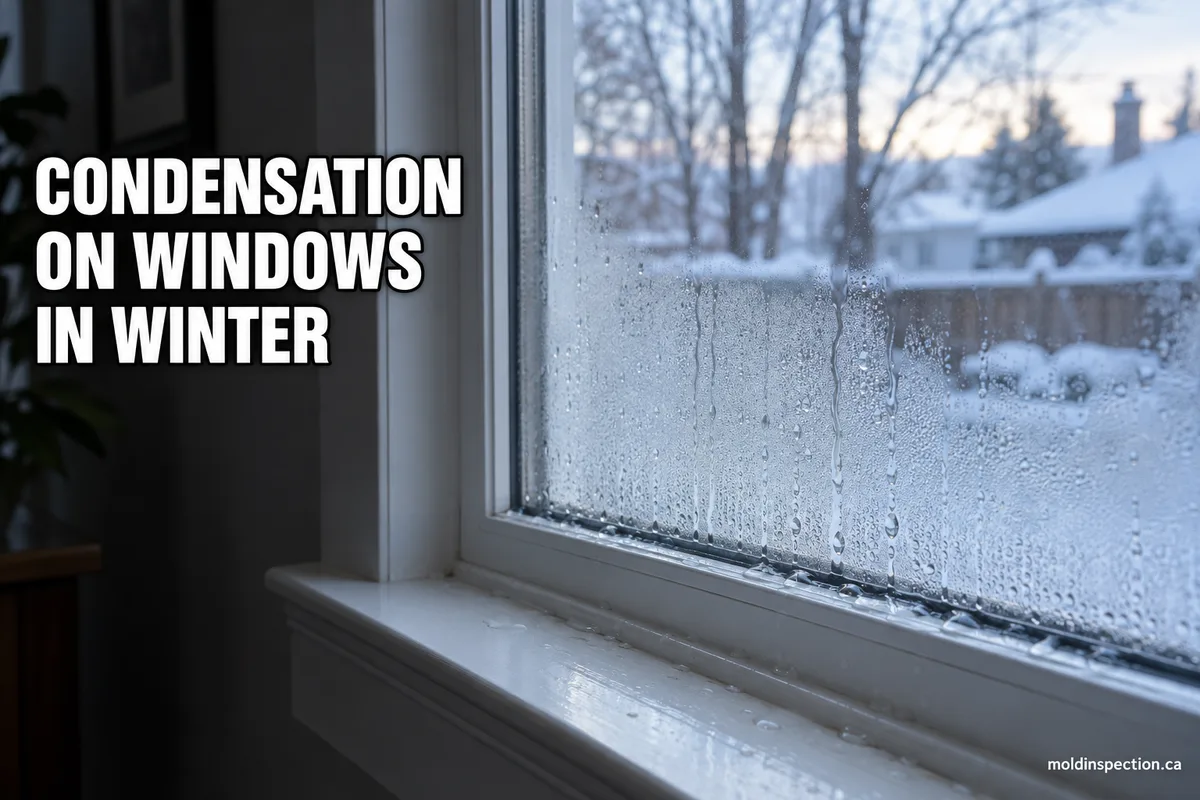
Condensation on the inside of your windows means the air in your home holds more moisture than your coldest glass can handle. Warm, humid indoor air touches glass that's below its dew point, and the water vapour turns back into droplets or frost. Health Canada recommends keeping indoor humidity between 30% and 50%, and on the coldest nights the right number sits near the bottom of that range. Lower the humidity, warm the glass, or get air moving across it, and the condensation stops.
Already seeing black spots on the sill or frame? Our guide to mold on window sills covers the cleanup.
Why Do Windows Get Condensation on the Inside in Winter?
Your windows sweat because the inside pane is the coldest surface in the room, and cold surfaces pull water out of the air. Every bit of indoor air has a dew point: the temperature where its moisture turns to liquid. When the glass falls below that temperature, water forms on it.
At a normal room temperature of 21 °C, the dew point depends entirely on how humid the air is.
| Indoor humidity (at 21 °C) | Water forms on any surface colder than |
|---|---|
| 30% | about 3 °C |
| 35% | about 5 °C |
| 40% | about 7 °C |
| 50% | about 10 °C |
| 60% | about 13 °C |
That's why the same humidity that felt fine in October drips in January. The air hasn't changed much, but the glass is colder. When it's minus 20 °C outside, the inside pane of an older window can drop well below 10 °C, and the bottom edge near the frame is colder still. That bottom strip is where you see the water first, and it's where it pools on the sill.
Moisture comes from ordinary living. Showers, cooking, laundry, plants, a humidifier, and the people in the house all add water to the air. A tight, well-sealed home keeps more of it in.
Inside, Outside or Between the Panes: What Does Each One Mean?
Where the water shows up tells you what's wrong, and two of the three places aren't a humidity problem at all.
| Where you see it | What it means | What to do |
|---|---|---|
| On the inside of the glass (room side) | Indoor humidity is too high for how cold the glass is | Lower humidity, open blinds, run fans (steps below) |
| On the outside of the glass | Usually a sign of an efficient window: the outer pane stays cold because little heat escapes | Nothing. It burns off as the sun warms the glass |
| Between the panes | The seal on the sealed glass unit has failed | Call a window installer to replace the glass unit |
Natural Resources Canada says the same thing about the between-panes case: a broken seal means the insulating glass unit needs replacing. No amount of drying out your home fixes it, and it isn't a mold question. The fog sits inside the sealed unit, not in your room.
Outside condensation surprises people the first winter after new windows go in. It tends to show up around sunrise on calm, humid mornings, and low-e coatings make it more likely. It's harmless.
Room-side condensation is the one to manage. A little fog in the corners on the coldest morning of the year is normal. Water running down the glass and soaking the sill most mornings isn't.
What Humidity Should Your House Be in Winter?
According to Health Canada's guide to moisture and mould (January 2023), indoor relative humidity should stay between 30% and 50%, and a dehumidifier should run if moisture is condensing on cold surfaces such as window panes.
Aim for 30% to 40% for most of the winter, and closer to 30% during a cold snap. The colder it gets outside, the lower you need to go.
We estimated the inside glass temperature of common window types on a minus 20 °C night with the house at 21 °C, then worked out the humidity where water starts to form in the middle of the glass.
| Window type | Inside glass, centre (minus 20 °C outside) | Condensation starts at about |
|---|---|---|
| Single pane (older basement and cottage windows) | about minus 8 °C | 14% humidity (frost) |
| Double pane, clear glass | about 7 °C | 41% humidity |
| Double pane, low-e with argon | about 12 °C | 57% humidity |
| Triple pane, low-e | about 16 °C | 73% humidity |
Look at the double-pane row. A home sitting at a comfortable 45% will fog an ordinary double-pane window on a minus 20 night, even though 45% is inside Health Canada's range. Health Canada's range is a health target, and your windows set a tighter limit.
The easiest way to know your number is a hygrometer, a small digital humidity meter sold at any hardware store. Put it in the main living area, away from the kitchen and bathroom, and check it in the morning when condensation is worst.
How Do You Stop Condensation on Windows?
Cut the moisture at the source first, then help the glass stay warm. Most homes fix it with the first three steps and never need the rest.
Run the bathroom fan during every shower and for 20 to 30 minutes after
If the mirror is still foggy when you leave, the fan isn't moving enough air or isn't vented outside.
Use the range hood when you cook
Especially when boiling water. Make sure it vents outdoors, not back into the kitchen.
Turn off or unplug the humidifier
In a tight house it's often the whole problem. Health Canada's checklist for window condensation says to unplug and remove humidifiers.
Open blinds and curtains, at least partway
Heavy drapes trap cold air against the glass. Health Canada and Natural Resources Canada both point to air flow across the glass as a fix.
Keep heating vents and baseboard heaters under windows clear
That heat is there to wash warm air over the glass. A couch or a deep sill shelf blocks it.
Dry clothes in a dryer vented outside
Avoid racks indoors. A load of wet laundry gives off a few litres of water as it dries.
Wipe the sills dry each morning
Do it during cold snaps. Health Canada recommends drying window frames and sills daily so water doesn't sit and feed mould.
Fix the window if the room side still fogs at 30%
Weatherstripping, a tight storm window, or replacing single-pane units will warm the glass.
Myth Condensation means the house is too cold, so turn the heat down at night.
Fact The glass is cold, not the house. Cooler air holds the same water and sits closer to its dew point, and the glass gets colder too. Keep a normal temperature and lower the humidity instead.
Myth New windows will stop condensation for good.
Fact Warmer glass handles more humidity before it fogs, so better windows help. They won't fix a home that's too humid: the water shows up on frames, in closets or in the attic instead.
Should You Use a Dehumidifier or an HRV?
A dehumidifier helps when one area, usually the basement, is damp. A heat recovery ventilator (HRV) is the better tool when the whole house is too humid in winter, because it swaps stale, moist indoor air for dry outdoor air while keeping most of the heat.
In winter, outdoor air is very dry. Bringing more of it in through an HRV, or simply running bathroom and kitchen fans longer, often lowers whole-house humidity more than a portable dehumidifier running in one room. If you already have an HRV, check that it's running and that its filters and core are clean. A clogged or switched-off HRV is a common reason a newer home suddenly fogs its windows.
A portable dehumidifier is still useful in a damp basement, where it also protects stored boxes, carpet and drywall. If you use one, keep it clean: the bucket and coil can grow mold themselves. Our guide to mold in dehumidifiers shows what to look for and how to clean it. For the room-level picture, our basement mold guide covers humidity below grade.
When Does Window Condensation Turn Into Mold?
Condensation turns into a mold problem when the water sits. A sill that's wet most mornings for a few weeks gives mold everything it needs: water, the dust on the sill, and the wood, paint or caulking around the frame. Health Canada lists condensation on cold surfaces such as windows among the main moisture sources that let mould grow indoors.
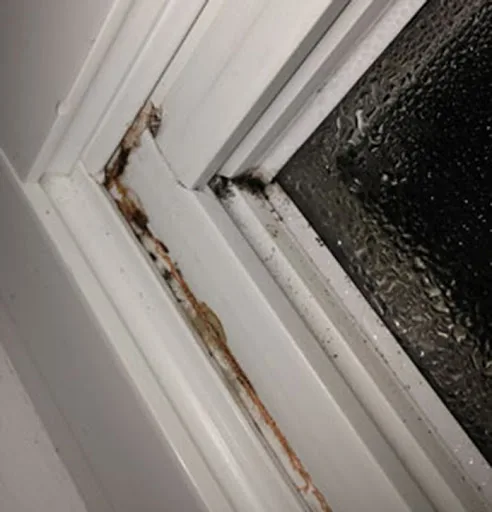
The early signs are easy to miss:
- Black or grey specks along the bottom of the frame or in the rubber seal.
- Paint on a wood sill that's peeling or turning dark.
- Caulking that's stained or coming away from the glass.
- A musty smell near one window, often in a bedroom where the door stays closed.

When a sill is wet every morning for a month, the glass isn't what we check first. We put a moisture meter on the drywall under the window.
The glass dries by noon. The wall below it often doesn't.
If you already see growth, our window sill guide walks through safe cleanup, which products to skip, and how to tell surface mold from something deeper. A musty room without visible spots is covered in our article on a musty smell in the house. Bathrooms get their own guide to bathroom mold, since window condensation there has an extra source.
When Is It Worth Having Someone Look?
Most window condensation never needs an inspector. If drying the air fixes it and the sills clean up with soap and water, you're done.
When condensation needs a professional
It's worth a professional look when the problem doesn't follow the rules: water keeps coming back with your humidity at 30% to 35%, mold returns within weeks of cleaning, the wall or floor under a window is stained, soft or bubbling, or several rooms smell musty. Those are signs that moisture is getting into the wall itself, from a leak around the frame or from condensation running down inside it.
That's what a mold inspection is for. Our inspectors hold Certified Mold Inspector (CMI) and InterNACHI mold credentials, and they use moisture meters and an infrared camera to find wet spots behind the drywall without opening it up, and when testing is needed, samples go to an independent CALA-accredited laboratory. An inspection shows where the moisture is and how far it reaches. It can't promise the wall stays dry, because that depends on the repair. If the inspection does find mold inside the wall, we handle the removal too.
Not sure it's worth a visit? A free virtual mold inspection lets you show an inspector the window on a video call first. We cover Ottawa, Kanata, Montreal and the rest of Eastern Ontario and Quebec.
Frequently Asked Questions
Does condensation on windows mean my house is too cold?
No. It means the glass is cold and the air is humid. Turning the heat up a little won't hurt, but turning it down makes condensation worse. Lowering indoor humidity is the real fix.
Is condensation on the inside of windows normal in winter?
A thin fog at the corners on the coldest mornings is normal in a Canadian winter. Water running down the glass, ice on the inside, or a wet sill most mornings isn't normal. It means humidity is too high for your windows.
Why is there condensation on the outside of my windows?
Outside condensation is usually a good sign. Efficient windows keep heat inside, so the outer pane stays cold enough to collect dew on calm, humid mornings. It clears on its own as the sun warms the glass.
How do I get rid of condensation between window panes?
You can't wipe it away or dry it out. Fog between the panes means the seal on the glass unit has failed. A window installer can replace the sealed glass unit, often without replacing the whole frame.
Will new windows stop condensation?
Better windows help because their inside glass stays warmer. Triple-pane low-e glass can handle much higher humidity before it fogs. But new windows won't fix a home that's too humid. If the humidity is high, the water will show up somewhere else, like the frames, closets or the attic.
Can window condensation damage walls?
Yes, when it runs off the sill for weeks. Water can soak into the drywall below the window, the wood framing, and the flooring. Wiping the sills dry during cold snaps and keeping humidity in range prevents it.
Water keeps coming back no matter what you do?
Bring the humidity down and check the glass on the next cold morning. If it keeps coming back, book a free virtual inspection and we'll look at it with you.