
 FR
Mold Statistics: What 1,339 Air Tests Found in Canada
Almost every air sample holds some mold. The numbers that matter are which types turn up, and whether there's more inside than outside.
By Luka Markovic, senior inspector Last updated: November 17, 2026
Mold turned up in 88% of indoor air tests from 1,339 properties in Ontario and Quebec, so finding some mold in the air is normal. The useful signal is which types show up and how the indoor air compares with the air outside. Stachybotrys was found in 16% of indoor air tests but only 2% of outdoor samples, and Chaetomium in 17% indoors against 4% outdoors. Both grow on building materials that stay wet, so they point to moisture inside the home. If a lab report says "mold detected" and you're wondering whether that means trouble, compare it with the outdoor sample first.
The figures come from a compilation of indoor air quality lab reports, with 990 outdoor samples taken alongside them for comparison. How the data was collected, and what it can't tell you, is set out further down. You can also download every number on this page as a spreadsheet file.
Is There Mold in the Air of Most Canadian Homes?
Yes. Only 12% of the indoor air tests found no mold at all, and only 6% of the outdoor samples did. Mold spores drift in through doors, windows and ventilation all year, so a clean result is the exception, not the rule.
That's why a single line on a report that says "mold detected" doesn't mean a home has a mold problem. A problem is mold that's growing indoors, and the way to see it in air results is to look for types that are more common inside than out, or counts that are higher inside than in the outdoor sample.
How does that compare with other Canadian numbers? Each study below counted something different, so the figures measure different things and shouldn't be lined up as one trend.
| Source | What was counted | Result |
|---|---|---|
| Statistics Canada, Households and the Environment survey (2009) | Households that noticed mould or mildew in their home | 13% in Canada, 15% in Ontario |
| Canadian Housing Survey (2018), as reported by Health Canada researchers | Homes with mould patches larger than one square metre | 5% |
| Health Canada home studies, Edmonton, Halifax, Montreal and Windsor (2005 to 2010) | Visible mould seen by trained field technicians in 290 homes | 31% |
| This page: 1,339 air tests, Ontario and Quebec (2018 on) | Indoor air tests with at least one mold type | 88% |
The gap between them is mostly about what was counted. People notice mould they can see, technicians spot more when they look, and air tests also pick up spores nobody can see. That's why the air-test figure is the highest.
These were homes and offices where someone asked for an air test, usually because they suspected a problem. So the results describe buildings that were checked, not every home in Canada. Don't read 88% as "88% of Canadian homes have a mold problem".
Which Mold Types Turned Up Most Indoors, and Which Were Really Outdoor Spores?
Most of the common types were more frequent outdoors than indoors. Cladosporium and Basidiospores, the two most common indoors, were in about two thirds or more of outdoor samples. Their spores come in from outside, so seeing them indoors is expected. Two types ran the other way.
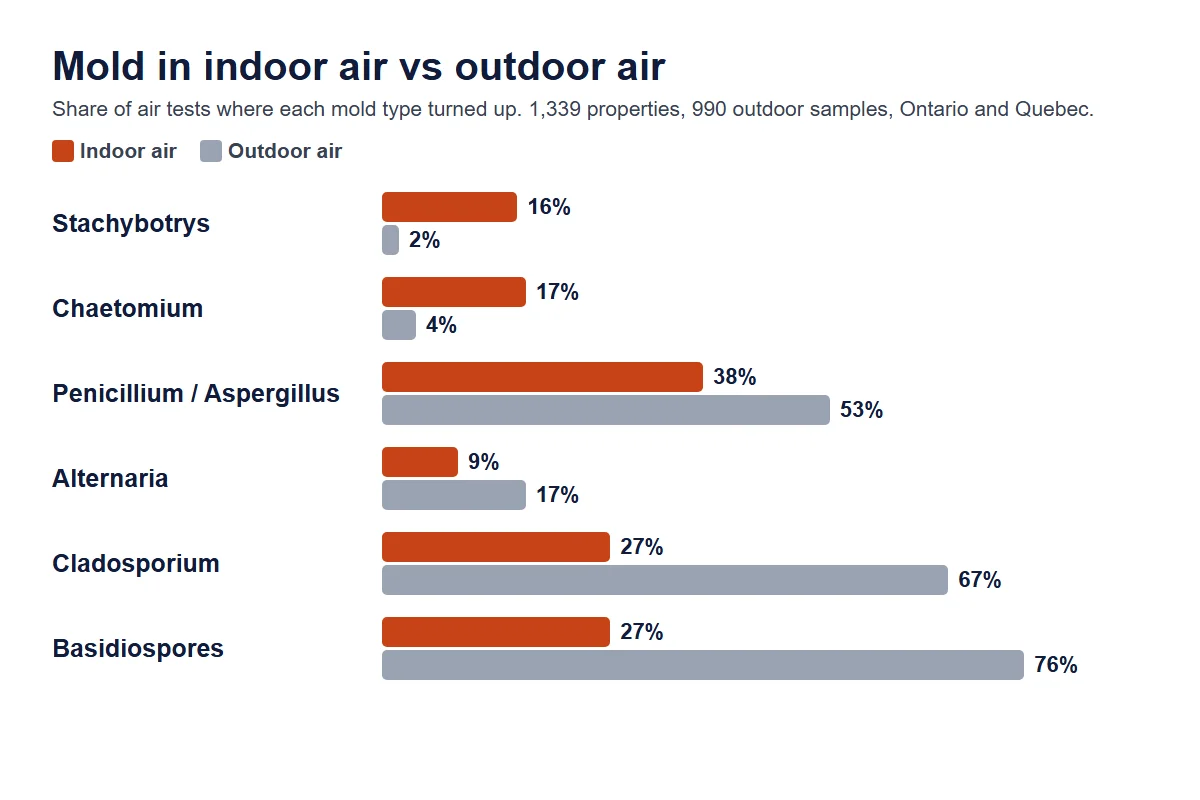
| Mold type | Indoor air | Outdoor air | Indoors compared with outdoors |
|---|---|---|---|
| Penicillium / Aspergillus group | 38% | 53% | Less common indoors |
| Basidiospores | 27% | 76% | Less common indoors |
| Cladosporium | 27% | 67% | Less common indoors |
| Smuts, Periconia, Myxomycetes | 19% | 28% | Less common indoors |
| Chaetomium | 17% | 4% | About 4 times more common indoors |
| Mitospores (spores the lab can't name to a type) | 17% | 10% | More common indoors |
| Stachybotrys | 16% | 2% | 8 times more common indoors |
| Ascospores | 14% | 59% | Less common indoors |
| Alternaria | 9% | 17% | Less common indoors |
| Ganoderma | 9% | 32% | Less common indoors |
| Epicoccum nigrum | 7% | 12% | Less common indoors |
| Pithomyces | 7% | 5% | About the same |
| No mold found | 12% | 6% |
Lab reports also count two things that aren't mold types. Hyphal fragments, broken pieces of mold growth, were in 25% of indoor tests and 37% of outdoor samples. Pollen was in 15% indoors and 28% outdoors.
Why Are Stachybotrys and Chaetomium the Ones to Watch?
Stachybotrys and Chaetomium need materials that stay wet for a long time, such as the paper on drywall, wood, cardboard and ceiling tiles. Their spores are also heavy and sticky, so they don't travel far through the air. When either one shows up indoors and hardly ever outdoors, the likeliest source is something damp inside the building.

Cladosporium in a basement sample doesn't tell me much. It's in the air outside every summer day.
Stachybotrys is different. It doesn't blow in from the street, so when I see it on a report, I go looking for drywall that's been wet for a while.
Myth Stachybotrys on a report means the house is toxic.
Fact It means water damage is likely, and that's worth finding. Health Canada's advice is to clean up mould in a home whatever the type and to fix the moisture behind it. How much mold there is matters more than its name.
Myth A clean air test means there's no mold in the house.
Fact An air test is a snapshot of the air in one room on one day. Mold sealed inside a wall can release few spores into the room, which is why an inspection also checks for moisture.
Health Canada sets out that approach in its guide to addressing moisture and mould in your home. For what each type looks like on a wall, see our guide to identifying common household molds, and for health questions, what black mold actually does to your health.
Which Rooms Had the Most Mold in the Air?
Basements, kitchens and living rooms were the least likely to come back clean: only 8% of tests in each found no mold. Offices came back clean most often, at 20%. Stachybotrys was most frequent in basements and storage rooms, at 17% each.
| Room | Penicillium / Aspergillus | Stachybotrys | Chaetomium | Alternaria | Cladosporium | No mold found |
|---|---|---|---|---|---|---|
| Basement | 71% | 17% | 17% | 9% | 56% | 8% |
| Living room | 68% | 9% | 14% | 9% | 56% | 8% |
| Storage room | 66% | 17% | 11% | 12% | 46% | 11% |
| Bedroom | 62% | 10% | 11% | 7% | 48% | 11% |
| Bathroom | 59% | 16% | 17% | 10% | 57% | 13% |
| Kitchen | 57% | 9% | 14% | 8% | 37% | 8% |
| Office | 53% | 14% | 10% | 8% | 53% | 20% |
Read the room table on its own
Every room shows Penicillium / Aspergillus in 53% to 71% of its tests, while the all-properties figure above is 38%. Cladosporium and Basidiospores show the same gap. The room shares and the overall shares were tallied separately in the original compilation, and it doesn't say how. Compare rooms with each other, not with the overall table. We'll update this page if the room counts are published.
Basements make sense at the top. They sit against wet soil, collect the most humidity in summer, and hold the stored boxes and carpet that mold feeds on. Our basement mold guide covers what to check there, and bathroom mold has its own guide.
Is Mold Different in Ontario and Quebec?
Barely. The same types turned up at almost the same rates in both provinces, and the share of clean tests was 12% in Ontario and 13% in Quebec. Climate and housing are close enough across the Ottawa Valley and the St. Lawrence that province isn't what decides whether a home has mold. Moisture is.
| Mold type | Ontario | Quebec |
|---|---|---|
| Penicillium / Aspergillus group | 38% | 37% |
| Cladosporium | 29% | 24% |
| Basidiospores | 26% | 28% |
| Stachybotrys | 17% | 15% |
| Chaetomium | 16% | 18% |
| Alternaria | 9% | 9% |
| No mold found | 12% | 13% |
How Was the Data Collected, and What Can't It Tell You?
The numbers come from Mold Busters' compilation of its indoor air quality tests, first published in June 2021. We checked every figure against that source, sorted each table by the numbers, and corrected a few lists where the order didn't match the percentages.
- Non-viable spore trap air samples, taken by certified inspectors in homes and offices from Southern and Eastern Ontario to Western Quebec, from 2018 onward.
- Outdoor samples taken alongside the indoor ones for comparison: 990 in all.
- Analysis by an accredited third-party laboratory, reporting mold by type (genus), not by species.
- 1,339 properties in the compilation. The figures show how often each type was present, not how much of it there was.
What this data can't tell you
- Whether mold is growing in a given home. Presence in one sample isn't a diagnosis, and the compilation doesn't report spore counts.
- What share of all Canadian homes have mold. The properties were ones where someone asked for a test.
- When in the year mold is worst, or what caused the moisture. The compilation doesn't record the season or the cause.
- Whether the spores were alive. Spore traps count spores; they don't grow them.
What Should You Do With a Lab Report That Says Mold Was Detected?
Read it against the outdoor sample, then look for the source. These four steps are how our inspectors read a report.
Find the outdoor sample
A proper air test includes one. Without it, an indoor count has nothing to be measured against.
Compare each type, indoors and out
A type that's much higher indoors, or present indoors and absent outside, suggests growth inside.
Look for the water-damage types
Stachybotrys and Chaetomium indoors are a reason to check walls, floors and ceilings for moisture.
Find the moisture, not just the mold
Mold comes back if the water does. Moisture meters and an infrared camera find wet materials behind the surface.
Our mold testing follows the same order. An indoor air quality test includes a visual inspection, one indoor sample with a free outdoor baseline, lab analysis by an independent CALA-accredited laboratory and a written report, for $550 before tax. Lab results usually take 3 to 5 business days. If the report points to mold behind a wall, the same certified team handles the removal and the clearance test after it.
Already holding a report from someone else? Our guide to reading a mold inspection report and our article on air sampling for mold explain the terms.
How Can You Cite These Numbers?
You're welcome to quote and chart these figures. Please link to this page and name the original source:
Mold Inspection Canada, "Mold Statistics: What 1,339 Air Tests Found in Canada" (2026), https://www.moldinspection.ca/resources/mold-statistics/, based on Mold Busters' compilation of indoor air quality tests in Ontario and Quebec.
Every table on this page is in one spreadsheet file (CSV).
Frequently Asked Questions
What percentage of homes have mold?
In 1,339 properties tested in Ontario and Quebec, 88% of indoor air tests found at least one mold type, but outdoor air had mold in 94% of samples, so spores in the air are normal. Statistics Canada found that 13% of households noticed mould or mildew in their home in 2009.
What is the most common mold found in homes?
The Penicillium / Aspergillus group, found in 38% of indoor air tests. Cladosporium and Basidiospores followed at 27% each, but both were far more common outdoors, so most of those spores come from outside.
Is Stachybotrys in an air test a reason to worry?
It's a reason to look for water damage. Stachybotrys was in 16% of indoor air tests and only 2% of outdoor samples, and it grows on materials that stay wet. Health Canada advises cleaning up mould whatever the type and fixing the moisture.
Does a mold air test show where the mold is?
No. An air test shows which types are in the air of one room on one day. Finding the source takes an inspection with moisture meters and an infrared camera, and sometimes surface samples.
Got a report that says mold was detected?
Send it to us with a few photos. In a free virtual inspection we'll go through it with you and tell you whether the results point to a problem.