
 FR
What Humidity Should Your House Be in Winter?
The right number drops as the temperature outside drops. Your windows tell you when you've passed it.
By Jesse Robertson, senior inspector and remediation supervisor Last updated: November 17, 2026
Keep the humidity in your house between 30% and 40% for most of a Canadian winter, and close to 30% when it drops below minus 10 °C outside. Health Canada's range for homes is 30% to 50%, but cold glass sets a lower limit than that in January. Most people guess that one number is right all year. It isn't: the colder it gets outside, the less moisture your house can hold before water forms on windows, in closets and in the attic.
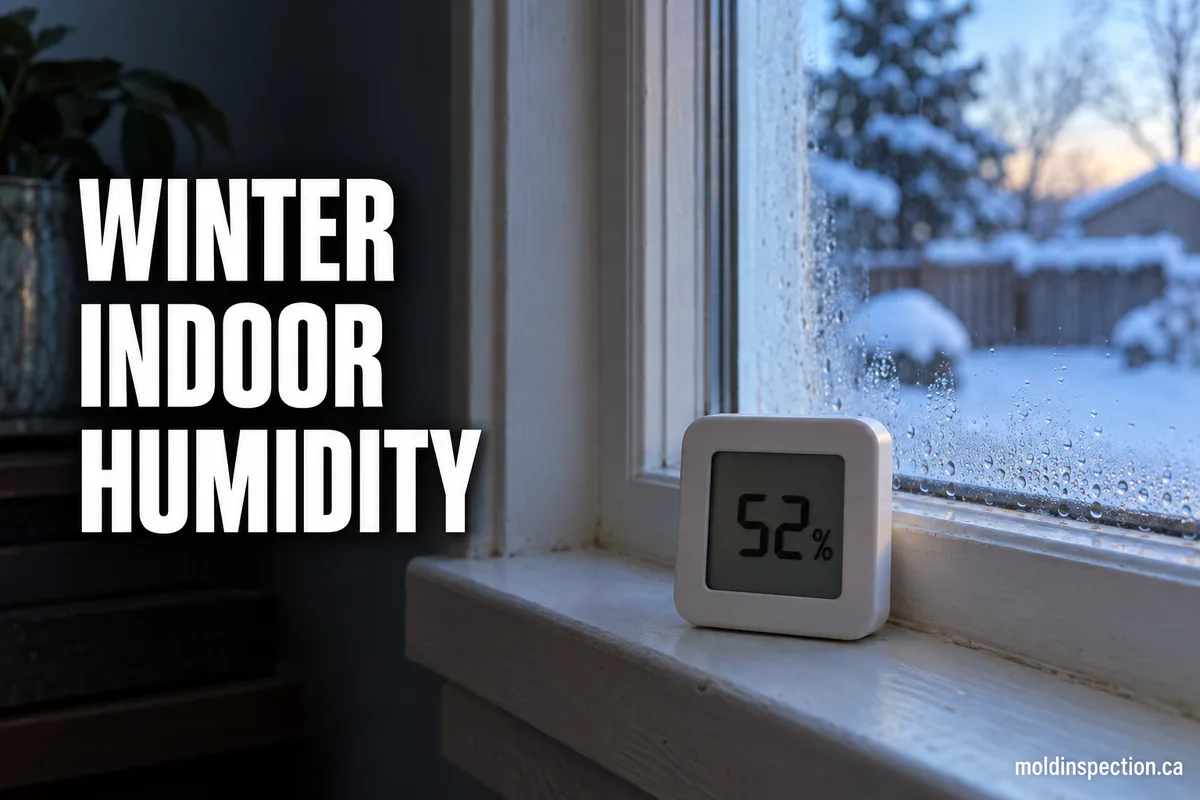
Your windows are the humidity gauge you already own. When the glass runs wet most mornings, the air is holding more water than your house can handle at that temperature. Our guide to condensation on windows covers the glass itself. This page covers the whole house.
What Humidity Level Is Right for Your House in Winter?
Health Canada's guide to moisture and mould recommends "maintaining relative humidity levels between 30% and 50%, using a dehumidifier as necessary."
That range is a health target for the whole year. Winter needs a tighter one. CMHC's mould guide for occupants says that when it's below minus 10 °C outside, indoor humidity should be 30%, and it can be as low as 25% in extremely cold regions, to prevent condensation on cold surfaces such as windows.
Natural Resources Canada publishes the limit for each outdoor temperature. Above these numbers, water starts to form on the inside of the glass in a house kept at 21 °C.
| Outside temperature | Double-glazed window | Double-glazed, low-e | Triple-glazed, low-e |
|---|---|---|---|
| 0 °C | 58% | 70% | 81% |
| minus 10 °C | 44% | 59% | 74% |
| minus 20 °C | 34% | 50% | 67% |
| minus 30 °C | 25% | 42% | 60% |
| minus 40 °C | 18% | 35% | 54% |
Read your own row. An Ottawa or Montreal house with ordinary double-glazed windows can sit at 44% on a minus 10 day and stay dry. When the next cold snap hits minus 20, the same 44% wets the glass. Older windows and the frame edges run colder than the centre of the glass, so they fog first, below these numbers.
Why Does the Right Humidity Drop When It Gets Colder Outside?
Because the coldest surfaces in your house get colder. Indoor air at 21 °C carries the same water whether it's minus 5 or minus 25 outside, but the inside of a window, the back of a closet on an outside wall and the underside of the roof all cool down with the weather. When one of those surfaces falls below the air's dew point, water comes out of the air onto it.
At 40% humidity and 21 °C, anything colder than about 7 °C collects water. At 30%, the surface has to drop to about 3 °C. That small difference decides whether the glass stays clear on a minus 20 morning.
Myth 45% is the perfect humidity all year.
Fact 45% is fine in spring and fall. In a Canadian cold snap it fogs ordinary double-glazed windows, and the extra water goes into frames, closets and the attic.
Myth Turning the heat down at night saves the windows.
Fact Cooler air sits closer to its dew point, and the glass gets colder too. Keep a normal temperature and lower the humidity instead.
How Do You Check the Humidity in Your House?
Buy a hygrometer. It's a small digital humidity meter, and CMHC puts the price at $10 to $60 at a hardware store. Most also show the temperature.
- Put it in a central room, about 1.5 metres off the floor, away from the kitchen, bathroom, heating vents and outside doors. That's where CAA-Québec suggests placing it.
- Read it in the early morning on the coldest days. That's when your windows are under the most strain.
- Give it a day to settle after you move it, then compare it with your windows. If the glass is wet and the meter says 32%, trust the glass and check the meter against a second one.
- Check the basement separately. Basement air behaves differently, and our basement mold guide covers the levels below grade.
No meter yet? Natural Resources Canada's own advice is to let your windows be the indicator: excessive condensation on the inside of double-glazed windows, outside the kitchen and bathroom, means there's too much moisture in the air.
Where Does the Moisture in a House Come From?
Mostly from the people living in it. A family of four puts about 50 litres of water into the air every week, according to Natural Resources Canada. That's more than two and a half big water cooler jugs, before anyone runs a humidifier.
| Source | Litres per week |
|---|---|
| Breathing and skin | 38.0 |
| Cooking | 6.3 |
| Bathing and showers | 2.4 |
| Washing clothes | 1.8 |
| Washing floors | 1.3 |
| Total | about 50 |
Some things add more on top: drying laundry on a rack indoors, a humidifier set too high, a crowd of houseplants, firewood stored inside, or a damp basement giving off water. A tight, newer house keeps more of all of it in, which is why it needs its fans or its heat recovery ventilator (HRV) running.
How Do You Lower Humidity in Your House in Winter?
Get the water out where it's made, then swap some indoor air for dry outdoor air. Winter air outside holds very little water, so a little ventilation goes a long way.
Turn off the humidifier
Health Canada and Natural Resources Canada both say to disconnect humidifiers when windows show condensation. On a furnace humidifier, close the damper or turn the dial down.
Run the bathroom fan during every shower and for 20 to 30 minutes after
Check that it vents outside. A fan that blows into the attic moves the problem up there.
Use the range hood when you cook
Especially when boiling water. Use a lid on pots too.
Keep the HRV running
CMHC says these units are meant to run continuously, and that shutting one off for a long time lets humidity build up. Clean the filters and the core each season.
Dry laundry in a dryer vented outside
A rack of wet clothes in a bedroom adds litres of water to that room overnight.
Run a dehumidifier in a damp basement
It helps the area it sits in. Keep the bucket and coil clean: our guide to mold in dehumidifiers shows what grows there.
If you've done all six and the windows still run with the meter near 30%, something else is adding water: a wet basement, a leak, or a crawl space. That's a different problem, covered below.
What If the Air in Your House Is Too Dry?
Dry air is real too, especially in older, leaky houses. Natural Resources Canada notes that humidity above 20% helps prevent dry, sore throats and static electricity, and protects plants and furniture. Ontario's Save on Energy lists chapped lips, static and the occasional nosebleed as signs the air is too dry.
Before you add water, look for where the dry air gets in. CMHC's advice for a very dry house is to weatherstrip and caulk windows and doors, which keeps cold, dry outdoor air from leaking in. It also cuts your heating bill.
If you use a humidifier
CMHC says not to use a humidifier if you notice mould or dampness, such as water on your windows, and that furnace-mounted humidifiers can be a source of mould, so clean and dry the trays often. Set it to stay inside the winter range above, check the meter, and turn it down when the glass starts to fog.
What Does Too Much Winter Humidity Do to a House?
It puts water on the coldest surfaces, and those are rarely the ones you look at. Natural Resources Canada lists staining and mould growth in bathrooms, closets and on walls or ceilings on exterior walls as the signs of high humidity.
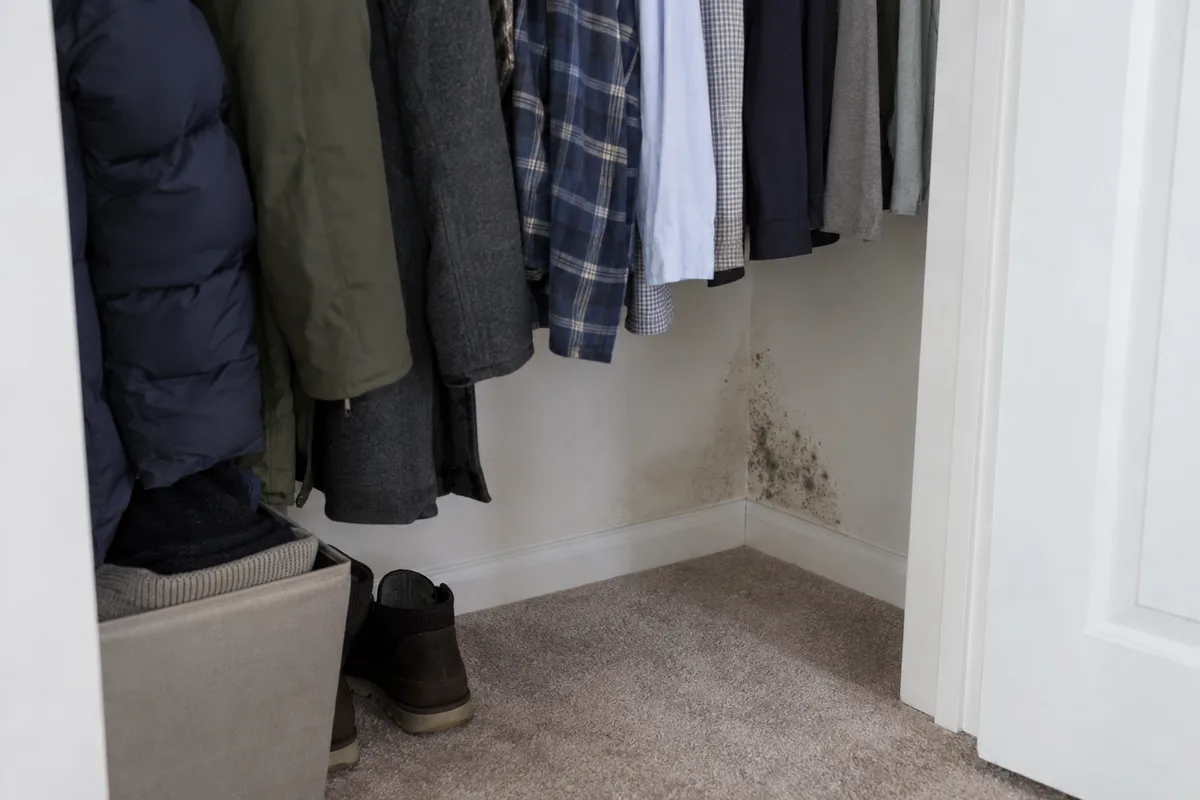
- Water or ice on the inside of windows most mornings, and black spots on the frames. See mold on window sills.
- Mold in the back corners of closets and behind furniture on outside walls. CMHC advises limiting storage in closets against outside walls.
- Frost on the underside of the roof boards in the attic. Warm, moist air leaks up and freezes there, and it melts in the first thaw. Our attic mold guide explains the fix.
- A musty smell in one room that won't clear. Our article on a musty smell in the house traces where it comes from.

People check the humidity on a mild afternoon and tell me it's fine. Check it on the coldest morning of the week instead.
That's the reading your closets and your attic live with.
When Is Winter Humidity Worth a Professional Look?
Most humidity problems are fixed with a meter, the fans and the humidifier dial. You don't need an inspector for that.
When it's more than the air
It's worth a professional look when the numbers don't add up: the meter stays above 50% with the humidifier off and the fans running, mold comes back within weeks of cleaning, a wall or ceiling on an outside wall is stained or soft, or the attic has heavy frost every cold snap. Those point to water getting into the building itself.
That's what a mold inspection is for. Our inspectors measure humidity room by room, use moisture meters and an infrared camera to find wet spots behind the drywall, and trace where the water comes from. When samples are needed, they go to an independent CALA-accredited laboratory. An inspection can find the source and show how far the moisture reaches. It can't keep the house dry on its own: that depends on the fix. If it finds mold that needs to come out, the same team handles the removal and the clearance test after it.
Not sure it's worth a visit? A free virtual mold inspection lets you show an inspector your windows, closets and meter readings on a video call. We cover Ottawa, Kanata, Montreal and the rest of Eastern Ontario and Quebec.
Frequently Asked Questions
What is a good humidity level for a house in winter?
Between 30% and 40% for most of the winter. When it's below minus 10 °C outside, CMHC recommends about 30%, and as low as 25% in extremely cold regions, so your windows stay dry.
Is 50% humidity too high in winter?
On cold days, usually yes. Natural Resources Canada's table shows ordinary double-glazed windows start to fog above 44% at minus 10 °C and above 34% at minus 20 °C. 50% is fine in spring and fall, not in a cold snap.
Is 25% humidity too low?
It's dry, but on very cold days it's often the right level. Natural Resources Canada says humidity above 20% helps prevent sore throats and static. If the house feels dry at 25% in a mild spell, look for air leaks before adding a humidifier.
Does opening windows in winter lower humidity?
Yes. Winter air outside holds very little water, so fresh air dries the house. Running the bathroom and kitchen fans or the HRV does the same job with less heat loss than an open window.
Should I run a humidifier in winter?
Only if the meter reads well below 30% and the windows are dry. CMHC says not to use one when there's water on your windows or signs of dampness, and to clean furnace humidifier trays often.
Where should I put a hygrometer?
In a central room, about 1.5 metres off the floor, away from the kitchen, bathroom, heating vents and outside doors. Read it early in the morning on cold days.
Windows wet at 30%?
If the meter is low and the glass still runs, the water is coming from somewhere else. Book a free virtual inspection and we'll look at it with you.